
Audre Lorde
Audre Lorde was a revolutionary Black feminist. Lorde's poetry was published very regularly during the 1960s — in Langston Hughes' 1962 New Negro Poets, USA; in several foreign anthologies; and in black literary magazines. During this time, she was politically active in civil rights, anti-war, and feminist movements. Her first volume of poetry, The First Cities (1968), was published by the Poet's Press and edited by Diane di Prima, a former classmate and friend from Hunter College High School. Dudley Randall, a poet and critic, asserted in his review of the book that Lorde "does not wave a black flag, but her blackness is there, implicit, in the bone." Her second volume, Cables to Rage (1970), which was mainly written during her tenure at Tougaloo College in Mississippi, addressed themes of love, betrayal, childbirth and the complexities of raising children. It is particularly noteworthy for the poem "Martha", in which Lorde poetically confirms her homosexuality: "[W]e shall love each other here if ever at all." Later books continued her political aims in lesbian and gay rights, and feminism. In 1980, together with Barbara Smith and Cherríe Moraga, she co-founded Kitchen Table: Women of Color Press, the first U.S. publisher for women of colour. Lorde was State Poet of New York from 1991 to 1992. Read More
30 Books Written

"These are poems which blaze and pulse on the page."—Adrienne Rich "The first declaration of a black, lesbian feminist identity took place in these poems, and set the terms—beautifully, forcefully—for contemporary multicultural and pluralist debate."—Publishers Weekly "This is an amazing collection of poetry by . . . one of our best contemporary poets. . . . Her poems are powerful, often political, always lyrical and profoundly moving."—Chuckanut Reader Magazine "What a deep pleasure to encounter Audre Lorde's most potent genius . . . you will welcome the sheer accessibility and the force and beauty of this volume."—Out Magazine

Moving between journal entry, memoir, and exposition, Audre Lorde fuses the personal and political as she reflects on her experience coping with breast cancer and a radical mastectomy. First published over forty years ago, The Cancer Journals is a startling, powerful account of Audre Lorde's experience with breast cancer and mastectomy. Long before narratives explored the silences around illness and women's pain, Lorde questioned the rules of conformity for women's body images and supported the need to confront physical loss not hidden by prosthesis. Living as a "black, lesbian, mother, warrior, poet," Lorde heals and re-envisions herself on her own terms and offers her voice, grief, resistance, and courage to those dealing with their own diagnosis. Poetic and profoundly feminist, Lorde's testament gives visibility and strength to women with cancer to define themselves, and to transform their silence into language and action.

From The Guardian. Oct. 4, 2017. R.O. Kwon"Lorde seems prophetic, perhaps alive right now, writing in and about the US of 2017 in which a misogynist with white supremacist followers is president. But she was born in 1934, published her first book of poetry in 1968, and died in 1992. Black, lesbian and feminist; the child of immigrant parents; poet and essayist, writer and activist, Lorde knew about harbouring multitudes. Political antagonists tried, for instance, to discredit her among black students by announcing her sexuality, and she decided: “The only way you can head people off from using who you are against you is to be honest and open first, to talk about yourself before they talk about you.” Over and over again, in the essays, speeches and poems collected in Your Silence Will Not Protect You, Lorde emphasises how important it is to speak up. To give witness: “What are the words you do not yet have? What do you need to say? What are the tyrannies you swallow day by day and attempt to make your own, until you will sicken and die of them, still in silence?” '

A collection of fifteen essays written between 1976 and 1984 gives clear voice to Audre Lorde's literary and philosophical personae. These essays explore and illuminate the roots of Lorde's intellectual development and her deep-seated and longstanding concerns about ways of increasing empowerment among minority women writers and the absolute necessity to explicate the concept of difference—difference according to sex, race, and economic status. The title Sister Outsider finds its source in her poetry collection The Black Unicorn (1978). These poems and the essays in Sister Outsider stress Lorde's oft-stated theme of continuity, particularly of the geographical and intellectual link between Dahomey, Africa, and her emerging self.Notes from a trip to RussiaPoetry is not a luxuryThe transformation of silence into language and actionScratching the surface : some notes on barriers to women and lovingUses of the erotic : the erotic as powerSexism : an American disease in blackfaceAn open letter to Mary DalyMan child : a black lesbian feminist's responseAn interview : Audre Lorde and Adrienne RichThe Master's tools will never dismantle the Master's houseAge, race, class, and sex : women redefining differenceThe uses of anger : women responding to racismLearning from the 60sEye to eye : black women, hatred, and angerGrenada revisited : an interim report

Zami: A Carriacou name for women who work together as friends and lovers“Zami is a fast-moving chronicle. From the author’s vivid childhood memories in Harlem to her coming of age in the late 1950s, the nature of Audre Lorde’s work is cyclical. It especially relates the linkage of women who have shaped her . . . Lorde brings into play her craft of lush description and characterization. It keeps unfolding page after page.”—Off Our Backs“Among the elements that make the book so good are its personal honesty and lack of pretentiousness, characteristics that shine through the writing bespeaking the evolution of a strong and remarkable character.”—The New York Times

From the self-described 'black, lesbian, mother, warrior, poet', these soaring, urgent essays on the power of women, poetry and anger are filled with darkness and light.Penguin Modern: fifty new books celebrating the pioneering spirit of the iconic Penguin Modern Classics series, with each one offering a concentrated hit of its contemporary, international flavour. Here are authors ranging from Kathy Acker to James Baldwin, Truman Capote to Stanislaw Lem and George Orwell to Shirley Jackson; essays radical and inspiring; poems moving and disturbing; stories surreal and fabulous; taking us from the deep South to modern Japan, New York's underground scene to the farthest reaches of outer space.

The Black Unicorn is a collection of poems by a woman who, Adrienne Rich writes, "for the complexity of her vision, for her moral courage and the catalytic passion of her language, has already become, for many, an indispensable poet." Rich continues: "Refusing to be circumscribed by any simple identity, Audre Lorde writes as a Black woman, a mother, a daughter, a Lesbian, a feminist, a visionary; poems of elemental wildness and healing, nightmare and lucidity. Her rhythms and accents have the timelessness of a poetry which extends beyond white Western politics, beyond the anger and wisdom of Black America, beyond the North American earth, to Abomey and the Dahomeyan Amazons. These are poems nourished in an oral tradition, which also blaze and pulse on the page, beneath the reader's eye."

A definitive selection of Audre Lorde’s "intelligent, fierce, powerful, sensual, provocative, indelible" (Roxane Gay) prose and poetry, for a new generation of readers.Self-described "black, lesbian, mother, warrior, poet" Audre Lorde is an unforgettable voice in twentieth-century literature, and one of the first to center the experiences of black, queer women. This essential reader showcases her indelible contributions to intersectional feminism, queer theory, and critical race studies in twelve landmark essays and more than sixty poems—selected and introduced by one of our most powerful contemporary voices on race and gender, Roxane Gay.Among the essays included here are:• "The Transformation of Silence into Language and Action"• "The Master’s Tools Will Never Dismantle the Master’s House"• "I Am Your Sister"• Excerpts from the American Book Award–winning A Burst of LightThe poems are drawn from Lorde’s nine volumes, including The Black Unicorn and National Book Award finalist From a Land Where Other People Live. Among them are:• "Martha"• "A Litany for Survival"• "Sister Outsider"• "Making Love to Concrete"

The author discusses her life as a Black lesbian, her struggle against cancer, sadomasochism within the gay community, and apartheid and its relationship to racism in American society

"There are many kinds of power, used and unused, acknowledged or otherwise." Thus begins this powerful essay; Uses of the Erotic defines the power of the erotic, names the process by which women have been stripped of this power, and considers how women can reclaim it.Uses of the Erotic shines among Audre Lorde's powerful legacy of speeches and essays, and has influenced feminist thinking for more than 15 years. The false dichotomies that Lorde debunks persist in our cultural imagination: the separation of the erotuc from the spiritual and political. Now, Kore Press brings this essay into stand-alone focus, reprinting it in a fine, handbound pamphlet illustrated with photographs by Tucson photographer Camille Bonzani. Designed by book artist Nancy Solomon, the essay is offset and letterpress printed in an edition of 1000.

'Women so empowered are dangerous'Written with a 'black woman's anger' and the precision of a poet, these searing pieces by the groundbreaking writer Audre Lorde are a celebration of female strength and solidarity, and a cry to speak out against those who seek to silence anyone they see as 'other'.One of twenty new books in the bestselling Penguin Great Ideas series. This new selection showcases a diverse list of thinkers who have helped shape our world today, from anarchists to stoics, feminists to prophets, satirists to Zen Buddhists.

Of Coal , the poet and critic Hayden Carruth said, "For us these words indeed are jewels in the open light." Coal is one of the earliest collections of poems by a woman who, Adrienne Rich writes, "for the complexity of her vision, for her moral courage and the catalytic passion of her language, has already become, for many, an indispensable poet."Marilyn Hacker captures the essence of Lorde and her poetry: "Black, lesbian, mother, urban woman: none of Lorde's selves has ever silenced the others; the counterpoint among them is often the material of her strongest poems."

"Undersong is a remarkable poetic document...."--Adrienne Rich

In this collection, Audre Lorde gives us poems that explore "differences as creative tensions, and the melding of past strength / pain with future hope / fear; the present being the vital catalyst, the motivating force―activism." As Marilyn Hacker has written, "Black, lesbian, mother, cancer survivor, urban woman: none of Lorde's selves has ever silenced the others; the counterpoint among them is often the material of her strongest poems."

“This volume resonates with some of the finest poems Audre Lorde ever wrote: sinewy, lyrical, celebratory even in the face of death, and always political in the best sense. Now the poet is gone―but the work lives, and sings.” ―Robin Morgan This collection, 39 poems written between 1987 and 1992, is the final volume by "a major American poet whose concerns are international, and whose words have left their mark on many lives,” in the words of Adrienne Rich. Audre Lorde (1934-1992) was the author of ten volumes of poetry and five works of prose. She was named New York State Poet in 1991; her other honors include the Manhattan Borough President’s Award for Excellence in the Arts. The Marvelous Arithmetics of Distance was nominated for a National Book Critics Circle Award in 1994.
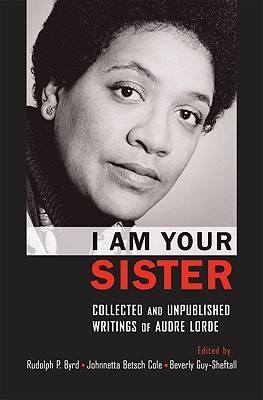
Audre Lorde was not only a famous poet; she was also one of the most important radical black feminists of the past century. Her writings and speeches grappled with an impressive broad list of topics, including sexuality, race, gender, class, disease, the arts, parenting, and resistance, and they have served as a transformative and important foundation for theorists and activists in considering questions of power and social justice. Lorde embraced difference, and at each turn she emphasized the importance of using it to build shared strength among marginalized communities. I Am Your Sister is a collection of Lorde's non-fiction prose, written between 1976 and 1990, and it introduces new perspectives on the depth and range of Lorde's intellectual interests and her commitments to progressive social change. Presented here, for the first time in print, is a major body of Lorde's speeches and essays, along with the complete text of A Burst of Light and Lorde's landmark prose works Sister Outsider and The Cancer Journals. Together, these writings reveal Lorde's commitment to a radical course of thought and action, situating her works within the women's, gay and lesbian, and African American Civil Rights movements. They also place her within a continuum of black feminists, from Sojourner Truth, to Anna Julia Cooper, Amy Jacques Garvey, Lorraine Hansberry, and Patricia Hill Collins. I Am Your Sister concludes with personal reflections from Alice Walker, Gloria Joseph, Johnnetta Betsch Cole, Beverly Guy-Sheftall, and bell hooks on Lorde's political and social commitments and the indelibility of her writings for all who are committed to a more equitable society.


Poetry chapbook by Audre Lorde; limited edition of 1,100 copies.
Feminista fordítássorozatunk mottóját – A hallgatásod nem véd meg – Audre Lorde afroamerikai leszbikus feminista szerzőtől kölcsönöztük. A sorozatban különböző nemzetközi és romániai interszekcionális, antirasszista és antikapitalista feminista esszék, elemzések és manifesztumok magyar fordításait közöljük, melyek a cinkos csend helyett a meghallgatást, az elhallgatás helyett a felszólalást és a párbeszédet kívánják katalizálni.

Lorde's third book of poems (1973).


Originally Published in Essence Magazine in 1984 the conversation about shared and divergent racial history between Black men and women remains relevant today.

Lorde's fouth book of poems (1974).

The internationally acclaimed author challenges homophobia as a divisive force, particularly among Black women.

Librarian Note: ISBN 0965072514/9780965072519This exclusive edition brings together a selection of Audre Lorde's poetry and essays with "biomythography," the form that she created in 'Zami: A New Spelling of My Name' (1982).'Zami' combines biography, mythology, and history as it records Lorde's experiences as a West Indian in America and the growth of her emotional and sexual resonance with women. Zami grows up, goes to high school and college in New York City, and looks for women like herself. Ultimately she discovers Afrekete, a kindred spirit whose passion and will match her own. She must learn to deal with racism, sexism, and opposition to her lesbian identity, but she has the spirit to retain her individuality.Lorde tackles the complexities of her multiple identities in 'Sister Outsider' (1984). It includes essays such as "Poetry Is Not a Luxury," in which she declares that poetry is "a vital necessity of our existence."Published just months before her death, 'Undersong: Chosen Poems Old and New' (1992) covers 30 years of Lorde's poetry. Here, Lorde demonstrates her mastery of the love poem, but she writes with equal passion and eloquence about everything from a conversation to her identity as a black woman.

Per la prima volta in traduzione italiana, questa antologia dà spazio alle poesie di amore e di lotta di una poeta, Audre Lorde, che ha saputo intrecciare le storie del proprio vissuto personale con le voci collettive dei movimenti femminista, Lgbt e delle persone di colore. Con il suo potente linguaggio poetico, Lorde ci regala istantanee della realtà filtrate attraverso uno sguardo acuto e mai distaccato. Nei suoi versi erompe il racconto di una donna Nera, lesbica, madre, guerriera, poeta, il cui linguaggio è intriso di ognuna di queste parti e dell'intersezione di tutte. Per questo il canto di Audre Lorde arriva a tutte e tutti noi, abbracciando la realtà da un punto di vista situato e proiettandosi oltre, fino a cambiare il nostro modo di guardare il mondo. Introduzione di Loredana Magazzeni, postfazione di Rita Monticelli.

Poetry. Literary Nonfiction. African & African American Studies. Women's Studies. LGBTQIA Studies. Edited by Mayra RodrÍguez Castro. Preface by Dagmar Schultz. AUDRE DREAM OF EUROPE elucidates Lorde's methodology as a poet, mentor, and activist during the last decade of her life. This volume compiles a series of seminars, interviews, and conversations held by the author and collaborators across Berlin, Western Europe, and The Caribbean between 1984-1992. While Lorde stood at the intersection of various historical and literary movements in The United States--the uprising of black social life after the Harlem Renaissance, poetry of the AIDS epidemic, and the unfolding of the Civil Rights Movement--this selection of texts reveals Lorde as a catalyst for the first movement of Black Germans in West Berlin. The legacy of this "Black, lesbian, mother, warrior, poet" has been well preserved by her colleagues in Germany. These selected writings lay bare struggles, bonds, and hopes shared among Black women in a transnational political context, as well as offering sometimes surprising reflections on the US American counter culture with which Lorde is associated. Many of the poems that were important to Lorde's development are excerpted in full within these pages, serving as a sort of critical anthology.