
Arundhati Roy
Arundhati Roy is an Indian writer who is also an activist who focuses on issues related to social justice and economic inequality. She won the Booker Prize in 1997 for her novel, The God of Small Things, and has also written two screenplays and several collections of essays. For her work as an activist she received the Cultural Freedom Prize awarded by the Lannan Foundation in 2002.
29 Books Written

Compared favorably to the works of Faulkner and Dickens, Arundhati Roy’s debut novel is a modern classic that has been read and loved worldwide. Equal parts powerful family saga, forbidden love story, and piercing political drama, it is the story of an affluent Indian family forever changed by one fateful day in 1969. The seven-year-old twins Estha and Rahel see their world shaken irrevokably by the arrival of their beautiful young cousin, Sophie. It is an event that will lead to an illicit liaison and tragedies accidental and intentional, exposing “big things [that] lurk unsaid” in a country drifting dangerously toward unrest. Lush, lyrical, and unnerving, The God of Small Things is an award-winning landmark that started for its author an esteemed career of fiction and political commentary that continues unabated.

A “fearless… staggeringly beautiful” New York Times bestseller. (The Boston Globe) Named a Best Book of 2017 by NPR, Amazon, Kirkus, The Washington Post, Newsday, and the Hudson Group: On the premises of a city graveyard, Anjum has created a sanctuary for societal misfits — and their extraordinary stories unfold across decades. A dazzling, richly moving new novel by the internationally celebrated author of The God of Small Things.The Ministry of Utmost Happiness takes us on an intimate journey of many years across the Indian subcontinent—from the cramped neighborhoods of Old Delhi and the roads of the new city to the mountains and valleys of Kashmir and beyond, where war is peace and peace is war.It is an aching love story and a decisive remonstration, a story told in a whisper, in a shout, through unsentimental tears and sometimes with a bitter laugh. Each of its characters is indelibly, tenderly rendered. Its heroes are people who have been broken by the world they live in and then rescued, patched together by acts of love—and by hope.The tale begins with Anjum—who used to be Aftab—unrolling a threadbare Persian carpet in a city graveyard she calls home. We encounter the odd, unforgettable Tilo and the men who loved her—including Musa, sweetheart and ex-sweetheart, lover and ex-lover; their fates are as entwined as their arms used to be and always will be. We meet Tilo’s landlord, a former suitor, now an intelligence officer posted to Kabul. And then we meet the two Miss Jebeens: the first a child born in Srinagar and buried in its overcrowded Martyrs’ Graveyard; the second found at midnight, abandoned on a concrete sidewalk in the heart of New Delhi.As this ravishing, deeply humane novel braids these lives together, it reinvents what a novel can do and can be. The Ministry of Utmost Happiness demonstrates on every page the miracle of Arundhati Roy’s storytelling gifts.
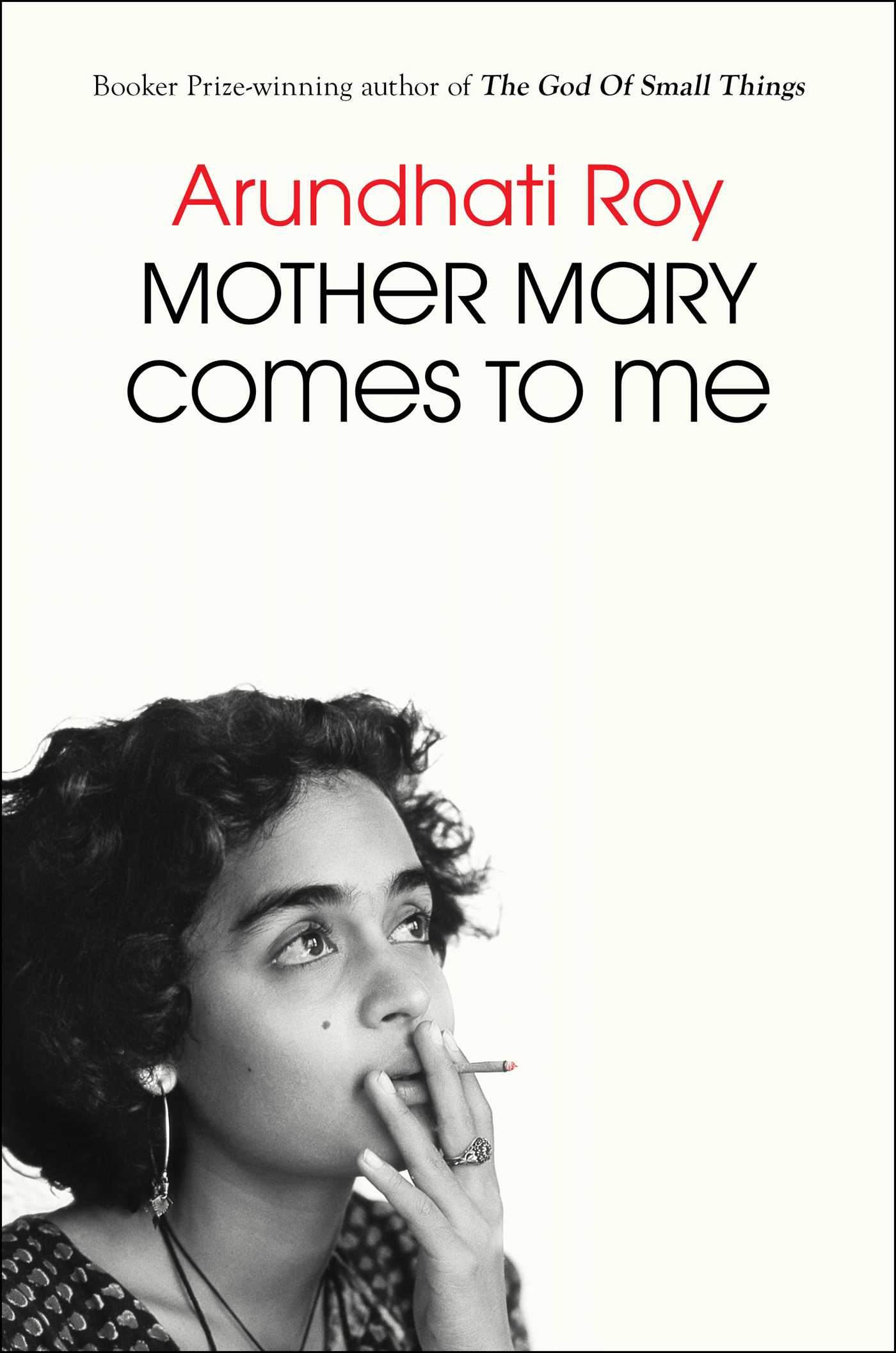
A raw and deeply moving memoir from the legendary author of The God of Small Things and The Ministry of Utmost Happiness that traces the complex relationship with her mother, Mary Roy, a fierce and formidable force who shaped Arundhati’s life both as a woman and a writer.Mother Mary Comes to Me, Arundhati Roy’s first work of memoir, is a soaring account, both intimate and inspirational, of how the author became the person and the writer she is, shaped by circumstance, but above all by her complex relationship to the extraordinary, singular mother she describes as “my shelter and my storm.”“Heart-smashed” by her mother Mary’s death in September 2022 yet puzzled and “more than a little ashamed” by the intensity of her response, Roy began to write, to make sense of her feelings about the mother she ran from at age eighteen, “not because I didn’t love her, but in order to be able to continue to love her.” And so begins this astonishing, sometimes disturbing, and surprisingly funny memoir of the author’s journey from her childhood in Kerala, India, where her single mother founded a school, to the writing of her prizewinning novels and essays, through today.With the scale, sweep, and depth of her novels, The God of Small Things and The Ministry of Utmost Happiness, and the passion, political clarity, and warmth of her essays, Mother Mary Comes to Me is an ode to freedom, a tribute to thorny love and savage grace—a memoir like no other.

From the best-selling author of My Seditious Heart and the Ministry of Utmost Happiness, a new and pressing dispatch from the heart of the crowd and the solitude of the writer's desk.The chant of "Azadi!"—Urdu for "Freedom!"—is the slogan of the freedom struggle in Kashmir against what Kashmiris see as the Indian Occupation. Ironically, it also became the chant of millions on the streets of India against the project of Hindu Nationalism.Even as Arundhati Roy began to ask what lay between these two calls for Freedom—a chasm or a bridge?—the streets fell silent. Not only in India, but all over the world. The coronavirus brought with it another, more terrible understanding of Azadi, making a nonsense of international borders, incarcerating whole populations, and bringing the modern world to a halt like nothing else ever could.In this series of electrifying essays, Arundhati Roy challenges us to reflect on the meaning of freedom in a world of growing authoritarianism.The essays include meditations on language, public as well as private, and on the role of fiction and alternative imaginations in these disturbing times.The pandemic, she says, is a portal between one world and another. For all the illness and devastation it has left in its wake, it is an invitation to the human race, an opportunity, to imagine another world.
From the poisoned rivers, barren wells, and clear-cut forests, to the hundreds of thousands of farmers who have committed suicide to escape punishing debt, to the hundreds of millions of people who live on less than two dollars a day, there are ghosts nearly everywhere you look in India. India is a nation of 1.2 billion, but the country’s 100 richest people own assets equivalent to one-fourth of India’s gross domestic product.Capitalism: A Ghost Story examines the dark side of democracy in contemporary India, and shows how the demands of globalized capitalism has subjugated billions of people to the highest and most intense forms of racism and exploitation.

To best understand and address the inequality in India today, Arundhati Roy insists we must examine both the political development and influence of M. K. Gandhi and why B. R. Ambedkar’s brilliant challenge to his near-divine status was suppressed by India’s elite. In Roy’s analysis, we see that Ambedkar’s fight for justice was systematically sidelined in favor of policies that reinforced caste, resulting in the current nation of India: independent of British rule, globally powerful, and marked to this day by the caste system. This book situates Ambedkar’s arguments in their vital historical context— namely, as an extended public political debate with Mohandas Gandhi. “For more than half a century—throughout his adult life—[Gandhi’s] pronouncements on the inherent qualities of black Africans, untouchables and the laboring classes remained consistently insulting,” writes Roy. “His refusal to allow working-class people and untouchables to create their own political organizations and elect their own representatives remained consistent too.” In The Doctor and the Saint, Roy exposes some uncomfortable, controversial, and even surprising truths about the political thought and career of India’s most famous and most revered figure. In doing so she makes the case for why Ambedkar’s revolutionary intellectual achievements must be resurrected, not only in India but throughout the world.“Arundhati Roy is incandescent in her brilliance and her fearlessness.”—Junot Díaz“The fierceness with which Arundhati Roy loves humanity moves my heart.”—Alice Walker
Just in time for the elections, Arundhati Roy offers us this lucid briefing on what the Bush administration really means when it talks about “compassionate conservativism” and “the war on terror.” Roy has characteristic fun in these essays, skewering the hypocrisy of the more-democratic-than-thou clan. But above all, she aims to remind us that we hold the essence of power and the foundation of genuine democracy—the power of the people to counter their self-appointed leaders’ tyranny.First delivered as fiery speeches to sold-out crowds, together these essays are a call to arms against “the apocalyptic apparatus of the American empire.” Focusing on the disastrous US occupation of Iraq, Roy urges us to recognize—and apply—the scope of our power, exhorting US dockworkers to refuse to load materials war-bound, reservists to reject their call-ups, activists to organize boycotts of Halliburton, and citizens of other nations to collectively resist being deputized as janitor-soldiers to clear away the detritus of the US invasion.Roy’s Guide to Empire also offers us sharp theoretical tools for understanding the New American Empire—a dangerous paradigm, Roy argues here, that is entirely distinct from the imperialism of the British or even the New World Order of George Bush, the elder. She examines how resistance movements build power, using examples of nonviolent organizing in South Africa, India, and the United States. Deftly drawing the thread through ostensibly disconnected issues and arenas, Roy pays particular attention to the parallels between globalization in India, the devastation in Iraq, and the deplorable conditions many African Americans, in particular, must still confront.With Roy as our “guide,” we may not be able to relax from the Sisyphean task of stopping the U.S. juggernaut, but at least we are assured that the struggle for global justice is fortified by Roy’s hard-edged brilliance.

A few weeks after India detonated a thermonuclear device in 1998, Arundhati Roy wrote the essay "The End of Imagination", in which she said: "My world has died. And I write to mourn its passing." The essay, as have all its successors, attracted worldwide attention, debate and acclaim. In the years since, the essays she has published in magazines and newspapers worldwide have reinforced an impression of a writer in the modern world prepared to use her fame and gifts in the cause of the voiceless and the overlooked. Those essays are gathered together here.
The terse, typewritten note slipped under my door in a sealed envelope confirmed my appointment with India s single biggest internal security challenge . I d been waiting for months to hear from them... In early 2010, Arundhati Roy travelled into the forests of Central India, homeland to millions of indigenous people, dreamland to some of the world s biggest mining corporations. The result is this powerful and unprecedented report from the heart of an unfolding revolution.
"Gorgeously wrought . . . pitch-perfect prose. . . . In language of terrible beauty, she takes India's everyday tragedies and reminds us to be outraged all over again."written in response to new developments in India that have seen the government launch a full scale war, "Operation Green Hunt," against the tribal community of Naxals defending their land in central India), and a previously unpublished essay also dealing with the government's response to the tribals' demands for greater land rights. Arundhati Roy's writings on the Naxals and her public support for their cause have led to a government investigation and threats of imprisonment, engendering worldwide petitions and outcry in her defense.

From the bestselling author of The God of Small Things comes a scathing and passionate indictment of big government'sdisregard for the individual.In her Booker Prize-winning novel, The God of Small Things , Arundhati Roy turned a compassionate but unrelenting eye on one family in India. Now she lavishes the same acrobatic language and fierce humanity on the future of her beloved country. In this spirited polemic, Roy dares to take on two of the great illusions of India's the massive dam projects that were supposed to haul this sprawling subcontinent into the modern age--but which instead have displaced untold millions--and the detonation of India's first nuclear bomb, with all its attendant Faustian bargains. Merging her inimitable voice with a great moral outrage and imaginative sweep, Roy peels away the mask of democracy and prosperity to show the true costs hidden beneath. For those who have been mesmerized by her vision of India, here is a sketch, traced in fire, of its topsy-turvy society, where the lives of the many are sacrificed for the comforts of the few.

Arundhati Roy —"India’s most impassioned critic of globalization" ( New York Times )—has expanded the compelling first edition of Power Politics with two new essays on the U.S. war on terrorism. A Book Sense 76 choice for November/December 2001 and Los Angeles Times "Discoveries" selection, Power Politics challenges the idea that only experts can speak out on such urgent matters as nuclear war, the privatization of India’s power supply by U.S.-based energy companies, and the construction of monumental dams in India. Arundhati Roy , the internationally acclaimed author of The God of Small Things , brings her keen novelist’s eye to her analysis of the tragic events of September 11 and the military response, starting with the U.S. bombing of Afghanistan.

Three new essays by India's fiercest most outspoken and fearless political activistWar has spread from the borders of India to the forests in the very heart of the country. Combining brilliant analysis and reportage by one of India's iconic writers, Broken Republic examines the nature of progress and development in the emerging global superpower and asks fundamental questions about modern civilization itself. In three incisive essays Roy lays bare the corruption at the centre of government and industry, explores life with the Maoist guerrilla movement and reveals the thwarted search for justice and democracy in India.

As the United States pushes for war on Iraq, Arundhati Roy, the internationally acclaimed author of The God of Small Things, addresses issues of democracy and dissent, racism and empire, and war and peace in this collection of new essays. The eloquence, passion, and political insight of Roy’s political essays have added legions of readers to those already familiar with her Booker Prize-winning novel. -Invited to lecture as part of the prestigious Lannan -Foundation series on the first anniversary of the unconscionable attacks of September 11, 2001, Roy challenged those who equate dissent with being "anti-American." Her previous essays on globalization and dissent have led many to see Roy as "India's most impassioned critic of globalization and American influence" ( New York Times ). War Talk collects new essays by this prolific writer. Her work highlights the global rise of religious and racial violence. From the horrific pogroms against Muslims in Gujarat, India, to U.S. demands for a war on Iraq, Roy confronts the call to militarism. Desperately working against the backdrop of the nuclear recklessness between her homeland and Pakistan, she calls into question the equation of nation and ethnicity. And throughout her essays, Roy interrogates her own roles as "writer" and "activist." "If [Roy] continues to upset the globalization applecart like a Tom Paine pamphleteer, she will either be greatly honored or thrown in jail," wrote Pawl Hawken in Wired Magazine. In fact she was jailed in March 2002, when -India's Supreme Court found Roy in contempt of the court after months of attempting to silence her criticism of the government. Fully annotated versions of all Roy's most recent -essays, including her acclaimed Lannan Foundation -lecture from September 2002, are included in War Talk . Arundhati Roy is the winner of the Lannan Foundation’s Prize for Cultural Freedom, 2002, and will be returning to the U.S. in association with the Lannan Foundation in 2003. Roy’s most recent collection of essays, Power Politics , now in its second edition, sold over 25,000 copies in its first 12 months.

Bookended by her two award-winning novels, The God of Small Things (1997) and The Ministry of Utmost Happiness (2017), My Seditious Heart collects the work of a two-decade period when Arundhati Roy devoted herself to the political essay as a way of opening up space for justice, rights, and freedoms in an increasingly hostile world. Taken together, the essays speak in a voice of unique spirit, marked by compassion, clarity, and courage. Radical and superbly readable, they speak always in defense of the collective, of the individual and of the land, in the face of the destructive logic of financial, social, religious, military, and governmental elites.

The End of Imagination brings together five of Arundhati Roy's acclaimed books of essays into one comprehensive volume for the first time and features a new introduction by the author.This new collection begins with her pathbreaking book The Cost of Living-published soon after she won the Booker Prize for her novel The God of Small Things-in which she forcefully condemned India’s nuclear tests and its construction of enormous dam projects that continue to displace countless people from their homes and communities. The End of Imagination also includes her nonfiction works Power Politics, War Talk, Public Power in the Age of Empire, and An Ordinary Person’s Guide to Empire, which include her widely circulated and inspiring writings on the U.S. invasions of Afghanistan and Iraq, the need to confront corporate power, and the hollowing out of democratic institutions globally.

The Shape of the Beast is our world laid bare, with great courage, passion and eloquence, by a mind that has engaged unhesitatingly with its changing realities, often anticipating the way things have moved in the last decade.In the 14 interviews collected here, conducted between January 2001 and March 2008, Arundhati Roy examines the nature of state and corporate power as it has emerged during this period, and the shape that resistance movements are taking. As she speaks, among other things, about people displaced by dams and industry, the genocide in Gujarat, Maoist rebels, the war in Kashmir and the global War on Terror, she raises fundamental questions about democracy, justice and non-violent protest.Unabashedly political, this is also a deeply personal collection. Through the conversations, Arundhati talks about the necessity of taking a stand, as also the dilemma of guarding the private space necessary for writing in a world that demands urgent, unequivocal intervention. And in the final interview, she discusses with uncommon candour her ambiguous feelings about success and both the pressures and the freedom that come with it.

In this acclaimed Lannan foundation lecture from September 2002, Roy speaks poetically to power on the US’ War on Terror, globalization, the misuses of nationalism, and the growing chasm between the rich and poor. With lyricism and passion, Roy combines her literary talents and encyclopedic knowledge to expose injustice and provide hope for a future world."Flags are bits of colored cloth that governments use first to shrink-wrap people’s brains and then as ceremonial shrouds to bury the dead."—From the CDArundhati Roy is an outspoken critic of globalization and American influence. She has authored four books, -including The God of Small Things, which won the Booker Prize. This summer, she will accept the Lannan Award for Cultural Freedom.

In her major address to the 99th annual meeting of the American Sociological Association on August 16, 2004, "Public Power in the Age of Empire," broadcast nationally on C-Span Book TV and on Democracy Now! and Alternative Radio, writer Arundhati Roy brilliantly examines the limits to democracy in the world today. Bringing the same care to her prose that she brought to her Booker Prize-winning novel The God of Small Things, Roy discusses the need for social movements to contest the occupation of Iraq and the reduction of "democracy" to elections with no meaningful alternatives allowed. She explores the dangers of the "NGO-ization of resistance," shows how governments that block nonviolent dissent in fact encourage terrorism, and examines the role of the corporate media in marginalizing oppositional voices.

A skillful interviewer can reveal aspects of a writer’s voice in simple yet telling ways. As a novelist, Arundhati Roy is known for her lush language and intricate structure. As a political essayist, her prose is searching and fierce. All of these qualities shine through in the interviews collected by David Barsamian for Globalizing Converations with Arundhati Roy . New and devoted readers will find that these exchanges, recorded between 2001 and 2003, add to their appreciation of Roy’s previous work. Whether discussing her childhood or the problems of translation in a multilingual society, Roy and Barsamian, the producer and host of Alternative Radio, engage in a lively and accessible manner. Speaking candidly and casually, Roy describes her participation in a demonstration against the Indian dam program as, "absolutely fantastic." She jokes that her Supreme Court charge for "corrupting public morality"—in the case of her novel The God of Small Things—should have been changed to "further corrupting public morality." She calls on her training as an architect to explain what she means by the "physics of power." Like a house of cards, she argues that "unfettered power . . . cannot go berserk like this and expect to hold it all together." Roy has been acclaimed for her courage (Salman Rushdie) and her eloquence ( Kirkus Reviews ), and her writing has been described as "a banquet for the senses" ( Newsweek ). She has found a readership among fiction enthusiasts and political activists. Globalizing Dissent captures Roy speaking one-on-one to her audience, revealing her intense and wide-ranging intellect, her very personal voice, and her opinion on momentous political events. Arundhati Roy ’s novel The God of Small Things was awarded the Booker Prize in 1997. She is the recipient of the 2002 Lannan Foundation Prize for Cultural Freedom.

Non fiction piece on Sardar Sarovar (Narmada) Project published in 1999.

A revelatory and wide-ranging series of interviews with award-winning writer Arundhati Roy, touching on US empire, Indian nationalism, a writer’s work, and more.As a novelist, Arundhati Roy is known for her lush language and intricate structure. As a political essayist, her prose is searching and fierce. All of these qualities shine through in the interviews collected here by David Barsamian.This newly reissued and expanded edition, featuring interviews from 2001 to 2022 and a moving foreword by Naomi Klein, explores Roy’s evolving political thought and commitments across the tumultuous twenty-first entry. The Architecture of Modern Empire is a searing reckoning with the mechanics of power, in all its forms, and the role of imagination and creative expression in envisioning a radically different world.

The screenplay of this moving, funny and unusual film is published here for the first time, together with over thirty stills and a witty, nostalgic preface in which Arundhati Roy writes about the making of the film, its relevance today and its significance in the development of her art and her politics.

13 December, a Reader: The Strange Case of the Attack on the Indian Parliament
by Arundhati Roy
Rating: 3.3 ⭐
On 13 december 2001, the indian parliament was attacked by five - some say six - heavily armed men five years later, we still do not know who was behind the attack, nor the identity of the attackers both the delhi high court and the supreme court have noted that the police violated legal safeguards, fabricated evidence and extracted false confessions yet one man, mohammad afzal, has been sentenced to death by hanging, to satisfy the collective conscience of society this reader brings together fifteen essays by lawyers, academics, journalists and writers who have looked closely at the available facts and raise serious questions about the investigations and the trial they show how there is hardly a single piece of evidence that stands up to scrutiny, and emphasize the urgent need for an impartial, transparent inquiry into the - parliament attack and its aftermath

Cultural Writing. "Empire is on the move, and Democracy is its sly new war cry. Democracy, home-delivered to your doorstep by daisy cutters. Death is a small price for people to pay for the privilege of sampling this new product: Instant-Mix Imperial Democracy (bring to a boil, add oil, then bomb)"--Arundhati Roy, from the DVD. Arundhati Roy breaks it all down in two remarkable lectures, and two lively discussions with Howard Zinn, combined in this 3-hour DVD. Included is her renowned speech delivered in New York City's Riverside Church, entitled "Instant-Mix Imperial Democracy." Addressing a sold-out crowd, Roy gives a fiery critique of the "New American Empire" and emphatically challenges Americans to reclaim democracy and resist the U.S. war machine.

Book by Arundhati Roy, Noam Chomsky, Johan Galtung, Harold Pinter, Achin Vanaik, Steve Boggin, Michael Barratt Brown, Tony Simpson, Ken Coates, Pamela White

Njan Desabhakthayalla is a book editted by E K Premkumar based on the interview with Arundhati Roy. Her views about nationalism and patriotism were discussed in the book. Lates offering from renowed writer and activist Arundhati Roy.

À l’occasion de la remise du prix européen de l’Essai 2023, la romancière, essayiste et activiste indienne Arundhati Roy a bravé tous les dangers en prononçant un discours poignant sur l’état politique alarmant de son pays. D’après elle, l’Inde n’est plus une démocratie depuis que Narendra Modi en est devenu le Premier ministre.Alors que les élections en Inde approchent et inquiètent considérablement les partisans de la paix, ce texte court et percutant se lit comme un cri du cœur bouleversant et riche en informations. Des mots essentiels qui nous ouvrent les yeux sur un pays en pleine dérive idéologique.

Una colección de brillantes e incisivos ensayos sobre temas de candente actualidad, dirigidos a todos los que desean que la democracia y la justicia lleguen hasta el último confín de la tierra, desde la escalada nuclear en la que rivalizan India y el Paquistán hasta la denuncia de los errores y falacias de la retórica propagandística norteamericana, dirigida a «justificar» la guerra de Irak.