
Arthur M. Schlesinger Jr.
Arthur Meier Schlesinger Jr., born Arthur Bancroft Schlesinger, was a Pulitzer Prize recipient and American historian and social critic whose work explored the liberalism of American political leaders including Franklin D. Roosevelt, John F. Kennedy, and Robert F. Kennedy. He served as special assistant and "court historian" to President Kennedy from 1961 to 1963. He wrote a detailed account of the Kennedy Administration, from the transition period to the president's state funeral, titled A Thousand Days. In 1968, he actively supported the presidential campaign of Senator Robert F. Kennedy until Kennedy's assassination in the Ambassador Hotel on June 5, 1968, and wrote the biography Robert Kennedy and His Times several years later. He popularized the term "imperial presidency" during the Nixon administration by writing the book The Imperial Presidency. His father was also a well-known historian.
28 Books Written
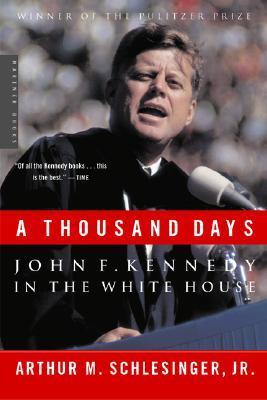
A Thousand Days: John F. Kennedy in the White House
by Arthur M. Schlesinger Jr.
Rating: 4.2 ⭐
• 1 recommendation ❤️
As special assistant to the president, Arthur Schlesinger witnessed firsthand the politics and personalities that influenced the now legendary Kennedy administration. Schlesinger’s close relationship with JFK, as a politician and as a friend, has resulted in this authoritative yet intimate account in which the president “walks through the pages, from first to last, alert, alive, amused and amusing” (John Kenneth Galbraith). A THOUSAND DAYS is “at once a masterly literary achievement and a work of major historical significance” (New York Times).

This extraordinary collection gathers the never-before-seen correspondence of a true American original—the acclaimed historian and lion of the liberal establishment, Arthur Schlesinger, Jr.An advisor to presidents, two-time Pulitzer Prize winner, and tireless champion of progressive government, Arthur Schlesinger, Jr., was also an inveterate letter writer. Indeed, the term “man of letters” could easily have been coined for Schlesinger, a faithful and prolific correspondent whose wide range of associates included powerful public officials, notable literary figures, prominent journalists, Hollywood celebrities, and distinguished fellow scholars.The Letters of Arthur Schlesinger, Jr. reveals the late historian’s unvarnished views on the great issues and personalities of his time, from the dawn of the Cold War to the aftermath of September 11. Here is Schlesinger’s correspondence with such icons of American statecraft as Harry Truman, Adlai Stevenson, Hubert Humphrey, Henry Kissinger, Bill Clinton, and, of course, John and Robert Kennedy (including a detailed critique of JFK’s manuscript for Profiles in Courage). There are letters to friends and confidants such as Eleanor Roosevelt, John Kenneth Galbraith, Gore Vidal, William Styron, and Jacqueline Kennedy (to whom Schlesinger sends his handwritten condolences in the hours after her husband’s assassination), and exchanges with such unlikely pen pals as Groucho Marx, Sammy Davis, Jr., and Bianca Jagger. Finally, there are Schlesinger’s many thoughtful replies to the inquiries of ordinary citizens, in which he offers his observations on influences, issues of the day, and the craft of writing history.Written with the range and insight that made Schlesinger an indispensable figure, these letters reflect the evolution of his thought—and of American liberalism—from the 1940s to the first decade of the new millennium. Whether he is arguing against the merits of preemptive war, advocating for a more forceful policy on civil rights, or simply explaining his preference in neckwear (“For sloppy eaters bow ties are a godsend”), Schlesinger reveals himself as a formidable debater and consummate wit who reveled in rhetorical combat. To a detractor who accuses him of being a Communist sympathizer, he writes: “If your letter was the product of sincere misunderstanding, the facts I have cited should relieve your mind. If not, I can only commend you to the nearest psychiatrist.” Elsewhere, he castigates a future Speaker of the House, John Boehner, for misattributing quotations to Abraham Lincoln.Combining a political strategist’s understanding of the present moment with a historian’s awareness that the eyes of posterity were always watching him, Arthur Schlesinger, Jr., helped shape the course of an era with these letters. This landmark collection frames the remarkable dynamism of the twentieth-century and ensures that Schlesinger’s legacy will continue to influence this one.
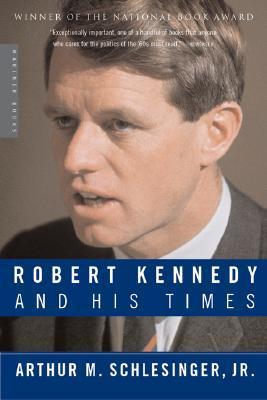
Arthur M. Schlesinger, Jr., chronicles the short life of the Kennedy family's second presidential hopeful in "a story that leaves the reader aching for what cannot be recaptured" (Miami Herald). Schlesinger's account vividly recalls the forces that shaped Robert Kennedy, from his position as the third son of a powerful Irish Catholic political clan to his concern for issues of social justice in the turbulent 1960s. ROBERT KENNEDY AND HIS TIMES is "a picture of a deeply compassionate man hiding his vulnerability, drawn to the underdogs and the unfortunates in society by his life experiences and sufferings" (Los Angeles Times).

The young Schlesinger, for all the tradition he embodied, had a refreshing streak of informality. While working in the Kennedy White House, he found time to review movies for Show magazine. He also admitted his mistakes. One, he said, was neglecting to mention President Jackson’s brutal treatment of the Indians in his Pulitzer Prize-winning “Age of Jackson.” It was published when he was 27, and is still standard reading. The book rejected earlier interpretations linking the rise of Jacksonian democracy with westward expansion. Instead, it gave greater importance to a coalition of intellectuals and workers in the Northeast who were determined to check the growing power of business. The book sold more than 90,000 copies in its first year and won the 1946 Pulitzer Prize for history.

The Disuniting of America: Reflections on a Multicultural Society
by Arthur M. Schlesinger Jr.
Rating: 3.5 ⭐
The conservative social commentator acknowledges the benefits of ethnic awareness in American but goes on to argue that the cult of ethnicity could lead to the fragmentation, resegregation, and tribalization of the country. Reprint. PW.

The Crisis of the Old Order, 1919-1933 , volume one of Pulitzer Prize-winning historian and biographer Arthur M. Schlesinger, Jr.’s Age of Roosevelt series, is the first of three books that interpret the political, economic, social, and intellectual history of the early twentieth century in terms of Franklin D. Roosevelt, the spokesman and symbol of the period. Portraying the United States from the Great War to the Great Depression, The Crisis of the Old Order covers the Jazz Age and the rise and fall of the cult of business. For a season, prosperity seemed permanent, but the illusion came to an end when Wall Street crashed in October 1929. Public trust in the wisdom of business leadership crashed too. With a dramatist’s eye for vivid detail and a scholar’s respect for accuracy, Schlesinger brings to life the era that gave rise to FDR and his New Deal and changed the public face of the United States forever.

From two-time Pulitzer Prize–winning historian Arthur M. Schlesinger, Jr., comes one of the most important and influential investigations of the American presidency. The Imperial Presidency traces the growth of presidential power over two centuries, from George Washington to George W. Bush, examining how it has both served and harmed the Constitution and what Americans can do about it in years to come. The book that gave the phrase “imperial presidency” to the language, this is a work of “substantial scholarship written with lucidity, charm, and wit” (The New Yorker).

A two-volume publication of the distinguished political historian's journals serves as an intimate history of post-war America, the writer's contributions to multiple presidential administrations, and his relationships with numerous cultural and intellectual figures throughout the past half century. 100,000 first printing.

The Coming of the New Deal, 1933-1935, volume two of Pulitzer Prize-winning historian and biographer Arthur M. Schlesinger, Jr.’s Age of Roosevelt series, describes Franklin Delano Roosevelt’s first tumultuous years in the White House. Coming into office at the bottom of the Great Depression, FDR told the American people that they have nothing to fear but fear itself. The conventional wisdom having failed, he tried unorthodox remedies to avert economic collapse. His first hundred days restored national morale, and his New Dealers filled Washington with new approaches to recovery and reform. Combining idealistic ends with realistic means, Roosevelt proposed to humanize, redeem, and rescue capitalism. The Coming of the New Deal, written with Schlesinger’s customary verve, is a gripping account of critical years in the history of the republic.

Arthur M. Schlesinger, Jr., first revealed the sequences that governed American politics over the past two centuries in The Cycles of American History. In this updated edition, the prominent political historian continues to reflect on the "recurring struggle between pragmatism and idealism in the American soul" (Time). Faced with a new century, a new millennium, and social and technological revolutions, Schlesinger confronts the possibility of a revolution in American political cycles.

The Politics of Upheaval, 1935-1936, volume three of Pulitzer Prize-winning historian and biographer Arthur M. Schlesinger, Jr.’s Age of Roosevelt series, concentrates on the turbulent concluding years of Franklin D. Roosevelt’s first term. A measure of economic recovery revived political conflict and emboldened FDR’s critics to denounce “that man in the White house.” To his left were demagogues — Huey Long, Father Coughlin, and Dr. Townsend. To his right were the champions of the old order — ex-president Herbert Hoover, the American Liberty League, and the august Supreme Court. For a time, the New Deal seemed to lose its momentum. But in 1935 FDR rallied and produced a legislative record even more impressive than the Hundred Days of 1933 — a set of statutes that transformed the social and economic landscape of American life. In 1936 FDR coasted to reelection on a landslide. Schlesinger has his usual touch with colorful personalities and draws a warmly sympathetic portrait of Alf M. Landon, the Republican candidate of 1936.

Grover Cleveland: The American Presidents Series: The 22nd and 24th President, 1885-1889 and 1893-1897
by Arthur M. Schlesinger Jr.
Rating: 3.7 ⭐
A fresh look at the only president to serve nonconsecutive terms.Though often overlooked, Grover Cleveland was a significant figure in American presidential history. Having run for President three times and gaining the popular vote majority each time -- despite losing the electoral college in 1892 -- Cleveland was unique in the line of nineteenth-century Chief Executives. In this book, presidential historian Henry F. Graff revives Cleveland's fame, explaining how he fought to restore stature to the office in the wake of several weak administrations. Within these pages are the elements of a rags-to-riches story as well as an account of the political world that created American leaders before the advent of modern media.

A Life in the Twentieth Century: Innocent Beginnings, 1917-1950
by Arthur M. Schlesinger Jr.
Rating: 3.7 ⭐
A memoir of the Pulitzer Prize-winning historian considers events that occurred during his lifetime and that contributed to America's rise to world power status, as told through his personal experiences in childhood, in college, and during war times. 50,000 first printing.

With a new introduction by the author The Vital Center is an eloquent and incisive defense of liberal democracy against its rivals to the left and to the right, communism and fascism. It shows how the failures of free society had led to the mass escape from freedom and sharpened the appeal of totalitarian solutions. It calls for a radical reconstruction of the democratic faith based on a realistic understanding of human limitation and frailty.

"Historical reflections that deftly challenge the political and ideological foundations of President Bush's foreign policy."--Charles A. Kupchan, New York Times In a book that brings a magisterial command of history to the most urgent of contemporary questions, two-time Pulitzer Prize-winning historian Arthur M. Schlesinger, Jr., explores the war in Iraq, the presidency, and the future of democracy. Describing unilateralism as "the oldest doctrine in American history," Schlesinger nevertheless warns of the dangers posed by the fatal turn in U.S. policy from deterrence and containment to preventive war. He writes powerfully about George W. Bush's expansion of presidential power, reminding us nevertheless of our country's distinguished legacy of patriotism through dissent in wartime. And in a new chapter written especially for the paperback edition, he examines the historical role of religion in American politics as a background for an assessment of Bush's faith-based presidency.

James Monroe: The American Presidents Series: The 5th President, 1817-1825
by Arthur M. Schlesinger Jr.
Rating: 3.9 ⭐
The former senator and presidential candidate offers a provocative new assessment of the first "national security president"James Monroe is remembered today primarily for two for being the last of the "Virginia Dynasty"—following George Washington, Thomas Jefferson, and James Madison—and for issuing the Monroe Doctrine, his statement of principles in 1823 that the western hemisphere was to be considered closed to European intervention. But Gary Hart sees Monroe as a president ahead of his time, whose priorities and accomplishments in establishing America's "national security" have a great deal in common with chief executives of our own time.Unlike his predecessors Jefferson and Madison, Monroe was at his core a military man. He joined the Continental Army at the age of seventeen and served with distinction in many pivotal battles. (He is prominently featured at Washington's side in the iconic painting Washington Crossing the Delaware.) And throughout his career as a senator, governor, ambassador, secretary of state, secretary of war, and president, he never lost sight of the fact that without secure borders and friendly relations with neighbors, the American people could never be truly safe in their independence. As president he embarked on an ambitious series of treaties, annexations, and military confrontations that would secure America's homeland against foreign attack for nearly two hundred years. Hart details the accomplishments and priorities of this forward-looking president, whose security concerns clearly echo those we face in our time."A well-written, useful précis of Monroe’s life and career." - Kirkus Reviews

Book by Arthur M. Schlesinger

Richard M. Nixon: The American Presidents Series: The 37th President, 1969-1974
by Arthur M. Schlesinger Jr.
Rating: 3.9 ⭐
The complex man at the center of America's most self-destructive presidencyIn this provocative and revelatory assessment of the only president ever forced out of office, the legendary Washington journalist Elizabeth Drew explains how Richard M. Nixon's troubled inner life offers the key to understanding his presidency. She shows how Nixon was surprisingly indecisive on domestic issues and often wasn't interested in them. Turning to international affairs, she reveals the inner workings of Nixon's complex relationship with Henry Kissinger, and their mutual rivalry and distrust. The Watergate scandal that ended his presidency was at once an overreach of executive power and the inevitable result of his paranoia and passion for vengeance.Even Nixon's post-presidential rehabilitation was motivated by a consuming desire for respectability, and he succeeded through his remarkable resilience. Through this book we finally understand this complicated man. While giving him credit for his achievements, Drew questions whether such a man—beleaguered, suspicious, and motivated by resentment and paranoia—was fit to hold America's highest office, and raises large doubts that he was.

The Bitter Heritage: Vietnam & American Democracy, 1941-1966
by Arthur M. Schlesinger Jr.
Rating: 3.8 ⭐
"The Vietnam War was one of this country's saddest sagas. Perhaps only during the Civil War did the people of this country so divide amongst themselves. A war thousands of miles away, an unclear goal, and a dishonest government all contributed to this division. A much heralded historical author, Arthur M. Schlesinger, Jr. looked at the unrest and instability, and traced the war back to its roots, all the way back to Franklin Roosevelt's administration from his view in 1967 in The Bitter Vietnam and American Democracy 1941-1966."

Get the story on Robert Kennedy with this great book.


The Politics of Hope/The Bitter Heritage: American Liberalism in the 1960s
by Arthur M. Schlesinger Jr.
Rating: 4.0 ⭐
The Politics of Hope and The Bitter Heritage brings together two important books that bracket the tempestuous politics of 1960s America. In The Politics of Hope, which historian Arthur Schlesinger, Jr., published in 1963 while serving as a special assistant to President Kennedy, Schlesinger defines the liberalism that characterized the Kennedy administration and the optimistic early Sixties. In lively and incisive essays, most of them written between 1956 and 1960, on topics such as the basic differences underlying liberal and conservative politics, the writing of history, and the experience of Communist countries, Schlesinger emphasizes the liberal thinker's responsibility to abide by goals rather than dogma, to learn from history, and to look to the future.Four years later, following Kennedy's assassination and the escalation of America's involvement in Vietnam, Schlesinger's tone changes. In The Bitter Heritage, a brief but penetrating appraisal of the "war that nobody wanted," he recounts America's entry into Vietnam, the history of the war, and its policy implications. The Bitter Heritage concludes with an eloquent and sobering assessment of the war's threat to American democracy and a reflection on the lessons or legacies of the Vietman conflict.With a new foreword by Sean Wilentz, the James Madison Library edition of The Politics of Hope and The Bitter Heritage situates liberalism in the convulsive 1960sand illuminates the challenges that still face liberalism today.


In an attempt to explore the facile and fashionable cliches of presidential campaigns, American historian Arthur Schlesinger, Jr. illuminates the differences between the campaigns of John F. Kennedy and Richard M. Nixon to evaluate what those differences predicted about the future of the nation.Pulitzer Prize-winning historian Arthur Schlesinger, Jr. examines the similarities and differences between the intense presidential campaigns of John F. Kennedy and Richard M. Nixon in 1960. With the introduction of television to air speeches and debates, the race between Kennedy and Nixon brought about a new style of campaign that truly had America questioning “What is the difference between your two parties?” Giving commentary on one of the most famous presidential races in American history, Schlesinger examines the candidates, their personalities, their policies, and their Parties in order to establish a considerable difference between JFK and Nixon, showing readers that those very differences would become vital to the safety and survival of the nation.

Coming to Power: Critical Presidential Elections in American History
by Arthur M. Schlesinger Jr.
Rating: 4.4 ⭐
"This book contains a selection of essays from the four-volume work "History of American Presidential Elections" published in 1971 by Chelsea House and McGraw-Hill. The pieces reprinted here deal with what the editors, after pained ad prolonged reflection, decided were the most critical fifteen of the forty-sox presidential elections held in the United States from 1789 to 1968."

The Crisis of Confidence: Ideas, Power and Violence in America
by Arthur M. Schlesinger Jr.
Rating: 4.0 ⭐
HB as shown and listed see my photos crisis of confidence (Ideas,Power and Violence in America. Copyrt 1969 0n title and copyrt page.First Printing. Arthur M. Schlesinger, Jr. In Memory of Robert Francis Kennedy. English. 313 pages. 8.4 by 5.6 by 1 inch.