
Antony Beevor
Sir Antony James Beevor is a British military historian. He has published several popular historical works, mainly on the Second World War, the Spanish Civil War, and most recently the Russian Revolution and Civil War. Educated at Abberley Hall School, Winchester College, and the Royal Military Academy Sandhurst, Beevor commanded a troop of tanks in the 11th Hussars in Germany before deciding in 1970 to leave the army and become a writer. He was a visiting professor at Birkbeck, University of London, and the University of Kent. His best-selling books, Stalingrad (1998) and Berlin: The Downfall 1945 (2002), have been acclaimed for their detailed coverage of the battles between the Soviet Union and Germany, and their focus on the experiences of ordinary people. Berlin proved very controversial in Russia because of the information it contained from former Soviet archives about the mass rapes carried out by the Red Army in 1945. Beevor's works have been translated into many languages and have sold millions of copies. He has lectured at numerous military headquarters, staff colleges and establishments in Britain, the US, Europe, and Australia. He has also written for many major newspapers.
27 Books Written

The Battle of Stalingrad was not only the psychological turning point of World War II: it also changed the face of modern warfare. Historians and reviewers worldwide have hailed Antony Beevor's magisterial Stalingrad as the definitive account of World War II's most harrowing battle. In August 1942, Hitler's huge Sixth Army reached the city that bore Stalin's name. In the five-month siege that followed, the Russians fought to hold Stalingrad at any cost; then, in an astonishing reversal, encircled and trapped their Nazi enemy. This battle for the ruins of a city cost more than a million lives. Stalingrad conveys the experience of soldiers on both sides, fighting in inhuman conditions, and of civilians trapped on an urban battlefield. Antony Beevor has interviewed survivors and discovered completely new material in a wide range of German and Soviet archives, including prisoner interrogations and reports of desertions and executions. As a story of cruelty, courage, and human suffering, Stalingrad is unprecedented and unforgettable.

Acclaimed for his vivid re-creations of some of the twentieth century's most significant battles, Antony Beevor is one of the best known and respected military historians writing today. He now offers readers a gripping, street-level portrait of the harrowing days of January 1945 in Berlin when the vengeful Red Army and beleaguered Nazi forces clashed for a final time. The result was the most gruesome display of brutality in the war, with tanks crushing refugee columns, mass rapes, pillage, and destruction. Hundreds of thousands of German civilians froze to death or were massacred because Nazi officials had forbidden their evacuation. Hitler, half crazed in his bunker, issued wild orders while Stalin was prepared to risk any number of his men to seize the city before the other Allies could get there.Making full use of newly disclosed material from former Soviet files as well as from German, American, British, French, and Swedish archives, Beevor has reconstructed the different experiences of those millions caught up in the death throes of the Third Reich. The Fall of Berlin 1945 depicts not only the brutality and desperation of a city under siege but also rare moments of extreme humanity and heroism. This account also contains new revelations about the motives behind Stalin's hurried assault. Sure to appeal to all readers interested in military history and the Second World War, The Fall of Berlin 1945 promises to be the definitive treatment of the subject for years to come.

Traces the history of the war, describes its causes, and discusses the war's relationship to World War II

The Normandy Landings that took place on D-Day involved by far the largest invasion fleet ever known. The scale of the undertaking was simply awesome. What followed them was some of the most cunning and ferocious fighting of the war, at times as savage as anything seen on the Eastern Front. As casualties mounted, so too did the tensions between the principal commanders on both sides. Meanwhile, French civilians caught in the middle of these battlefields or under Allied bombing endured terrible suffering. Even the joys of Liberation had their darker side. The war in northern France marked not just a generation but the whole of the post-war world, profoundly influencing relations between America and Europe. Making use of overlooked and new material from over thirty archives in half a dozen countries, "D-Day" is the most vivid and well-researched account yet of the battle of Normandy. As with Stalingrad and Berlin, Antony Beevor's gripping narrative conveys the true experience of war.

A masterful and comprehensive chronicle of World War II, by internationally bestselling historian Antony Beevor.Over the past two decades, Antony Beevor has established himself as one of the world's premier historians of WWII. His multi-award winning books have included Stalingrad and The Fall of Berlin 1945 . Now, in his newest and most ambitious book, he turns his focus to one of the bloodiest and most tragic events of the twentieth century, the Second World War.In this searing narrative that takes us from Hitler's invasion of Poland on September 1st, 1939 to V-J day on August 14, 1945 and the war's aftermath, Beevor describes the conflict and its global reach -- one that included every major power. The result is a dramatic and breathtaking single-volume history that provides a remarkably intimate account of the war that, more than any other, still commands attention and an audience.Thrillingly written and brilliantly researched, Beevor's grand and provocative account is destined to become the definitive work on this complex, tragic, and endlessly fascinating period in world history, and confirms once more that he is a military historian of the first rank.

El sábado 16 de diciembre de 1944, Hitler inició su «última apuesta» en los bosques nevados de las Ardenas. Su intención era realizar un ataque por sorpresa que, al dirigirse hacia Amberes, dividiese los ejércitos aliados e hiciese posible infligirles una severa derrota: un nuevo Dunquerque que cambiase el curso de una guerra que había llegado a una situación angustiosa, con los ejércitos soviéticos avanzando en suelo alemán. La ofensiva, en la que intervendrían dos ejércitos blindados, se complementaba con la actuación en la retaguardia de un comando de soldados alemanes, con uniformes y vehículos norteamericanos. Como hiciera en Stalingrado, Beevor consigue aquí combinar una visión épica de la que fue la mayor batalla de la guerra en el frente occidental —una batalla librada en condiciones extremas, que llegó a implicar a un millón de hombres y en la que los dos bandos cometieron crímenes brutales— con una aproximación directa al heroísmo, el miedo y el sufrimiento de los seres humanos.

The great airborne battle for the bridges in 1944 by Britain's Number One bestselling historianOn 17 September 1944, General Kurt Student, the founder of Nazi Germany's parachute forces, heard the growing roar of aeroplane engines. He went out on to his balcony above the flat landscape of southern Holland to watch the air armada of Dakotas and gliders carrying the British 1st Airborne and the American 101st and 82nd Airborne divisions. He gazed up in envy at this massive demonstration of paratroop power.Operation Market Garden, the plan to end the war by capturing the bridges leading to the Lower Rhine and beyond, was a bold concept: the Americans thought it unusually bold for Field Marshal Montgomery. But could it ever have worked? The cost of failure was horrendous, above all for the Dutch, who risked everything to help. German reprisals were pitiless and cruel, and lasted until the end of the war.The British fascination with heroic failure has clouded the story of Arnhem in myths. Antony Beevor, using often overlooked sources from Dutch, British, American, Polish and German archives, has reconstructed the terrible reality of the fighting, which General Student himself called 'The Last German Victory'. Yet this book, written in Beevor's inimitable and gripping narrative style, is about much more than a single, dramatic battle. It looks into the very heart of war.

An epic new account of the conflict that reshaped Eastern Europe and set the stage for the rest of the twentieth century.Between 1917 and 1921 a devastating struggle took place in Russia following the collapse of the Tsarist empire. The doomed White alliance of moderate socialists and reactionary monarchists stood little chance against Trotsky’s Red Army and the single-minded Communist dictatorship under Lenin. In the savage civil war that followed, terror begat terror, which in turn led to ever greater cruelty with man’s inhumanity to man, woman and child. The struggle became a world war by proxy as Churchill deployed weaponry and troops from the British empire, while contingents from the United States, France, Italy, Japan, Poland, and Czechoslovakia played rival parts. Using the most up to date scholarship and archival research, Antony Beevor assembles the complete picture in a gripping narrative that conveys the conflict through the eyes of everyone from the worker on the streets of Petrograd to the cavalry officer on the battlefield and the doctor in an improvised hospital.
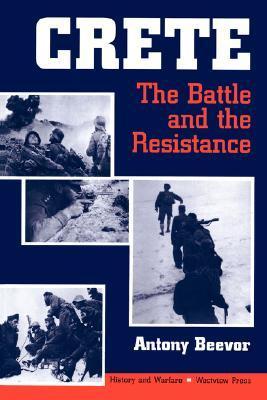
A riveting account of the fall of Greece, the Battle of Crete, and the Cretan Resistance, from the beginning of World War II to its end.Nazi Germany expected its airborne attack on Crete in 1941 to be a textbook victory based on tactical surprise. Little did they know that the British, using Ultra intercepts, had already laid a careful trap. It should have been the first German defeat of the war when a fatal misunderstanding turned the battle around.Prize-winning historian and bestselling author Antony Beevor lends his gift for storytelling to this important conflict, showing not only how the situation turned bad for Allied forces, but also how ferocious Cretan freedom fighters mounted a heroic resistance. Originally published in 1991, Crete 1941 is a breathtaking account of a momentous battle of World War II.

In this brilliant synthesis of social, political, and cultural history, Antony Beevor and Artemis Cooper present a vivid and compelling portrayal of the City of Lights after its liberation. Paris became the diplomatic battleground in the opening stages of the Cold War. Against this volatile political backdrop, every aspect of life is portrayed: scores were settled in a rough and uneven justice, black marketers grew rich on the misery of the population, and a growing number of intellectual luminaries and artists including Hemingway, Beckett, Camus, Sartre, de Beauvoir, Cocteau, and Picasso contributed new ideas and a renewed vitality to this extraordinary moment in time.

In his latest work, Antony Beevor—bestselling author of Stalingrad and The Battle of Arnhem and one of our most respected historians of World War II—brings us the true, little-known story of a family torn apart by revolution and war. Olga Chekhova, a stunning Russian beauty, was the niece of playwright Anton Chekhov and a famous Nazi-era film actress who was closely associated with Hitler. After fleeing Bolshevik Moscow for Berlin in 1920, she was recruited by her composer brother Lev to become a Soviet spy—a career she spent her entire postwar life denying. The riveting story of how Olga and her family survived the Russian Revolution, the rise of Hitler, the Stalinist Terror, and the Second World War becomes, in Beevor’s hands, a breathtaking tale of survival in a merciless age.

Antony Beevor's Stalingrad, published by Penguin in 1998, was a worldwide bestseller, telling one of the most harrowing stories of the Second World War and reminding everybody of the power of narrative history in the hands of an expert storyteller. In this extract Beevor takes us back to December 1942 when the German 6th Army was surrounded by the Russians and facing annihilation. Only thoughts of Christmas kept German soldiers' hopes alive.

The anatomy of an institution and a study of a tribal society unique to this country. From Rhine Army headquarters in Germany to underground bunkers in South Armagh the author talks with the Army's Generals, officers, NCO's and soldiers. His research has coincided with a period of social and political change of dramatic implications; revisiting the Army almost 20 years after he left it he has been able to combine the understanding of an insider with the freshness of a new observer.

Тази война, която отнема живота на повече от 60 милиона души и засяга цялата планета, илюстрира безпомощността на повечето обикновени смъртни пред непреодолимите сили на историята. В безпощадния си разказ, който проследява събитията от нахлуването на Хитлер в Полша на 1 септември 1939 г. до победата над Япония на 14 август 1945 г., Бийвър описва конфликта в неговия глобален обхват с участието на всички големи държави. Резултатът е зашеметяваща със своя драматизъм и задълбоченост история на най-кръвопролитните и трагични събития на XX век.

World War II Trilogy by Antony Beevor: Stalingrad / The Fall of Berlin / D-Day
by Antony Beevor
Rating: 4.8 ⭐
StalingradThe Fall of Berlin 1945D-DayAntony Beevor, the world's bestselling military historian, writes about three pivotal battles of World War II in three astounding books. In Stalingrad, The Fall of Berlin 1945, and D-Day, Beevor conveys the experiences of soldiers and civilians on all sides, offering definitive accounts of these three harrowing offensives, bringing the cruelty, courage, and human suffering of World War II Europe to vivid life."Magnificent . . . Not likely to be surpassed in our time." - John Keegan, on Stalingrad"A tale drenched in drama and blood, heroism and cowardice, loyalty and betrayal." - Jonathan Yardley, The Washington Post, on The Fall of Berlin 1945"Glorious, horrifying . . . Honors the sacrifices of tens of thousands of men and women." - Time, on D-Day

Тази война, която отнема живота на повече от 60 милиона души и засяга цялата планета, илюстрира безпомощността на повечето обикновени смъртни пред непреодолимите сили на историята. В безпощадния си разказ, който проследява събитията от нахлуването на Хитлер в Полша на 1 септември 1939 г. до победата над Япония на 14 август 1945 г., Бийвър описва конфликта в неговия глобален обхват с участието на всички големи държави. Резултатът е зашеметяваща със своя драматизъм и задълбоченост история на най-кръвопролитните и трагични събития на XX век.

Obra fornece detalhes sobre o fim da maior guerra de todos os tempos.Antony Beevor, especialista em história militar, revela detalhes de como o Exército Vermelho derrotou o Exército Alemão, em 1945, o que culminou no fim do Terceiro Reich de Hitler. Neste volume o autor apresenta a preparação das partes envolvidas e as decisões que culminaram no ataque soviético a Berlim, fatal para o regime nazista.Esta coleção é dividida em dois volumes em edição de bolso.

Obra fornece detalhes sobre o fim da maior guerra de todos os tempos.Antony Beevor, especialista em história militar, revela detalhes de como o Exército Vermelho derrotou o Exército Alemão, em 1945, o que culminou no fim do Terceiro Reich de Hitler. No volume 1 o autor apresenta a preparação das partes envolvidas e as decisões que culminaram no ataque soviético a Berlim, fatal para o regime nazista. Neste volume temos o início do grande ataque, em 1945, o que culminou com o fim da Segunda Guerra Mundial. De maneira dinâmica, Antony Beevor apresenta diálogos entre os chefes militares e grandes personalidades da História e as investidas à cidade e à sua população, com bombardeios, invasões de exércitos e ataques aéreos.

Prompt delivery and an excellent customer service.

When an Andes mountain guide is kidnapped and tortured by the secret police of General Iniesta, an unlikely alliance is forged between a former British army officer and an anarchist group planning to assassinate the corrupt dictator.

Crete and abducting a general 2 books collection set The Battle and the Acclaimed historian and best-selling author Antony Beevor vividly brings to life the epic struggles that took place in Second World War Crete - reissued with a new introduction., Abducting a The Kreipe Operation and SOE in A daring behind-enemy-lines mission from the author of A Time of Gifts and The Broken Road, who was once described by the BBC as 'a cross between Indiana Jones, James Bond and Graham Greene'. Although a story often told, this is the first time Patrick Leigh Fermor's own account of the kidnapping of General Kriepe, has been published.


When Russia's Dowager Empress was pregnant with the future Tsar, she dreamed that a peasant would one day kill her son. The idea terrified her, and for the rest of her days she 'lived under the pressure of the prophecy'.Rasputin had no official position. A barely literate moujhik from Siberia, he had no forces at his command. He was a devoted monarchist, not a revolutionary. And yet, through his uncanny seduction of the imperial household, he contributed more than any other individual to the collapse of the greatest autocracy in the world. 'This man was unique', observed one writer. 'Like a character out of a novel, he lived in legend, he died in legend, and his memory is cloaked in legend.' In this extraordinary new work, Antony Beevor, master of narrative history on the grandest scale, sharpens his focus to pierce the fog of fantasy that has only grown denser over time. The result is an unparalleled portrait of one of history's most dubious masterminds.


Tango !
by Antony Beevor
Antony Beevor 3 Books Collection Set
by Antony Beevor
Please Note That The Following Individual Books As Per Original ISBN and Cover Image In this Listing shall be Dispatched Antony Beevor 3 Books Collection The Germans expected their airborne attack on Crete in 1941 - a unique event in the history of warfare - to be a textbook victory based on tactical surprise. The Normandy Landings that took place on D-Day involved by far the largest invasion fleet ever known. The scale of the undertaking was awesome and what followed was some of the most cunning and ferocious fighting of the war. The Red Army had much to avenge when it finally reached the frontiers of the Reich in January 1945. Political instructors rammed home the message of Wehrmacht and SS brutality. The result was the most terrifying example of fire and sword ever known, with tanks crushing refugee columns under their tracks, mass rape, pillage and destruction.