
António Damásio
Damásio studied medicine at the University of Lisbon Medical School in Portugal, where he also did his medical residency rotation and completed his doctorate. Later, he moved to the United States as a research fellow at the Aphasia Research Center in Boston. His work there on behavioral neurology was done under the supervision of Norman Geschwind. As a researcher, Dr. Damásio's main interest is the neurobiology of the mind, especially neural systems which subserve memory, language, emotion, and decision-making. His research has helped to elucidate the neural basis for the emotions and has shown that emotions play a central role in social cognition and decision-making. Damásio has formulated the somatic markers hypothesis. As a clinician, he and his collaborators study and treat the disorders of behavior and cognition, and movement disorders. Damásio's books deal with the relationship between emotions and feelings, and what are their bases in the brain. His 1994 book, Descartes' Error: Emotion, Reason and the Human Brain, was nominated for the Los Angeles Times Book Award and is translated in over 30 languages. His second book, The Feeling of What Happens: Body and Emotion in the Making of Consciousness, was named as one of the ten best books of 2001 by New York Times Book Review, a Publishers Weekly Best Book of the Year, a Library Journal Best Book of the Year, and has thirty foreign editions. Damásio's most recent book, Looking for Spinoza: Joy, Sorrow, and the Feeling Brain, was published in 2003. In it, Damásio explores philosophy and its relations to neurobiology, suggesting that it might provide guidelines for human ethics. He is a member of the American Academy of Arts and Sciences, the National Academy of Science's Institute of Medicine, and the European Academy of Arts and Sciences. Damásio has received many awards including the Prince of Asturias Award in Science and Technology, Kappers Neuroscience Medal, the Beaumont Medal from the American Medical Association and the Reenpaa Prize in Neuroscience. He is also in the editorial board of many important journals in the field. His current work involves the social emotions, decision neuroscience and creativity. Prof. Damásio is married to Dr. Hanna Damásio, his colleague and co-author of several works. (from: Wikipedia)
28 Books Written

The Strange Order of Things: Life, Feeling, and the Making of Cultures
by António Damásio
Rating: 3.7 ⭐
• 2 recommendations ❤️
The Strange Order of Things is a pathbreaking investigation into homeostasis, the condition that regulates human physiology within the range that makes possible not only survival but also the flourishing of life. Antonio Damasio makes clear that we descend biologically, psychologically, and even socially from a long lineage that begins with single living cells; that our minds and cultures are linked by an invisible thread to the ways and means of ancient unicellular existence and other primitive life-forms; and that inherent in our very chemistry is a powerful force, a striving toward life maintenance that governs life in all its guises, including the development of genes that help regulate and transmit life. The Strange Order of Things is a landmark reflection that spans the biological and social sciences, offering a new way of understanding the origins of life, feeling, and culture.
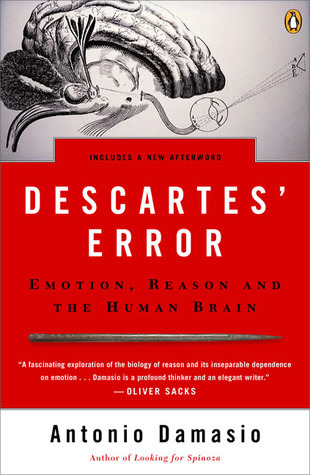
Descartes' Error: Emotion, Reason and the Human Brain
by António Damásio
Rating: 4.0 ⭐
• 1 recommendation ❤️
Since Descartes famously proclaimed, "I think, therefore I am," science has often overlooked emotions as the source of a person’s true being. Even modern neuroscience has tended, until recently, to concentrate on the cognitive aspects of brain function, disregarding emotions. This attitude began to change with the publication of Descartes’ Error in 1995. Antonio Damasio—"one of the world’s leading neurologists" (The New York Times)—challenged traditional ideas about the connection between emotions and rationality. In this wondrously engaging book, Damasio takes the reader on a journey of scientific discovery through a series of case studies, demonstrating what many of us have long suspected: emotions are not a luxury, they are essential to rational thinking and to normal social behavior.

The Feeling of What Happens: Body and Emotion in the Making of Consciousness
by António Damásio
Rating: 4.0 ⭐
The publication of this book is an event in the making. All over the world scientists, psychologists, and philosophers are waiting to read Antonio Damasio's new theory of the nature of consciousness and the construction of the self. A renowned and revered scientist and clinician, Damasio has spent decades following amnesiacs down hospital corridors, waiting for comatose patients to awaken, and devising ingenious research using PET scans to piece together the great puzzle of consciousness. In his bestselling Descartes' Error, Damasio revealed the critical importance of emotion in the making of reason. Building on this foundation, he now shows how consciousness is created. Consciousness is the feeling of what happens-our mind noticing the body's reaction to the world and responding to that experience. Without our bodies there can be no consciousness, which is at heart a mechanism for survival that engages body, emotion, and mind in the glorious spiral of human life. A hymn to the possibilities of human existence, a magnificent work of ingenious science, a gorgeously written book, The Feeling of What Happens is already being hailed as a classic.

From one of the most significant neuroscientists at work today, a pathbreaking investigation of a question that has confounded philosophers, psychologists, and neuroscientists for centuries: how is consciousness created? Antonio Damasio has spent the past thirty years studying and writing about how the brain operates, and his work has garnered acclaim for its singular melding of the scientific and the humanistic. In Self Comes to Mind, he goes against the long-standing idea that consciousness is somehow separate from the body, presenting compelling new scientific evidence that consciousness—what we think of as a mind with a self—is to begin with a biological process created by a living organism. Besides the three traditional perspectives used to study the mind (the introspective, the behavioral, and the neurological), Damasio introduces an evolutionary perspective that entails a radical change in the way the history of conscious minds is viewed and told. He also advances a radical hypothesis regarding the origins and varieties of feelings, which is central to his framework for the biological construction of consciousness: feelings are grounded in a near fusion of body and brain networks, and first emerge from the historically old and humble brain stem rather than from the modern cerebral cortex. Damasio suggests that the brain’s development of a human self becomes a challenge to nature’s indifference and opens the way for the appearance of culture, a radical break in the course of evolution and the source of a new level of life regulation—sociocultural homeostasis. He leaves no doubt that the blueprint for the work-in-progress he calls sociocultural homeostasis is the genetically well-established basic homeostasis, the curator of value that has been present in simple life-forms for billions of years. Self Comes to Mind is a groundbreaking journey into the neurobiological foundations of mind and self.

The last in a trilogy of books that investigates the philosophical and scientific foundations of human life Joy, sorrow, jealousy, and awe—these and other feelings are the stuff of our daily lives. In the seventeenth century, the philosopher Spinoza devoted much of his life's work examining how these emotions supported human survival, yet hundreds of years later the biological roots of what we feel remain a mystery. Leading neuroscientist Antonio Damasio—whose earlier books explore rational behavior and the notion of the self—rediscovers a man whose work ran counter to all the thinking of his day, pairing Spinoza's insights with his own innovative scientific research to help us understand what we're made of, and what we're here for.

From one of the world’s leading neuroscientists: a succinct, illuminating, wholly engaging investigation of how biology, neuroscience, psychology, and artificial intelligence have given us the tools to unlock the mysteries of human consciousnessIn recent decades, many philosophers and cognitive scientists have declared the problem of consciousness unsolvable, but Antonio Damasio is convinced that recent findings across multiple scientific disciplines have given us a way to understand consciousness and its significance for human life. In the forty-eight brief chapters of Feeling & Knowing, and in writing that remains faithful to our intuitive sense of what feeling and experiencing are about, Damasio helps us understand why being conscious is not the same as sensing, why nervous systems are essential for the development of feelings, and why feeling opens the way to consciousness writ large. He combines the latest discoveries in various sciences with philosophy and discusses his original research, which has transformed our understanding of the brain and human behavior. Here is an indispensable guide to understanding how we experience the world within and around us and find our place in the universe.



The Feeling Of What Happens: Body and Emotion in the Making of Consciousness
by António Damásio
Rating: 3.0 ⭐
In The Feeling of What Body and Emotion in the Making of Consciousness, neuroscientist Antonio Damasio, director of UCLA's Brain and Creativity Institute, presents "the first truly compelling neurobiological account of the self...a remarkable work of intellectual daring" (Nature).A New York Times Book Review Editors' ChoiceWidley praised for his innovative scientific thinking and elegant writing, Antonio Damasio, the international bestselling author of Descartes' Error achieves an understanding of consciousness by asking and answering profound How is it we know what we know? How is it that our conscious and private minds have a sense of self?In this groundbreaking book, Damasio — a renowned and revered scientist and clinician who spent decades following amnesiacs down hospital corridors, waiting for comatose patients to awaken, and devising ingenious research using PET scans to piece together the great puzzle of consciousness — explores the biological roots of sentient awareness and its role in survival.Consciousness is the feeling of what happens-our mind noticing the body's reaction to the world and responding to that experience. Without our bodies there can be no consciousness, which is at heart a mechanism for survival that engages body, emotion, and mind in the glorious spiral of human life. Linking body and emotion in an arresting and original study of what it is to be human, The Feeling of What Happens "will change your experience of yourself" (The New York Times)."Both Descartes Error and The Feeling of What Happens are essential reading. They are ground-breaking classics of psychology and neuroscience."—Journal of the Royal Society of Medicine

Fornemmelsen af det, der sker - krop og emotion ved dannelsen af bevidsthed
by António Damásio
Rating: 3.5 ⭐

El extraño orden de las cosas: La vida, los sentimientos y la creación de las culturas
by António Damásio
Rating: 5.0 ⭐
Antonio Damasio, el mayor divulgador científico, analiza qué son los sentimientos y cuál es su papel en el ciclo de la vida."Este libro trata de un interés y de una idea. Hace mucho tiempo que me intriga el afecto humano (el mundo de las emociones y de los sentimientos) y he pasado muchos años investigá por qué y cómo nos emocionamos, sentimos, usamos los sentimientos para construir nuestro yo; cómo los sentimientos ayudan a nuestras mejores intenciones o las socavan; por qué y cómo el cerebro interactúa con el cuerpo para sostener dichas funciones. Tengo nuevos hechos e interpretaciones para compartir acerca de todas estas cuestiones."De uno de los neurocientíficos más importantes del mundo nos llega el que sin duda será uno de los libros de referencia sobre el origen de la vida, la mente y la cultura, ofreciendo una nueva forma de entender la vida, la cultura y los sentimientos.En este libro el autor nos aporta las claves para comprender qué son los sentimientos y qué relación tienen con nuestro cuerpo. Una vez más, nos demuestra que cuerpo y mente están íntimamente relacionados y que los sentimientos son los cimientos de nuestra mente, revelaciones del estado de la vida en el seno del organismo entero.Damasio nos presenta una investigación única y pionera en la relación que se establece entre el hecho de sentir y su condición de regular la vida, conocida con el nombre científico de homeostasis. Deja claro que descendemos tanto a nivel biológico, como psicológico e incluso social de un largo linaje que comienza con tan solo unas pocas células vivas; que nuestras mentes y culturas están ligadas por un hilo invisible a la antigua vida unicelular; que hay una poderosísima fuerza de autoconservación que lo gobierna todo, inherente a la propia química de la vida.La misteriosa naturaleza de las cosas nos ofrece una nueva forma de entender el mundo y también del lugar que nosotros ocupamos en él.

Was macht uns zum Menschen? Antonio Damasio schafft die Verbindung von Philosophie und Hirnforschung zu einer erstaunlichen Theorie des Bewusstseins"Wie wir denken, wie wir fühlen" bringt Antonio Damasios Lebensthemen auf den In glänzend geschriebenen kurzen Kapiteln führt er uns vom Beginn des Lebens auf der Erde hin zu einem umfassenden Verständnis dessen, was uns im Innersten ausmacht – Verstand, aber Emotion. Was ist Bewusstsein? Kaum eine Frage rührt so sehr an den Kern des Menschseins. Seit Jahrhunderten wird sie von Philosophen gestellt, seit Neuerem bemühen sich auch die Naturwissenschaften um Antworten. Antonio Damasio, gefeierter Sachbuchautor und einer der renommiertesten Neurowissenschaftler der Welt, verbindet Erkenntnisse aus Philosophie und Hirnforschung, aus Evolutions- und Neurobiologie, aus Psychologie und KI-Forschung zu einer originellen Theorie des Bewusstseins.
神経心理学と病巣解析
by António Damásio

El error de Descartes: La emoción, la razón y el cerebro humano
by António Damásio
Tras el éxito de Y el cerebro creó al hombre, Destino incorpora dos clásicos de Antonio Damasio. Publicado originalmente en 1994, El error de Descartes es un libro de referencia en la literatura sobre ciencia y filosofía. ¿Y cuál es el error de Descartes? Pues creer que la mente existe de forma independiente al cuerpo, una idea profundamente arraigada en la cultura occidental desde entonces. Descartes proclamó "pienso, luego existo", a lo que Damasio contrapone en este libro todo tipo de argumentos que demuestran que las emociones y los sentimientos no sólo tienen un papel relevante en la racionalidad humana, sino que cualquier daño en la corteza prefrontal puede hacer que un individuo sea incapaz de generar las emociones necesarias para tomar decisiones de forma efectiva.
Self Comes to Mind: Constructing the Conscious Brain by Antonio Damasio
by António Damásio
Il s?? viene alla mente. La costruzione del cervello cosciente by Antonio R. Damasio
by António Damásio

Antony Gormley
by António Damásio
Antony Gormley has renewed figurative sculpture by pitching works based on his own body against a variety of scales to articulate a sense of embodied "awe" and spatial expansiveness for the human body. This volume accompanies Gormley's 2009 show in Bregenz.
Self Comes to Mind: Constructing the Conscious Brain By Antonio Damasio(A)/Fred Stella(N) [Audiobook, MP3 CD]
by António Damásio

El extraño orden de las cosas: La vida, los sentimientos y la creación de las culturas
by António Damásio
[The Feeling of What Happens: Body and Emotion in the Making of Consciousness] [By: Damasio, Antonio] [October, 2000]
by António Damásio
El error de Descartes by Antonio Damasio
by António Damásio
Y el cerebro creó al hombre: ¿cómo pudo el cerebro generar emociones, sentimientos, ideas y el yo?
by António Damásio

Inteligencia natural y la lógica de la consciencia
by António Damásio

Inteligencia natural y la lógica de la consciencia (Imago Mundi)
by António Damásio
Inteligencia humana versus Inteligencia la relación del futuro.El tradicional misterio de la conciencia —nuestra capacidad de experimentar la propia existencia y tener sentido de nosotros mismos— sigue sin resolverse a pesar de los grandes intentos de neurobiólogos y filósofos. En su nuevo libro, Damasio comparte sus investigaciones más punteras sobre el surgimiento de la conciencia y las contrapone a las nuevas y extraordinarias capacidades de la inteligencia artificial. Basándose en sus amplios estudios sobre neurología y psicología humanas, nos explica cómo cerebro, mente y cuerpo se unen para generar consciencia y aborda la necesidad de reconciliar sus diferencias para permitir una coexistencia saludable entre la cultura humana y la artificial.
O ERRO DE DESCARTES. Emoção, Razão e Cérebro Humano
by António Damásio

A Inteligência Natural & a Lógica da Consciência
by António Damásio
Nome cimeiro da neurociência mundial, António Damásio mostra-nos que o desenvolvimento da Consciência é uma das mais notáveis consequências da Inteligência Natural, sobretudo nos seres humanos.«Quem imaginaria que o afeto, em geral, e os sentimentos, em particular, gerados por obra e graça da Inteligência Natural como meio de manter a vida em criaturas relativamente simples, se tornariam, na longa trajetória do tempo, elementos caracterizadores da existência humana, provedores de alegrias e tristezas, de glórias e tragédias, de valores elevados e mesquinhos, nada mais, nada menos do que a mais profunda base da humanidade que habitamos e observamos?Não haverá dúvida de que aquilo que os seres humanos inventaram especificamente e acrescentaram a este universo, desde a engenharia das coisas e dos modos de comportamento às artes e à filosofia, será notável.Não obstante, tudo isso empalidece face à dádiva do afeto e, convenhamos, ao que parecem ter sido as ambições da Inteligência Natural.Não admira, assim, que depois de ter ajudado a fundar mil e um reinos e algumas religiões, a Inteligência Natural e os seus afetos viessem, por fim, a desafiar os seres humanos, e tentar conduzi-los à descoberta das suas próprias origens e poder.Ainda lá não chegámos, mas, por incrível que seja, graças a esse ímpeto, conseguimos, pelo menos, abordar uma pequena parte do mistério — a criação da Consciência — e resolvê-lo!»