
Angela Carter
Born Angela Olive Stalker in Eastbourne, in 1940, Carter was evacuated as a child to live in Yorkshire with her maternal grandmother. As a teenager she battled anorexia. She began work as a journalist on the Croydon Advertiser, following in the footsteps of her father. Carter attended the University of Bristol where she studied English literature. She married twice, first in 1960 to Paul Carter. They divorced after twelve years. In 1969 Angela Carter used the proceeds of her Somerset Maugham Award to leave her husband and relocate for two years to Tokyo, Japan, where she claims in Nothing Sacred (1982) that she "learnt what it is to be a woman and became radicalised." She wrote about her experiences there in articles for New Society and a collection of short stories, Fireworks: Nine Profane Pieces (1974), and evidence of her experiences in Japan can also be seen in The Infernal Desire Machines of Doctor Hoffman (1972). She was there at the same time as Roland Barthes, who published his experiences in Empire of Signs (1970). She then explored the United States, Asia, and Europe, helped by her fluency in French and German. She spent much of the late 1970s and 1980s as a writer in residence at universities, including the University of Sheffield, Brown University, the University of Adelaide, and the University of East Anglia. In 1977 Carter married Mark Pearce, with whom she had one son. As well as being a prolific writer of fiction, Carter contributed many articles to The Guardian, The Independent and New Statesman, collected in Shaking a Leg. She adapted a number of her short stories for radio and wrote two original radio dramas on Richard Dadd and Ronald Firbank. Two of her fictions have been adapted for the silver screen: The Company of Wolves (1984) and The Magic Toyshop (1987). She was actively involved in both film adaptations, her screenplays are published in the collected dramatic writings, The Curious Room, together with her radio scripts, a libretto for an opera of Virginia Wolf's Orlando, an unproduced screenplay entitled The Christchurch Murders (based on the same true story as Peter Jackson's Heavenly Creatures) and other works. These neglected works, as well as her controversial television documentary, The Holy Family Album, are discussed in Charlotte Crofts' book, Anagrams of Desire (2003). At the time of her death, Carter was embarking on a sequel to Charlotte Brontë's Jane Eyre based on the later life of Jane's stepdaughter, Adèle Varens. However, only a synopsis survives. Her novel Nights at the Circus won the 1984 James Tait Black Memorial Prize for literature. Angela Carter died aged 51 in 1992 at her home in London after developing lung cancer. Her obituary published in The Observer said, "She was the opposite of parochial. Nothing, for her, was outside the pale: she wanted to know about everything and everyone, and every place and every word. She relished life and language hugely, and reveled in the diverse."
29 Books Written

For the 75th anniversary of her birth, a Deluxe Edition of the master of the literary supernatural’s most celebrated book—featuring a new introduction by Kelly LinkAngela Carter was a storytelling sorceress, the literary godmother of Neil Gaiman, David Mitchell, Audrey Niffenegger, J. K. Rowling, Kelly Link, and other contemporary masters of supernatural fiction. In her masterpiece, The Bloody Chamber—which includes the story that is the basis of Neil Jordan’s 1984 movie The Company of Wolves—she spins subversively dark and sensual versions of familiar fairy tales and legends like “Little Red Riding Hood,” “Bluebeard,” “Puss in Boots,” and “Beauty and the Beast,” giving them exhilarating new life in a style steeped in the romantic trappings of the gothic tradition.For more than seventy years, Penguin has been the leading publisher of classic literature in the English-speaking world. With more than 1,700 titles, Penguin Classics represents a global bookshelf of the best works throughout history and across genres and disciplines. Readers trust the series to provide authoritative texts enhanced by introductions and notes by distinguished scholars and contemporary authors, as well as up-to-date translations by award-winning translators.

Is Sophie Fevvers, toast of Europe's capitals, part swan...or all fake?Courted by the Prince of Wales and painted by Toulouse-Lautrec, she is an aerialiste extraordinaire and star of Colonel Kearney's circus. She is also part woman, part swan. Jack Walser, an American journalist, is on a quest to discover the truth behind her identity. Dazzled by his love for her, and desperate for the scoop of a lifetime, Walser has no choice but to join the circus on its magical tour through turn-of-the-nineteenth-century London, St Petersburg and Siberia.

One night Melanie walks through the garden in her mother's wedding dress. The next morning her world is shattered. Forced to leave the comfortable home of her childhood, she is sent to London to live with relatives she never met: Aunt Margaret, beautiful and speechless, and her brothers, Francie, whose graceful music belies his clumsy nature, and the volatile Finn, who kisses Melanie in the ruins of the pleasure garden. And brooding Uncle Philip loves only the life-sized wooden puppets he creates in his toyshops. The classic gothic novel established Angela Carter as one of our most imaginative writers and augurs the themes of her later creative works. "Beneath its contemporary surface, this novel shimmers with blurred echoes—from Lewis Carroll, from 'Giselle' and 'Coppelia,' Harlequin and Punch… It leave behind it a flavor, pungent and unsettling" —The New York Times Book Review

Dora and Nora Chance are a famous song-and-dance team of the British music halls. Billed as The Lucky Chances, the sisters are the illegitimate and unacknowledged daughters of Sir Melchior Hazard, the greatest Shakespearean actor of his day. At once ribald and sentimental, glittery and tender, this rambunctious family saga is Angela Carter at her bewitching best.

Once upon a time fairy tales weren't meant just for children, and neither is Angela Carter's Book of Fairy Tales. This collection contains lyrical tales, bloody tales and hilariously funny and ripely bawdy stories from countries all around the world - from the Arctic to Asia - and no dippy princesses or soppy fairies. Instead, we have pretty maids and old crones; crafty women and bad girls; enchantresses and midwives; rascal aunts and odd sisters.

I know nothing. I am a tabula rasa, a blank sheet of paper, an unhatched egg. I have not yet become a woman, although I possess a woman's shape. Not a woman, both more and less than a real woman. Now I am a being as mythic and monstrous as Mother herself . . . 'New York has become the City of Dreadful Night where dissolute Leilah performs a dance of chaos for Evelyn. But this young Englishman's fate lies in the arid desert, where a many-breasted fertility goddess will wield her scalpel to transform him into the new Eve.

Desiderio, an employee of the city under a bizarre reality attack from Doctor Hoffman's mysterious machines, has fallen in love with Albertina, the Doctor's daughter. But Albertina, a beautiful woman made of glass, seems only to appear to him in his dreams. Meeting on his adventures a host of cannibals, centaurs and acrobats, Desiderio must battle against unreality and the warping of time and space to be with her, as the Doctor reduces Desiderio's city to a chaotic state of emergency - one ridden with madness, crime and sexual excess.A satirical tale of magic and sex, The Infernal Desire Machines of Doctor Hoffman is a dazzling quest for truth, love and identity.

One of our most imaginative and accomplished writers, Angela Carter left behind a dazzling array of work: essays, citicism, and fiction. But it is in her short stories that her extraordinary talents—as a fabulist, feminist, social critic, and weaver of tales—are most penetratingly evident. This volume presents Carter's considerable legacy of short fiction gathered from published books, and includes early and previously unpublished stories. From reflections on jazz and Japan, through vigorous refashionings of classic folklore and fairy tales, to stunning snapshots of modern life in all its tawdry glory, we are able to chart the evolution of Carter's marvelous, magical vision.

After the apocalypse the world is neatly divided. Rational civilization rests with the Professors in their steel and concrete villages; marauding tribes of Barbarians roam the surrounding jungles; mutilated Out People inhabit the burnt scars of cities. But Marianne, a Professor's daughter, is carried away into the jungle--a grotesque vegetable paradise--where she will become the captive bride of Jewel, the proud and beautiful Barbarian. There she will witness the savage rituals of the snake worshippers, indulge her voluptuous, virginal fantasies, taste the forbidden fruit of chaos... Erotic, exotic, and bizarre, HEROES AND VILLAINS is a post-apocalyptic romance, a gripping adventure story, a colourful embroidery of religion and magic and, not least, a dispassionate vision of life beyond our brave nuclear world.
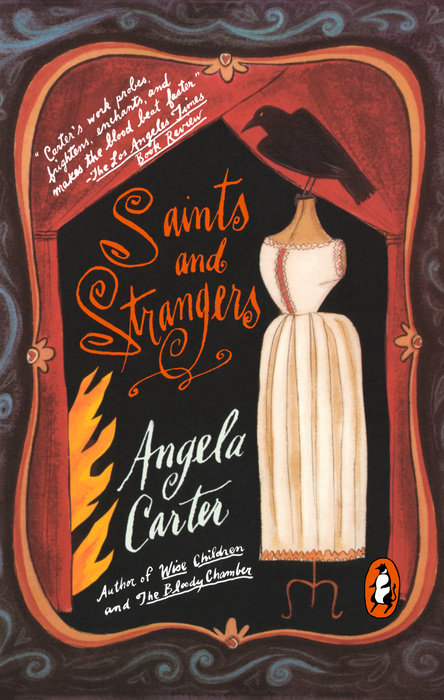
An alternate cover edition can be found here.Black Venus (also published as Saints and Strangers), is an anthology of short fiction. Angela Carter takes real people and literary legends - most often women - who have been mythologized or marginalized and recasts them in a new light. In a style that is sensual, cerebral, almost hypnotic, "The Fall River Axe-Murders" portrays the last hours before Lizzie Borden's infamous act: the sweltering heat, the weight of flannel and corsets, the clanging of the factory bells, the food reheated and reserved despite the lack of adequate refrigeration, the house "full of locked doors that open only into other rooms with other locked doors." In "Our Lady of the Massacre" the no-nonsense voice of an eighteenth-century prostitute/runaway slave questions who is civilized - the Indians or the white men? "Black Venus" gives voice to Charles Baudelaire's Creole mistress, Jeanne Duval: "you could say, not so much that Jeanne did not understand the lapidary, troubled serenity of her lover's poetry but, that it was a perpetual affront to her. He recited it to her by the hour and she ached, raged and chafed under it because his eloquence denied her language." "The Kiss" takes the traditional story of Tamburlaine's wife and gives it a new and refreshing ending. Sometimes disquieting, sometimes funny, always thought-provoking, Angela Carter's stories offer a feminist revision of images that lie deep in the public psyche.

Love is Angela Carter's fifth novel and was first published in 1971. With surgical precision it charts the destructive emotional war between a young woman, her husband and his disruptive brother as they move through a labyrinth of betrayal, alienation and lost connections. This revised edition has lost none of Angela Carter's haunting power to evoke the ebb of the 1960s, and includes an afterword which describes the progress of the survivors into the anguish of middle age.

Draws on de Sade's embodiments of women's two roles, Justine and Juliette, and on more contemporary models to argue that sexuality is a mode of power politics as well as a vital way to advance relationships admitting of neither conqueror nor conquered. Reprint.


Little Red Riding Hood, Cinderella & Other Classic Fairy Tales of Charles Perrault
by Angela Carter
Rating: 4.0 ⭐
Ten beloved fairy tales, given new life by the one and only Angela CarterLittle Red Riding Hood. Cinderella. Sleeping Beauty. Bluebeard. The Fairies. Many classic fairy tale characters might not have survived into the present were it not for Charles Perrault, a seventeenth-century French civil servant who rescued them from the oral tradition and committed them to paper. Three centuries later, Angela Carter, widely regarded as one of England’s most imaginative writers, adapted them for contemporary readers. The result is a cornucopia of fantastic characters and timeless adventures, stylishly retold by a modern literary visionary.For more than seventy years, Penguin has been the leading publisher of classic literature in the English-speaking world. With more than 1,700 titles, Penguin Classics represents a global bookshelf of the best works throughout history and across genres and disciplines. Readers trust the series to provide authoritative texts enhanced by introductions and notes by distinguished scholars and contemporary authors, as well as up-to-date translations by award-winning translators.

This marvelous collection of stories about bad girls, wicked women and unsatisfactory wives is designed to promote the female virtues of discontent, sexual disruptiveness and bad manners, and to give a positive role to women who will not put up with the status quo, and to hell with the consequences. Widely ranging in time and place, these subversive tales -- by Grace Paley, Bessie Head, Katherine Mansfield, Elizabeth Jolley, Djuna Barnes, Colette, Angela Carter, Jamaica Kincaid, Ama Ata Aidoo, Jane Bowles and many more -- all have one thing in common: to restore adventuresses and revolutionaries to the rightful position as models for all women, everywhere. Leonora Carrington's debutante swaps places with a hyena who exchanges the cage for the ball -- and goes dressed to kill. Christina Stead's seedy seducer is eventually wrecked by the utterly conventional bride. Some of these stories celebrate toughness and resilience, some of them low cunning: all of them are about not being nice.

The wolf is described as an evil thing. The first story is about a witch that turned a whole wedding ceremony into wolves. She likes them coming to her cabin and howling their misery for it soothes her. The following story is about a young lady and a man that are about to have sex on their wedding night. As they get ready, the husband says he needs to stop and relieve himself in the forest. The wife waits and he never returns. Off in the distance you can hear a wolf howling. She then figures her husband will never return and marries a new man. With her new husband she bears children. Her first husband comes back and sees his wife and the story unravels... Later we meet a girl walking in the woods. She was loved by everyone and feared nothing. She made a deal with a hunter; whoever can get to the grandmothers house first wins. If the hunter wins she owes him a kiss. She lets the hunter win because she wants to kiss him. The hunter arrives at the grandmothers house but she's frail and sick, holding a Bible for protection. The last thing she sees is the young man at the foot of her bed.... "See! sweet and sound she sleeps in granny's bed, between the paws of the tender wolf."

The scar drew her whole face sideways and even in profile, with the hideous thing turned away, her face was horribly lop-sided, skin, features and all, dragged away from the bone. She was a beautiful girl, a white and golden girl, like moonlight on daisies, a month ago.' And yet the men still hover around her, more out of curiosity than lust, and none more so than the wildly seductive, dangerous funny man, Honeybuzzard; lithe as a stick of liquorice, he is the demonic puppet master at the swirling centre of the tale. 'In a modern day horror story gleaming with perfect 1960's detail, she performs a double act, conjuring up just the right amount of unease and perversion beneath the idiosyncratic business of relatively ordinary lives' THE TIMES

(based upon a radio play called "Vampirella")A virginal English soldier, traveling through Romania by bicycle, finds himself in a deserted village. He comes across a mansion inhabited by a vampiress who survives by enticing young men into her bedroom and feeding on them. She intends to feed on the young soldier but his purity and virginity have a curious effect on her.

A collection of short stories which tear through the archives of cinema, of art and of the subconscious. A young Lizzie Borden visits the circus; a pianist makes a Faustian pact in a fly-blown Southern brothel; and a transfigured Mary Magdalene steps out of the canvases of Donatello and de la Tour.

'Curiosity is the most fleeting of pleasures; the moment is satisfied, it ceases to exist and it always proves very, very expensive.'Angela Carter's playful and subversive retellings of Charles Perrault's classic fairy tales conjure up a world of resourceful women, black-hearted villains, wily animals and incredible transformations. In these seven stories, bristling with frank, earthy humour and gothic imagination, nothing is as it seems.This book includes Bluebeard, Little Red Riding Hood, Puss in Boots, The Sleeping Beauty of the Wood, Cinderella: or, The Glass Slipper, Ricky with the Tuft and The Foolish Wishes.

Joseph - a 22-year-old self-styled nihilist in search of meaning, found releasing a badger from a zoo, seducing his best friend's mother, dancing at a Dionysic revel and spending his days in a mortuary - is the anti-hero at the heart of this novel.

A woman moves in with a mysterious "Milord", after her father loses her to him in a game of cards. He is eventually revealed to be a tiger. But in the end, transformations reinforce identities...

"An electrifying intellectual autobiography, with all the narrative expanse, drama, outrage, and high comedy of the author’s fiction. Angela Carter is revealed here, anew, as one of the most important thinkers of twentieth-century world literature—and one of its most pungent voices.”—Rick Moody One of contemporary literature’s most original and affecting fiction writers, Angela Carter also wrote brilliant nonfiction. Shaking a Leg comprises the best of her essays and criticism, much of it collected for the first time. Carter’s acute observations are spiked with her piercing matter-of-factness, her devastating wit, her penchant for mockery, and her passion for the absurd. Whether discussing films or food, feminism or fantasy, science fiction or sex, Carter consistently explores new territories and overturns old ideas. No cultural icon escapes her scrutiny; as in her fiction, Carter offers glorious evidence of the transforming power of the imagination. From delightfully wicked commentaries on Gone with the Wind , a Japanese fertility festival, and fellow writers, including Lawrence, Lovecraft, Borges, and Burroughs, to enchanting personal essays, Carter shares her thoughts and herself with glee. “What a wonderful collection—sharp, funny, too decent for sarcasm but great wit and humanity, an unusual combination. But it makes us miss her, miss laughing with her, that real, intelligent, tough writing woman.”—Grace Paley

A tale of a girl who goes visit her grandmother, but encounters a mysterious werewolf on the way...

WITH AN INTRODUCTION BY MICHAEL MOORCOCKAngela Carter was one of the most important and influential writers of our time: a novelist of extraordinary power and a searching critic and essayist.This selection of her writing, which she made herself, covers more than a decade of her thought and ranges over a diversity of subjects giving a true measure of the wide focus of her interests: the brothers Grimm; William Burroughs; food writing, Elizbaeth David; British writing: American writing; sexuality, from Josephine Baker to the history of the corset; and appreciations of the work of Joyce and Christina Stead.

a) The UnicornAs with the night-scented stock, the full splendour of the unicorn manifests itself most potently at twilight. Then the horn sprouts, swells, blooms in all its glory. SEE THE HORN(bend the tab, slit in slotmarked 'x')Despite being one of the most influential - and best-loved - of the post-war English writers, Angela Carter remains little-known as a poet. In Unicorn, the critic and historian Rosemary Hill collects together her published verse from 1963-1971, a period in which Carter began to explore the themes that dominated her later work: magic, the reworking of myths and their darker sides, and the overturning of literary and social conventions. With imagery at times startling in its violence and disconcerting in its presentation of sexuality, Unicorn provides compelling insight into the formation of a remarkable imagination. In the essay that accompanies the poems the critic and historian Rosemary Hill considers them in the context of Carter's other work and as an aspect of the 1960s, the decade which as Carter put it 'wasn't like they say in the movies'.

[Contiene le raccolte: Primi Racconti, 1962-1966 / Fuochi d'Artificio: nove pezzi profani, 1974 / La Camera di Sangue e altri racconti, 1979]Scomparsa al culmine della sua carriera, dotata di un estro narrativo magico e irraggiungibile, Angela Carter ha scritto romanzi e racconti, e sono stati proprio questi ultimi a consacrarla come una delle autrici più talentuose del ventesimo secolo."Nell’antro dell’alchimista" – diviso in due volumi di cui questo è il primo – raccoglie la produzione migliore di un’autrice fondamentale. "La camera di sangue", secondo Salman Rushdie il capolavoro per cui verrà sempre ricordata, è una serie di bellissime fiabe in chiave moderna, libere riscritture di quelle classiche, in cui l’autrice sbeffeggia gli stereotipi di genere affidando alla figura femminile le redini della storia, donandole un erotismo inedito e conducendola verso un finale vincente rimaneggiato in chiave ironica. "Fuochi d’artificio" nasce invece dall’esperienza dell’autrice in Giappone ed è il punto di svolta nella sua produzione, nonché il momento in cui il tema del femminismo diventa centrale: «In Giappone ho imparato cosa significa essere donna e mi sono radicalizzata».Ai tesori custoditi all’interno di questa magistrale raccolta Angela Carter ha affidato il proprio testamento stilistico, servendosi di una scrittura raffinata, barocca, a tratti ermetica e costruendo una nuova mitologia femminista con cui condurre un’acuta analisi della società che supera le barriere del tangibile e penetra i meandri dell’immaginazione. Queste pagine, semplicemente, sono la testimonianza di una perdita incolmabile per la letteratura.«Le sue cose migliori, secondo me, sono i racconti. La camera di sangue è il capolavoro della Carter. Probabilmente sarà il libro per cui verrà ricordata per sempre».dall’introduzione di Salman Rushdie«Una scrittrice raffinata dallo stile bizzarro, originale, barocco».Margaret Atwood«Talentuosa e fantasiosa scrittrice. L’immaginazione di Angela Carter non ha confini».Joyce Carol Oates

A maiden wanders into the woods and is seduced by the sinister Erl-King, a seeming personification of the forest itself. However, she eventually realizes his plans and takes action...

Bela's father, after experiencing car trouble, takes advantage of a stranger's hospitality...