
Andrew David Naselli
Andrew David Naselli (PhD, Bob Jones University; PhD, Trinity Evangelical Divinity School) is associate professor of New Testament and theology at Bethlehem College & Seminary in Minneapolis, Minnesota and an elder of Bethlehem Baptist Church.
16 Books Written

“I will put enmity between you and the woman, and between your offspring and her offspring; he shall bruise your head, and you shall bruise his heel.”― Genesis 3:15 We’ve all heard this story: the hero fights a dragon in an epic battle, and just as it appears the dragon is going to prevail, the hero saves the day. Best-selling novels and blockbuster movies are filled with this type of story, but did you know that this is the main theme of the Bible too? Tracing the theme of serpents and dragons through both Testaments, trusted scholar Andrew David Naselli demonstrates that these stories reflect our desire to know the ultimate story―the struggle between God’s offspring and the offspring of the serpent. As we come to experience this captivating, unifying narrative, we will rejoice in the ultimate victory of Jesus―the serpent slayer―over the devouring dragon in Revelation.

Conscience: What It Is, How to Train It, and Loving Those Who Differ
by Andrew David Naselli
Rating: 4.4 ⭐
Christian, meet your conscience. What do you do when you disagree with other Christians? How do you determine which convictions are negotiable and which are not? How do you get along with people who have different personal standards? All of these questions have to do with the conscience. Yet there is hardly a more neglected topic among Christians. In this much-needed book, a New Testament scholar and a cross-cultural missionary explore all thirty passages in the New Testament that deal with the conscience, showing how your conscience impacts virtually every aspect of life, ministry, and missions. As you come to see your conscience as a gift from God and learn how to calibrate it under the lordship of Jesus Christ, you will not only experience the freedom of a clear conscience but also discover how to lovingly interact with those who hold different convictions.

When people ask me what I do for a living, sometimes I reply, “I teach people how to read.” My paid vocation is to train graduate-level students to be faithful and fruitful pastors, and that requires the ability to read well. But it’s not just graduate-level students who need tips on how to read better. Any literate Christian—from high school students to scholars—can improve, and I aim in this book to help you take your reading to the next level.

No Quick Fix: Where Higher Life Theology Came From, What It Is, and Why It's Harmful
by Andrew David Naselli
Rating: 4.3 ⭐
Every Christian struggles with sin and wants to be victorious in the fight.Higher life theology--also known as Keswick theology--offers a quick fix for this struggle. It teaches that there are two categories of those who are merely saved, and those who have really surrendered to Christ. Those who have Jesus as their Savior alone, and those who have him as their Master as well. If Christians can simply "let go and let God" they can be free of struggling with sin and brought to that higher level of spiritual life. What could be wrong with that?A lot, it turns out. In No Quick Fix , a shorter and more accessible version of his book Let Go and Let God? , Naselli critiques higher life theology from a biblical perspective. He shows that it leads not to freedom, but to frustration, because it promises something it has no power to deliver. Along the way, he tells the story of where higher life theology came from, describes its characteristics, and compares it to what the Bible really says about how we overcome sin and become more like Christ.
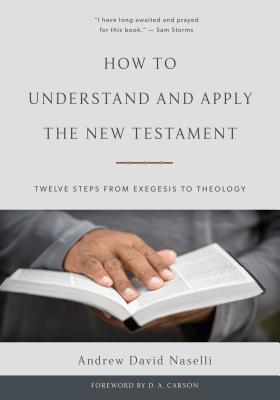
How to Understand and Apply the New Testament: Twelve Steps from Exegesis to Theology
by Andrew David Naselli
Rating: 4.4 ⭐
In the New Testament, the good news of God's plan of salvation shines forth. The richness of these Scriptures rewards any level of studybut there are particular ways such study can be done well. In his easy-to-understand guide to New Testament exegesis, Andrew Naselli explains and illustrates each step of a logical twelve-stage interpretive process that can be used with benefit by pastors, scholars, teachers, and laypeople. Move from genre to textual criticism, take Greek grammar and literary context into account, and journey through the passage all the way to practical application. Learn how to track an author's thought-flow, grasp the text's message, and apply the ancient Word in this modern world, all in light of Christ's redeeming work. Then plunge into Naselli's recommended resources to go further in your studies every step of the way.

A Concise, Verse-by-Verse Commentary on the Book of Romans, Perfect for Individual or Group Study Martin Luther called the book of Romans the “chief part of the New Testament” and “the purest gospel.” The apostle Paul’s letter to the Romans has had arguably the largest influence on believers throughout church history. Paul systematically and formally articulates the gospel of Jesus Christ―the righteousness God gives to sinful humans through faith. Scholar and author Andrew David Naselli traces Paul’s argument for the gospel throughout this concise and accessible guide to the book of Romans. Designed to be read alongside the epistle itself, it provides accessible, standalone commentary unpacking the text verse by verse. This volume dives into the key themes of righteousness, peace, and God’s promises, accompanied by reflection questions on interpretation and application―perfect for individual or group study.

Three Views on Israel and the Church: Perspectives on Romans 9–11
by Andrew David Naselli
Rating: 4.0 ⭐
A comparison of three major views on the relationship between Israel and the churchThe relationship between Israel and the church is a long-standing debate in Christian theology, and Romans 9–11 are the most important chapters for understanding it. How one interprets these chapters determines how one understands biblical theology, how the New Testament uses the Old Testament, and how the old and new covenants are related.To help readers draw their own conclusion, four leading scholars on this issue present a case for their viewpoint, followed by a response and critique from the others. Michael Vlach argues for a future mass conversion and a role for ethnic Israel in the church. Fred Zaspel and Jim Hamilton present a case for a future mass conversion that does not include a role for ethnic Israel. And Benjamin Merkle contends that Romans 9 - 11 promises neither a future mass conversion nor a role for ethnic Israel.General editor Andrew David Naselli helpfully sets the debate in its larger biblical-theological context in the introduction, while Jared Compton provides a useful summary of the views and interactions at the end of the volume.

When that little voice in your head tells you that you shouldn't be doing what you're doing, do you listen to it?Emma is a little girl whose Mommy explains to her that the little voice in her head is her conscience, a gift from God that tells her whether something is wrong or right. She explains how we can have a clean conscience because of Jesus, and how we train our consciences to work better by understanding the Bible.

Keswick theology—one of the most significant strands of second-blessing theology—assumes that Christians experience two “blessings.” The first is getting “saved,” and the second is getting serious. The change is dramatic: from a defeated life to a victorious life, from a lower life to a higher life, from a shallow life to a deeper life, from a fruitless life to a more abundant life, from being “carnal” to being “spiritual,” from merely having Jesus as your Savior to making Jesus your Master. So how do people experience this second blessing? Through surrender and faith: “Let go and let God.”Second-blessing theology is pervasive because countless people have propagated it in so many ways, especially in sermons and devotional writings. It is appealing because Christians struggle with sin and want to be victorious in that struggle—now. Second-blessing theology offers a quick fix to this struggle, and its shortcut to instant victory appeals to genuine longings for holiness.This book’s thesis is simple: Keswick theology is not biblically sound. This book tells the story of where Keswick theology comes from, explains what exactly it is, and then refutes it while building a case for a biblical alternative. No other book surveys the history and theology of second-blessing theology like this and then analyzes it from a soteriologically Reformed perspective.

The Mentoring Project’s flagship mentoring resource is its field guides. These long-form pieces provide practical guidance on various aspects of life as a Christian, like finances, purity, technology, work, and more. Written by pastors and other Christian leaders, these field guides provide a biblical framework for mentors and mentees to discuss these topics and grow together.

From Typology to Doxology: Paul's Use of Isaiah and Job in Romans 11:34-35
by Andrew David Naselli
Rating: 3.9 ⭐
At the end of Romans 11, Paul quotes both Isaiah and Job. As with other New Testament uses of Old Testament texts, this raises several questions. What is the context of these Old Testament passages? How are they used in other Jewish literature? What is Paul's hermeneutical warrant for using them in Romans 11? What theological use does Paul make of them? How, if at all, does their use in Romans 11 contribute to the broader discussion on the use of the Old Testament in the New? In addressing these questions, this book reveals a remarkable typological connection that climaxes in the doxology of Romans 11:33-36, exalting God's incomprehensibility, wisdom, mercy, grace, patience, independence, and sovereignty.

New Testament Exegesis : Understanding and Applying the New Testament
by Andrew David Naselli
Rating: 4.3 ⭐
OVERVIEWWhen people interpret the Bible, even though they may have the best motives in the world, they can still read their ideas into the Bible rather than draw out what the author originally intended to mean. Don’t miss the whole point of exegesis. It’s to know and worship God. Dr. Naselli will help you exegete the New Testament texts in a way that spreads a passion for the supremacy of God in all things for the joy of all peoples through Jesus Christ by exploring the concepts of genre, theology, translation, and much more. Exegesis and theology are thrilling because they help you know and worship God, and only God satisfies.LEARNING OBJECTIVESUpon successful completion you should be able to:- Understand characteristics that make for a great Bible translation- Describe the rationale behind interpretive decisions that remain faithful to the intent of the original author- Recognize key Scriptural phrases and their meaningCOURSE OUTLINEIntroduction- Introducing the Speaker and CourseUnit 1: Introduction to Exegesis and Theology- What Is Exegesis?- Twelve Steps for Exegesis and Theology- Exegesis vis-à-vis Theology- Study vis-à-vis Prayer- Organizing Your Theological Library- Resources: ExegesisUnit 2: Genre- Starting with Text Criticism or with Genre- Principles for Interpreting the Bible- Interpreting Figures of Speech- Genres in the Gospels and Acts- Interpreting the Gospels and Acts- Interpreting Parables- Example: Prodigal Son (Luke 15)- Interpreting the Epistles- Interpreting the Book of Revelation- Resources: GenreUnit 3: Textual Criticism- What Is Textual Criticism?- Evaluating Variant Readings- KJV-Only and Inerrancy- Example (1 Cor 13:3)- Resources: Text CriticismUnit 4: Translation- Four Qualities of an Excellent Translation- Approaches to Bible Translation- Comparing Contemporary Translations- Comparing the NASB with the ESV and NIV- How to Disagree about Bible Translation Philosophy- Alternative to Bickering (Part 1)- Alternative to Bickering (Part 2)- Translating Figurative Language and Cultural Issues- Importance of Dignified Translations- Translating with Gender Accuracy- Footnotes in Bible Translations- Translation Examples- Resources: TranslationUnit 5: Greek Grammar- Basics of Greek Grammar (Part 1)- Basics of Greek Grammar (Part 2)- Exegetically Significant Words, Phrases, and Clauses- Analyzing the Nominative Case- Analyzing the Genitive Case- Analyzing the Dative Case- Analyzing the Accusative Case- Analyzing Articles- Analyzing Verbal Aspect- Analyzing the Infinitives- Analyzing Participles (Part 1)- Analyzing Participles (Part 2)- Analyzing Antecedents of Pronouns- Resources: Greek GrammarUnit 6: Diagramming an Argument- Tracing the Argument in Greek- Propositional Relations- Creating an Argument Diagram- Eight Steps for Phrasing- Phrasing for Tracing the Argument- Phrasing 1 Peter 5:6–7- Phrasing Matthew 28:19–20a- Phrasing Jude 20–21- Phrasing Romans 11:33–36- Phrasing Colossians 1:9–14- Phrasing Romans 3:21–26- Resources: DiagrammingUnit 7: Historical-Cultural Context- The Need for Background Information- Examples Where Background Information Is Necessary- Sufficiency and Clarity of Scripture- Questions for Analyzing the Historical-Cultural Context- Mirror Reading- Primary Sources for Historical-Cultural Context- Using Jewish and Graeco-Roman Resources- Example: Eye of a Needle (Matt 19:24)- Example: Rhetoric (1 Cor 2:1–5)- Resources: Historical-Cultural ContextUnit 8: Literary Context- Levels of the Literary Context- The New Testament in Ten Minutes- Suggestions for Reading in Literary Context- Memorizing an Entire New Testament Book- Example: “Judge Not” (Matt 7:1)- Example: “I Can Do All Things” (Phil 4:13)- Resources: Literary ContextUnit 9: Word Studies- The Importance of Word Studies- Four Steps for Doing a Word Study- What to Avoid in Word Studies (Part 1)- What to Avoid in Word Studies (Part 2)- A Thought Experiment on Poor Commentaries- Example: συνείδησις (“Conscience”)- Example: σάρξ and πνεῦμα (“Flesh” and “Spirit”)- Example: μὴ γένοιτο (“God Forbid!”)- Resources: Word StudiesUnit 10: Biblical Theology- Where We Are on the Exegetical-Theological Map- What Is Biblical Theology? (Part 1)- What Is Biblical Theology? (Part 2)- Illustration: Harry Potter- Example: Holiness- Example: Temple (1 Cor 6:19–20)- Example: Mystery (Eph 3:1–6)- Example: Work- Motivation to Do Biblical Theology- Resources: Biblical TheologyUnit 11: Historical Theology- Survey of Historical Theology, and Significant Exegetes and Theologians- Reasons to Study Historical Theology (Part 1)- Reasons to Study Historical Theology (Part 2)- Example: Keswick Theology- Resources: Historical TheologyUnit 12: Systematic Theology- What I...


La serpiente y el que mata a la serpiente (Estudios Breves de Teología Bíblica)
by Andrew David Naselli
Rating: 5.0 ⭐

The Serpent and the Serpent Slayer: Short Studies in Biblical Theology
by Andrew David Naselli
“I will put enmity between you and the woman, and between your offspring and her offspring; he shall bruise your head, and you shall bruise his heel.”―Genesis 3:15We’ve all heard this the hero fights a dragon in an epic battle, and just as it appears the dragon is going to prevail, the hero saves the day. Best-selling novels and blockbuster movies are filled with this type of story, but did you know that this is the main theme of the Bible too?Tracing the theme of serpents and dragons through both Testaments, trusted scholar Andrew David Naselli demonstrates that these stories reflect our desire to know the ultimate story―the struggle between God’s offspring and the offspring of the serpent. As we come to experience this captivating, unifying narrative, we will rejoice in the ultimate victory of Jesus―the serpent slayer―over the devouring dragon in Revelation.
Predestination: An Introduction
by Andrew David Naselli
A Concise and Systematic Exploration of the Doctrine of PredestinationHow can God choose to save some and eternally punish others? What about my loved ones who are not believers? For many, contemplating predestination brings about fear, trepidation, controversy, and emotional exhaustion, making it a difficult topic to study―let alone view as a blessing.This addition to the Short Studies in Systematic Theology series carefully examines God’s word to answer 15 commonly asked questions regarding the doctrines of election and reprobation. With many helpful tools, this concise guide is perfect for all believers who want to discover and delight in what God has revealed throughout Scripture. Listeners will not only learn how God saves his people from their sins, but will be stirred to respond to him in worship.Great for Theologians, Pastors, and Designed to be short and approachable, this concise study dives deep into the doctrine of predestination Part of the Short Studies in Systematic Theology Other titles include The Person of Christ; Glorification; and The Doctrine of Scripture Written by Andrew David Pastor and professor of systematic theology and New Testament