
Amitava Kumar
Amitava Kumar is a novelist, poet, journalist, and Professor of English at Vassar College. He was born in Bihar, India; he grew up in the town of Patna, famous for its corruption, crushing poverty, and delicious mangoes. He is the author of Nobody Does the Right Thing; A Foreigner Carrying in the Crook of His Arm a Tiny Bomb; Husband of a Fanatic: A Personal Journey through India, Pakistan, Love, and Hate, a New York Times “Editors’ Choice” selection; Bombay—London—New York, a New Statesman (UK) “Book of the Year” selection; and Passport Photos. He is the editor of several books, including Away: The Indian Writer as an Expatriate, The Humour and the Pity: Essays on V. S. Naipaul, and World Bank Literature. He is also an editor of the online journal Politics and Culture and the screenwriter and narrator of the prize-winning documentary film Pure Chutney. Kumar’s writing has appeared in The Nation, Harper’s, Vanity Fair, The American Prospect, The Chronicle of Higher Education, The Hindu, and other publications in North America and India.
19 Books Written

A NEW YORK TIMES NOTABLE BOOK ONE OF THE NEW YORKER'S BEST BOOKS OF THE YEARCarrying a single suitcase, Kailash arrives in post-Reagan America from India to attend graduate school. As he begins to settle into American existence, Kailash comes under the indelible influence of a charismatic professor, and also finds his life reshaped by a series of very different women with whom he recklessly falls in and out of love.Looking back on the formative period of his youth, Kailash's wry, vivid perception of the world he is in, but never quite of, unfurls in a brilliant melding of anecdote and annotation, picture and text. Building a case for himself, both as a good man in spite of his flaws and as an American in defiance of his place of birth, Kailash weaves a story that is at its core an incandescent investigation of love--despite, beyond, and across dividing lines.

It is not only the past that lies in ruins in Patna, it is also the present. But that is not the only truth about the city that Amitava Kumar explores in this vivid, entertaining account of his hometown. We accompany him through many Patnas, the myriad cities locked within the city—the shabby reality of the present-day capital of Bihar; Pataliputra, the storied city of emperors; the dreamlike embodiment of the city in the minds and hearts of those who have escaped contemporary Patna's confines. Full of fascinating observations and impressions, A Matter of Rats reveals a challenging and enduring city that exerts a lasting pull on all those who drift into its orbit.Kumar's ruminations on one of the world's oldest cities, the capital of India's poorest province, are also a meditation on how to write about place. His memory is partial. All he has going for him is his attentiveness. He carefully observes everything that surrounds him in rats and poets, artists and politicians, a girl's picture in a historian's study, and a sheet of paper on his mother's desk. The result is this unique book, as cutting as it is honest.

An exceptionally moving novel that traces the arc of a man's life from his 1935 birth in a small village in India to his death from COVID-19 in 2020Jadunath Kunwar's beginnings are humble, even inauspicious. While pregnant, his mother nearly dies from a cobra bite--and this is only the first of many challenges in store for Jadu. As his life skates between the mythical and the mundane, he finds meaning in the most unexpected places. He becomes a historian. He has a daughter who becomes a television journalist and then escapes her marriage for a career in the United States. And he sees currents of huge change sweep across India—from Independence to Partition, Gandhi to Modi, the Mahabharata to Somerset Maugham—in ways that Jadu is both apart from and can't help but represent.

A blistering novel about fake news, memory, and the ways in which truth gives over to fiction When Satya, a professor and author, attends a prestigious artist retreat to write, he finds the pressures of the outside world won't let up: the president rages online; a dangerous virus envelopes the globe; and the twenty-four-hour news cycle throws fuel on every fire. For most of the retreat fellows, such stories are unbearable distractions, but for Satya, who sees them play out in both America and his native India, these Orwellian interruptions begin to crystallize into an idea for his new novel, Enemies of the People, about the lies we tell ourselves and one another. Satya scours his life for instances in which truth bends toward the imagined and misinformation is mistaken as fact.Mixing Satya's experiences—as a father, husband, and American immigrant—with newspaper clippings, the president's tweets, and observations on famous works of art, A Time Outside This Time captures a feverish political moment with intelligence, beauty, and an eye for the uncanny. It is a brilliant interrogation on life in a post-truth era and an attempt to imagine a time outside this one.

'In those terrible days of the lockdown during the pandemic, we were all waiting. We were waiting for things to be all right. And one day, they will indeed be all right. But the dead will never come back. The businesses that have closed and will not reopen; the dreams dashed; the families and relationships that could not withstand the strain. This is why it is important to note down all the changes in our lives. Write them down in a journal. When we do that, we are recording our own history.'-Drawing as a way of keeping a diary, writing down thoughts in a journal as a way of maintaining a historical record - in watercolours and also in words.These were resources that Amitava Kumar had been using even before the pandemic arrived. But the task gained urgency just when he felt most isolated and afraid. The Blue Book is a writer's artistic response to our present world: one that has bestowed upon us countless deaths from a virus, a flood of fake news, but also love in the face of loss, travels through diverse landscapes, and - if we care to notice - visions of blazing beauty.From one of the acclaimed and accomplished authors of our time, this writer's journal is a panoramic portrait of the experience, both individual and collective, of the pandemic.-'To mull over a beautiful line while looking upon a beautiful painting is the sublime pleasure offered by Amitava Kumar's The Blue Book. This painted diary is a collage of the personal and the political, of terrifying news, the fleeting seasons, everyday pleasures, precious conversations, families and friendships-and on every page, the solace of art.' -- KIRAN DESAI'A lovely homage to--and extension of--the tradition of writer-artists such as John Berger.' -- GEOFF DYER'It's not good to read another person's diary. But Amitava Kumar makes the experience so intimate in The Blue Book that you don't feel guilty. You feel like it is your own.' -- GULZAR
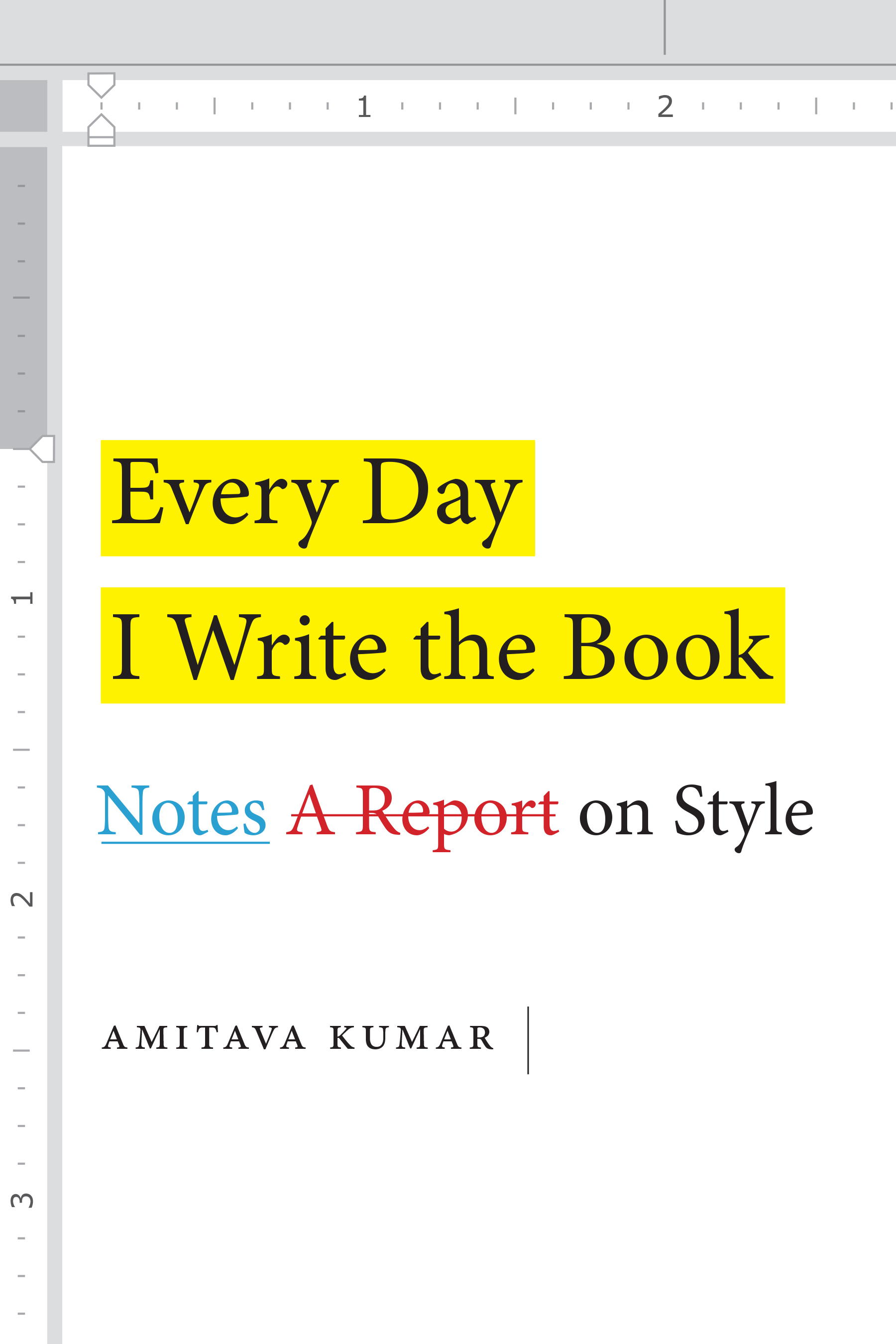
Amitava Kumar's Every Day I Write the Book is for academic writers what Annie Dillard's The Writing Life and Stephen King's On Writing are for creative writers. Alongside Kumar's interviews with an array of scholars whose distinct writing offers inspiring examples for students and academics alike, the book's pages are full of practical advice about everything from how to write criticism to making use of a kitchen timer. Communication, engagement, these are the aims and sources of good writing. Storytelling, attention to organization, solid work these are its tools. Kumar's own voice is present in his essays about the writing process and in his perceptive and witty observations on the academic world. A writing manual as well as a manifesto, Every Day I Write the Book will interest and guide aspiring writers everywhere.

To be a writer, Amitava Kumar says, is to be an observer. The twenty-six essays in Lunch With a Bigot are Kumar's observations of the world put into words. A mix of memoir, reportage and criticism, the essays include encounters with writers Salman Rushdie and Arundhati Roy, discussions on the craft of writing, and a portrait of the struggles of a Bollywood actor. The title-essay is Kumar's account of his visit to a member of an ultra-right Hindu organization who put him on a hit-list. In these and other essays, Kumar tells a broader story of immigration, change, and a shift to a more globalized existence, all the while demonstrating how he practices being a writer in the world.

Husband of a Fanatic: A Personal Journey Through India, Pakistan, Love, and Hate
by Amitava Kumar
Rating: 3.4 ⭐
"In the summer of 1993, while India and Pakistan were engaged in a war, Amitava Kumar - a Indian Hindu writer living and teaching in the United States - married a Pakistani Muslim woman. That event led to a process of discovery that prompted Kumar to examine the hatreds and intimacies joining Indians and Pakistanis, Hindus and Muslims, fundamentalists and secularists, writers and rioters." In Husband of a Fanatic, Kumar chronicles the entanglements that his new marriage provoked - from ambivalent encounters with family to his disquieting lunch with the amiable bigot who had posted Kumar's name on his Web site blacklist of Hindu traitors. Kumar also travels across the South Asian continent, visiting a classroom in riot-torn Gujarat, a village beside the Ganges, a psychiatric ward in Kashmir. With a poet's eye for detail, Kumar draws a map of violence, moving from the wars and nuclear rivalry dividing two nation-states to the more blurred relationship between two religions and their adherents.

Part reportage and part protest, A Foreigner Carrying in the Crook of His Arm a Tiny Bomb is an inquiry into the cultural logic and global repercussions of the war on terror. At its center are two men convicted in U.S. courts on terrorism-related Hemant Lakhani, a seventy-year-old tried for attempting to sell a fake missile to an FBI informant, and Shahawar Matin Siraj, baited by the New York Police Department into a conspiracy to bomb a subway. Lakhani and Siraj were caught through questionable sting operations involving paid informants; both men received lengthy jail sentences. Their convictions were celebrated as major victories in the war on terror. In Amitava Kumar’s riveting account of their cases, Lakhani and Siraj emerge as epic bunglers, and the U.S. government as the creator of terror suspects to prosecute. Kumar analyzed the trial transcripts and media coverage, and he interviewed Lakhani, Siraj, their families, and their lawyers. Juxtaposing such stories of entrapment in the United States with narratives from India, another site of multiple terror attacks and state crackdowns, Kumar explores the harrowing experiences of ordinary people entangled in the war on terror. He also considers the fierce critiques of post-9/11 surveillance and security regimes by soldiers and torture victims, as well as artists and writers, including Coco Fusco, Paul Shambroom, and Arundhati Roy.

First published in 2003.When Amitava Kumar left Patna, India, he envisioned himself as an up-and-coming citizen of the world, leaving behind the confines of Indian traditions. Yet like the wave of exiles that preceded him, he found that once we leave our past, we are defined by in the U.S. he is pigeonholed by his appearance and quizzed about saris and arranged marriages. BR>There is no beginning that is a blank page, writes Kumar. Circling the three capitals of the Indian diaspora, Bombay-London-New York captures the contours of the expatriate experience, touching on the themes of abandonment, nostalgia, and exile that have powered some of the most prominent Indian writers today -- Naipaul, Rushdie, Roy, Kureishi, as well as E.M. Forster and Gandhi. BR>With resonant, poetic language and a storyteller's sensibility, Kumar explores the works of these writers through the lens of his own life as an immigrant and writer. As their fiction reveals, the past of the expatriate is mythical,shaped by memory and loss. BR>With tales of life in India and London and meditations on the form Indian fiction gives to the lives of those who read about it, this is a sweeping, passionate search to find one's own story in the stories of others.

Passport Photos , a self-conscious act of artistic and intellectual forgery, is a report on the immigrant condition. A multigenre book combining theory, poetry, cultural criticism, and photography, it explores the complexities of the immigration experience, intervening in the impersonal language of the state. Passport Photos joins books by writers like Edward Said and Trinh T. Minh-ha in the search for a new poetics and politics of diaspora.Organized as a passport, Passport Photos is a unique work, taking as its object of analysis and engagement the lived experience of post-coloniality--especially in the United States and India. The book is a collage, moving back and forth between places, historical moments, voices, and levels of analysis. Seeking to link cultural, political, and aesthetic critiques, it weaves together issues as diverse as Indian fiction written in English, signs put up by the border patrol at the U.S.-Tijuana border, ethnic restaurants in New York City, the history of Indian indenture in Trinidad, Native Americans at the Superbowl, and much more.The borders this book crosses again and again are those where critical theory meets popular journalism, and where political poetry encounters the work of documentary photography. The argument for such border crossings lies in the reality of people's lives. This thought-provoking book explores that reality, as it brings postcolonial theory to a personal level and investigates global influences on local lives of immigrants.

One day passes. Then another. A whole succession of days turning into months and years. How to mark our separate days? The places we have been. Our individual passions, our pain. Against the blurring of years, the clarity of a record. And even amidst crises, how to keep creativity alive?Also, how to stop time?After the first wave of Covid had passed, the lockdown was lifted and travel resumed in earnest. Amitava Kumar found himself in London with a group of American students on a study tour-in the midst of the Omicron wave. A year later, he was in India, in his native Motihari among other places. Meanwhile, Russia attacked Ukraine and Rushdie was assaulted with a knife in upstate New York. Amitava kept a journal-to record the times he was living through and how he would like to remember them.In these pages, through words and drawings, an acclaimed author and artist reveals how a writer observes the world around us-and the world inside us. The Yellow Book, like The Blue Book, shows us how we can put together not just a journal or a book, but also how we assemble a life; and, in our troubled times, why we must plant memories and continue to believe in spring.

When Lord Macaulay introduced English as the instrument of education in India, healso bequeathed to us a legacy of language-use that is often stiff and bureaucratic. Thisawkwardness plagues academic, journalistic, legal, even creative writing in India.You fail as a writer if your writing is not concrete, if it is vague and abstract, and your readeris unable to see what you mean. Writing Badly is Easy is a style guide for those who want towrite well. It presents advice given by award-winning creative writers—including JonathanFranzen, Jennifer Egan, Suketu Mehta, Marilynne Robinson, George Saunders and ColsonWhitehead—and noted thinkers like Alain de Botton, Andrew Ross, Anna Tsing, KathleenStewart and Rob Nixon, as well as numerous others. Amitava Kumar’s own essays on writing,including his collaboration with Teju Cole, demonstrate the importance of blurring the linebetween critical and creative writing. A manifesto for writing that is exuberant, imaginativeand playful, Writing Badly is Easy will change the way you think about reading and writing,and reveal the pleasures to be had in the inventive use of language.

A young poet is killed by her lover, a politician, in the eastern Indian state of Bihar. Soon afterward, across India in Bombay, an idealistic journalist is hired by a movie director to write a Bollywood screenplay about the murdered poet. Research for the script takes the writer, Binod, back to Bihar, where he and his cousin Rabinder were raised. While the high-minded Binod struggles to turn the poet’s murder into a steamy tale about small towns, desire, and intrigue, Rabinder sits in a Bihari jail cell, having been arrested for distributing pornography through a cybercafé. Rabinder dreams of a career in Bollywood filmmaking, and, unlike his cousin, he is not burdened by ethical scruples. Nobody Does the Right Thing is the story of these two cousins and the ways that their lives unexpectedly intertwine. Set in the rural villages of Bihar and the metropolises of Bombay and Delhi, the novel is packed with telling details and anecdotes about life in contemporary India. At the same time, it is a fictional investigation into how narratives circulate and vie for supremacy through gossip, cinema, popular fiction, sensational journalism, and the global media.

Many of the drawings and paintings in this book are the result of the walks I have undertaken. Don't stop walking! And keep a journal. What you draw is a way of keeping a diary, of course, but also write words to record what you see.On a fast-heating planet, it has become more important than ever to hold on to every vestige of hope. We must save every drop of creativity to imagine new futures. We must remember that like leafy trees, art also offers us shade, and that literature quenches our thirst for finding the right words for every emotion.In these pages, the acclaimed author Amitava Kumar shows us that great literature often begins as jottings made in writers' notebooks. His examples extend from Virginia Woolf and John Berger to Mohandas Gandhi and Shiva Naipaul. In Kumar's own notebooks, we find written accounts and drawings of travels across among mountains and rivers, walks in parks and journeys on highways, even a visit to a prison. In each instance, we discover what comes from noticing. There are many ways of seeing-but seeing is, in fact, being.The third book in the series that started with The Blue Book and continued with The Yellow Book, The Green Book gives us a profound insight into the mind of a writer who observes closely and attempts to capture in images and words what is happening to the world around us.


World Bank literature is more than a concept -- it is a provocation, a call to arms. It is intended to prompt questions about each word, to probe globalization, political economy, and the role of literary and cultural studies. As asserted in this major work, it signals a radical rewriting of academic debates, a rigorous analysis of the World Bank and the International Monetary Fund (IMF), and a consideration of literature that deals with new global realities. Made more relevant than ever by momentous antiglobalization demonstrations in Seattle and Genoa, World Bank Literature brings together essays by a distinguished group of economists, cultural and literary critics, social scientists, and public policy analysts to ask how to understand the influence of the World Bank/IMF on global economic power relations and cultural production. The authors attack this question in myriad ways, examining World Bank/IMF documents as literature; their impact on developing nations; the relationship between literature and globalization; the connection between the academy and the global economy; and the emergence of coalitions confronting the new power. World Bank Literature shows, above all, the multifarious and sometimes nefarious ways that abstract academic debates play themselves out concretely in social policy and cultural mores that reinforce traditional power structures.

Not everyone is innocent but 95 per cent are Bureaucratic in its convolutions and brutal in its deceptions, the war on terror has had an impact on our lives that we do not yet understand. We sense it. A growing claustrophobia, wariness, suspicion, the stickiness of constant surveillance. But for those who are actually entangled in it, the trap has teeth and they are fierce. Author and teacher Amitava Kumar examines the mangled lives of some of those who tripped. In a US court Hemant Lakhani, an old man with a congenital heart condition, stands trial for selling a fake missile to an FBI informant; in another court Shahawar Matin Siraj, inveigled by the FBI into a conspiracy to bomb a subway, is sentenced to thirty years in prison. In New Delhi Kumar interviews S.A.R. Geelani, the mild-mannered professor apprehended for the 2001 Parliament attack, jailed and tortured. He also tries to speak to Tabassum Guru, the wife of the man on death row for the same attack, at the Sopore hospital in which she works. A few kilometres away, in Srinagar, he visits an army camp, where he sees the peculiarities that develop in an everyday battle-zone that is also a living, working city. And, he catalogues, with the critic's compass and a curator's zeal, the fierce renewal in art and literature that has evolved out of the war. Spanning the subcontinents of India and the USA, part reportage, part philosophy, part protest, this is a book whose importance cannot be exaggerated. Its intellectual power and moral force will keep the reader pinned to the page.

No Tears for the NRI: A First Book of Poems
by Amitava Kumar
SIGNED COLLECTIBLE VERY GOOD FIRST EDITION hardcover, clean text, solid binding, no remainders, NOT ex-library, slight shelfwear; WE SHIP FAST. 201308314 "For Abdul, in solidarity Amitava 1996" 78 It is a collection of twenty-eight poems on topics like History, The Moon over Harijan Tola, The Police Testify That, Mistaken Identity, Sex in Sedone, Lord Macualay's Tail, and Iraqi Restaurant. We recommend Priority Mail where/when available -- $3.99 Standard / Media Mail can take up to 15 business days.