
Alisa Smith
The book Plenty has different subtitles in hardcover and paperback and the Canadian edition was called The 100-Mile Diet. Alisa Smith, a Vancouver-based freelance writer who has been nominated for a National Magazine Award, has been published in Outside, Explore, Canadian Geographic, Reader’s Digest, Utne, and many other periodicals. The books Way Out There and Liberalized feature her work.
8 Books Written

The remarkable, amusing and inspiring adventures of a Canadian couple who make a year-long attempt to eat foods grown and produced within a 100-mile radius of their apartment.When Alisa Smith and James MacKinnon learned that the average ingredient in a North American meal travels 1,500 miles from farm to plate, they decided to launch a simple experiment to reconnect with the people and places that produced what they ate. For one year, they would only consume food that came from within a 100-mile radius of their Vancouver apartment. The 100-Mile Diet was born.The couple’s discoveries sometimes shook their resolve. It would be a year without sugar, Cheerios, olive oil, rice, Pizza Pops, beer, and much, much more. Yet local eating has turned out to be a life lesson in pleasures that are always close at hand. They met the revolutionary farmers and modern-day hunter-gatherers who are changing the way we think about food. They got personal with issues ranging from global economics to biodiversity. They called on the wisdom of grandmothers, and immersed themselves in the seasons. They discovered a host of new flavours, from gooseberry wine to sunchokes to turnip sandwiches, foods that they never would have guessed were on their doorstep.The 100-Mile Diet struck a deeper chord than anyone could have predicted, attracting media and grassroots interest that spanned the globe. The 100-Mile A Year of Local Eating tells the full story, from the insights to the kitchen disasters, as the authors transform from megamart shoppers to self-sufficient urban pioneers. The 100-Mile Diet is a pathway home for anybody, anywhere.Call me naive, but I never knew that flour would be struck from our 100-Mile Diet. Wheat products are just so ubiquitous, “the staff of life,” that I had hazily imagined the stuff must be grown everywhere. But of I had never seen a field of wheat anywhere close to Vancouver, and my mental images of late-afternoon light falling on golden fields of grain were all from my childhood on the Canadian prairies. What I was able to find was Anita’s Organic Grain & Flour Mill, about 60 miles up the Fraser River valley. I called, and learned that Anita’s nearest grain suppliers were at least 800 miles away by road. She sounded sorry for me. Would it be a year until I tasted a pie?—From The 100-Mile DietFrom the Hardcover edition.
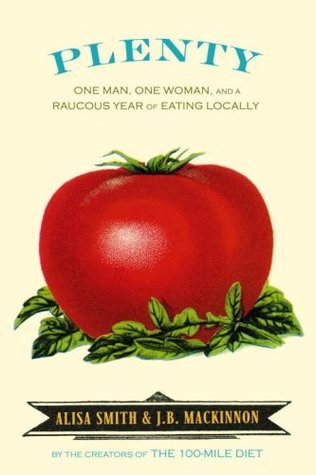
Like many great adventures, the 100-mile diet began with a memorable feast. Stranded in their off-the-grid summer cottage in the Canadian wilderness with unexpected guests, Alisa Smith and J.B. MacKinnon turned to the land around them. They caught a trout, picked mushrooms, and mulled apples from an abandoned orchard with rose hips in wine. The meal was truly satisfying; every ingredient had a story, a direct line they could trace from the soil to their forks. The experience raised a question: Was it possible to eat this way in their everyday lives?Back in the city, they began to research the origins of the items that stocked the shelves of their local supermarket. They were shocked to discover that a typical ingredient in a North American meal travels roughly the distance between Boulder, Colorado, and New York City before it reaches the plate. Like so many people, Smith and MacKinnon were trying to live more lightly on the planet; meanwhile, their “SUV diet” was producing greenhouse gases and smog at an unparalleled rate. So they decided on an experiment: For one year they would eat only food produced within 100 miles of their Vancouver home.It wouldn’t be easy. Stepping outside the industrial food system, Smith and MacKinnon found themselves relying on World War II–era cookbooks and maverick farmers who refused to play by the rules of a global economy. What began as a struggle slowly transformed into one of the deepest pleasures of their lives. For the first time they felt connected to the people and the places that sustain them.For Smith and MacKinnon, the 100-mile diet became a journey whose destination was, simply, home. From the satisfaction of pulling their own crop of garlic out of the earth to pitched battles over canning tomatoes, Plenty is about eating locally and thinking globally.The authors’ food-focused experiment questions globalization, monoculture, the oil economy, environmental collapse, and the tattering threads of community. Thought-provoking and inspiring, Plenty offers more than a way of eating. In the end, it’s a new way of looking at the world.

A WALTER SCOTT PRIZE ACADEMY RECOMMENDED BOOK OF 2018!In this literate and action-packed historical thriller, set during World War II, a plucky code-breaker fights to keep a deadly secret as her Bonnie-and-Clyde past threatens to catch up with her.Thirty-year-old Lena Stillman is living a perfectly respectable life when a shocking newspaper headline calls up her past: It concerns her former lover, charismatic bank robber Bill Bagley. a romantic and charming figure whom Lena had tried to forget by resuming her linguistic studies ... which led to her recruitment as a Navy code-breaker and subsequent work intercepting Japanese messages during World War II.But can Lena keep her own secrets? Threatening notes and the appearance of an old diary that recalls her gangster days are poised to upset her new life. Whom can she really trust? Is there a spy among the code-breakers? And who is it that wants her dead?“Alisa Smith’s novel Speakeasy, set in the thirties and forties, is written with great authority. A wonderful read, and very convincing.” —Richard Bausch, author of Something Is Out There and Peace

The followup to the literate and action-packed historical thriller Speakeasy, Doublespeak finds plucky protagonist Lena on a journey back to her past. Lieutenant Lena Stillman has been left, nearly alone, on her code-breaking mission in remote Alaska. World War II has been over for a month, but due to crimes committed a lifetime ago, Lena is still under the control of the powerful Miss Maggie, her spymaster in Washington, DC.Shaken by her role in the disappearance of Corporal Link Hughes—and by her own misjudgment of his character—Lena yearns for an opportunity to redeem them both. Then she receives a shocking message containing Link’s potential location: Siam. Embarking on a clandestine rescue mission to Bangkok, Lena is reunited with shadows from her past—including loyal friend Byron who is eager to escape his safe, dull life and the attractive yet dangerous “William Yardley.” As personal and political allegiances shift in the postwar maelstrom, it seems impossible to know who is good or bad, innocent or culpable and whether they are motivated by love or revenge.Overlaying rich historic detail and an intricate plot, Doublespeak is an entrancing sequel to Alisa Smith’s first novel Speakeasy, which received the honor of being a Walter Scott Prize Academy recommended book of 2018.

Law, Social Science and the Criminal Courts fills a gap in the fields of criminal justice and law and society. Unlike any other available text, this book integrates legal cases and empirical research on social science questions confronted by the criminal courts. In other words, it examines how social science impacts criminal law and procedure. The book is organized around the criminal court process beginning with issues related to pretrial proceedings and ending with issues concerning sentencing. Specifically, the book provides an introduction to the history of social science used by the courts and the types of social science admitted as evidence in the courts. The chapters that follow provide seminal legal cases and empirical, social science research on a variety of topics ranging from pretrial publicity and racial profiling to Megan's Law and the death penalty.Readers are introduced to the "law in action" by demonstrating how social science influences the courts and the courts influence society. Readers will be able to critically review court opinions and social science studies that test some of the assumptions relied upon in court decisions. Sociology of law, law and society, and criminal justice students will find this book interesting as it raises questions about the influence of law on society and whether empirical research helps or hinders grounded judicial decision-making.

Criminal Courts: Process and Social Science
by Alisa Smith

Have You Been Thinking About Visiting Japan or Are You Currently in Japan And Are Just Wondering Where You Should Start?Do you wish to have a remarkable experience during your stay to the country of the rising sun? Relax. This book offers all the information you need on where to visit, what to see, various outdoor excursions, traveling safety, transit and a lot more. If you are searching for a book that won’t bore you with too much unneeded information, this is your excellent guide; it will get you to visit as many sites as possible and enjoy Japan to the fullest whether you are going for a few days or for over a month.As a tourist site in current days, Japan has lots to offer to everyone's interests. It is contemporary with all the newest trend and technology yet has a distinguishing culture with deep roots into history at the same time. Whether you are interested in exciting outdoor sports, feasting in its great food, resting on the gorgeous beaches, staying in ryokan (traditional inn) and meditating in temples or enjoying the hustle and bustle of contemporary world, Japan offers it all. Whether you are visiting Japan for two days or for a month, you absolutely cannot exhaust all there is to see and experience.I’m quite thrilled that you are going to read about this great nation. My objective is to motivate you to visit the country of the rising sun to build one-of-a-kind lifelong unforgettable experience to treasure throughout your lifetime. Let’s get started!Here is the preview of this And Much More!
