
Alice Miller
Alice Miller was a Polish-Swiss psychologist, psychoanalyst and philosopher of Jewish origin, who is noted for her books on parental child abuse, translated into several languages. She was also a noted public intellectual. Her book The Drama of the Gifted Child caused a sensation and became an international bestseller upon the English publication in 1981. Her views on the consequences of child abuse became highly influential. In her books she departed from psychoanalysis, charging it with being similar to the poisonous pedagogies.
14 Books Written

The Drama of the Gifted Child: The Search for the True Self
by Alice Miller
Rating: 4.0 ⭐
• 9 recommendations ❤️
The bestselling book on childhood trauma and the enduring effects of repressed anger and pain. Why are many of the most successful people plagued by feelings of emptiness and alienation? This wise and profound book has provided millions of readers with an answer—and has helped them to apply it to their own lives. Far too many of us had to learn as children to hide our own feelings, needs, and memories skillfully in order to meet our parents' expectations and win their "love." Alice Miller writes, "When I used the word 'gifted' in the title, I had in mind neither children who receive high grades in school nor children talented in a special way. I simply meant all of us who have survived an abusive childhood thanks to an ability to adapt even to unspeakable cruelty by becoming numb.... Without this 'gift' offered us by nature, we would not have survived." But merely surviving is not enough. The Drama of the Gifted Child helps us to reclaim our life by discovering our own crucial needs and our own truth.

An examination of childhood trauma and its surreptitious, debilitating effects by one of the world's leading psychoanalysts. Never before has world-renowned psychoanalyst Alice Miller examined so persuasively the long-range consequences of childhood abuse on the body. Using the experiences of her patients along with the biographical stories of literary giants such as Virginia Woolf, Franz Kafka, and Marcel Proust, Miller shows how a child's humiliation, impotence, and bottled rage will manifest itself as adult illness―be it cancer, stroke, or other debilitating diseases. Never one to shy away from controversy, Miller urges society as a whole to jettison its belief in the Fourth Commandment and not to extend forgiveness to parents whose tyrannical childrearing methods have resulted in unhappy, and often ruined, adult lives. In this empowering work, writes Rutgers professor Philip Greven, "readers will learn how to confront the overt and covert traumas of their own childhoods with the enlightened guidance of Alice Miller."

For Your Own Good: Hidden Cruelty in Child-Rearing and the Roots of Violence
by Alice Miller
Rating: 4.3 ⭐
For Your Own Good, the contemporary classic exploring the serious if not gravely dangerous consequences parental cruelty can bring to bear on children everywhere, is one of the central works by Alice Miller, the celebrated Swiss psychoanalyst.With her typically lucid, strong, and poetic language, Miller investigates the personal stories and case histories of various self-destructive and/or violent individuals to expand on her theories about the long-term affects of abusive child-rearing. Her conclusions―on what sort of parenting can create a drug addict, or a murderer, or a Hitler―offer much insight, and make a good deal of sense, while also straying far from psychoanalytic dogma about human nature, which Miller vehemently rejects.This important study paints a shocking picture of the violent world―indeed, of the ever-more-violent world―that each generation helps to create when traditional upbringing, with its hidden cruelty, is perpetuated. The book also presents readers with useful solutions in this regard―namely, to resensitize the victimized child who has been trapped within the adult, and to unlock the emotional life that has been frozen in repression.

The Truth Will Set You Free: Overcoming Emotional Blindness and Finding Your True Adult Self
by Alice Miller
Rating: 4.0 ⭐
More than twenty years ago, a little-known Swiss psychoanalyst wrote a book that changed the way many people viewed themselves and their world. In simple but powerful prose, the deeply moving Drama of the Gifted Child showed how parents unconsciously form and deform the emotional lives of their children. Alice Miller's stories about the roots of suffering in childhood resonated with readers, and her book soon became a backlist best seller.In The Truth Will Set You Free Miller returns to the intensely personal tone and themes of her best-loved work. Only by embracing the truth of our past histories can any of us hope to be free of pain in the present, she argues. Miller uses vivid true stories to reveal the perils of early-childhood mistreatment and the dangers of mindless obedience to parental will. Drawing on the latest research on brain development, she shows how spanking and humiliation produce dangerous levels of denial, which leads in turn to emotional blindness and to mental barriers that cut off awareness and the ability to learn new ways of acting. If this cycle repeats itself, the grown child will perpetrate the same abuse on later generations--a message vitally important, especially given the increasing popularity of programs like Tough Love and of "child disciplinarians" like James Dobson. The Truth Will Set You Free will provoke and inform all readers who want to know Alice Miller's latest thinking on this important subject.

Child abuse is beginning to be recognized as something more significant than an isolated family affair. The title of Alice Miller's book, first published in Germany in 1981, spells out the unspoken commandment that such abused children - indeed, all of us - have been obeying since early childhood. We have all been made to feel from our earliest days that we are to blame for anything shameful that happens to us, so that our awareness of these inflicted abuses dims. Alice Miller demonstrates that this centuries-old tradition also finds expression in Freud's notions of "the Oedipus complex" and "infantile sexuality" - his drive theory - which put the blame on the child. Freud maintained that his patients who claimed to have been sexually molested as children were only "fantasizing" as a defense against their own sexual desires for their innocent parents. This theory helped to conceal the fact that sexual abuse of children occurs frequently and results in later emotional disturbances in the victims of such abuse - because they are not allowed awareness of it. In fairy tales, works of literature, and dreams, Alice Miller maintains, the truth about childhood can emerge, precisely because it is not recognized as such. Detailed examples from Kafka, Flaubert, Beckett, and Virginia Woolf offer proof of her thesis and illustrate her understanding of human creativity.

The Untouched Key: Tracing Childhood Trauma in Creativity and Destructiveness
by Alice Miller
Rating: 4.0 ⭐
As in her former books, Alice Miller again focuses on facts. She is as determined as ever to cut through the veil that, for thousands of years now, has been so meticulously woven to shroud the truth. When she lifts that veil and brushes it aside, the results are astonishing, amply demonstrated by her analyses of the works of Nietzsche, Picasso, Kathe Kollwitz, Buster Keaton, and others. With the key shunned by so many for so long--childhood--she opens rusty locks and offers her readers a wealth of unexpected perspectives. What did Picasso express in Guernica? Why did Buster Keaton never smile? Why did Nietzsche heap so much opprobrium on women and religion and lose his mind for 11 years? Why did Hitler and Stalin become tyrannical mass murderers?Miller investigates these and other questions thoroughly in this book. She draws from her discoveries that human beings are not "innately" destructive, that they are made that way by ignorance, abuse, and neglect, particularly if no sympathetic witness comes to their aid. She also shows why some mistreated children do not become criminals, but instead bear witness as artists to the truth about their childhoods, even though in purely intuitive and unconscious ways.

In direct opposition to the Freudian drive theory, the author of the best-selling The Drama Of The Gifted Child believes that children, at birth, are inherently good, and she traces all forms of criminal deeds to past mistreatments.

How do early experiences of love or suffering affect our adult relationships? What effect is child abuse likely to have on the victim's later life? How does hatred evolve and take root? How do people develop into cult leaders or political tyrants? Through the seven hypothetical scenarios and two essays that make up Paths of Life, Miller examines these questions and many others. Her narratives demonstrate that with knowledge and understanding of our past we have the power to change our future, freeing ourselves from the curse of repeating our parents' mistakes. In this, her eighth book, Alice Miller has given us yet another wise and profound study of the inestimable importance of childhood."Alice Miller wrote the book on narcissistic parents and the havoc they wreak on children. Twenty years later, she's still on the case with a new book and even more radical ideas."--Mirabella

Breaking Down the Wall of Silence: The Liberating Experience of Facing Painful Truth
by Alice Miller
Rating: 4.3 ⭐
"Both prolific and eloquent in her continuing indictment of parents who abuse their children and societies that tolerate such behavior."— Kirkus Reviews .

In PICTURES OF CHILDHOOD, Alice Miller explores the connection between childhood and that creative anxiety which 'somehow permits us to come to grips with the demons of our past and give form to the chaos within and thereby master our anxiety.'Having realised in the early seventies a lifelong desire to paint, Dr Miller found an unfamiliar world emerging from her not the 'nice' world of her childhood, to which she had always testified, but one of fear, despair and loneliness. Meditating on her spontaneously executed watercolours- sixty-six of which are reproduced here in full colour- and their implications, Dr Miller offers a profound analysis of the roots of creativity in the authentic self's struggle for survival.

Collected for the first time, Alice Miller's most helpful, therapeutic, and invaluable answers to thousands of readers' letters.The renowned childhood researcher, psychotherapist, and best-selling author Alice Miller has received, throughout her long and distinguished career, countless personal letters from readers all over the world. Here, in From Rage to Courage, Dr. Miller has assembled the most recent, producing an insightful work that illuminates the issues and consequences of childhood abuse. Whether exploring the connection between repressed anger and physical illnesses like cancer, the reasons why many survivors of abuse turn to drugs or crime, or the cycle that condemns generations of families to cruelty in childhood, Dr. Miller's answers are sensitive, honest, and supported by decades of experience. A practical guide to Dr. Miller's unique therapeutic concept, this work once again affirms the healing and liberating power of retrieved emotions.
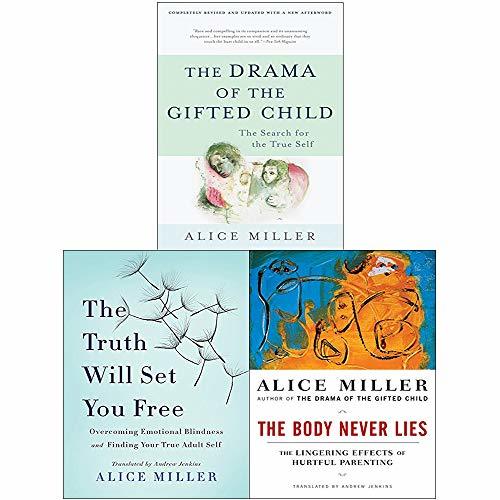
Collection Set: Drama of the Gifted Child / Body Never Lies / Truth Will Set You Free
by Alice Miller
Rating: 4.7 ⭐
The Drama of the Gifted Child: Why are many of the most successful people plagued by feelings of emptiness and alienation? This wise and profound book has provided thousands of readers with an answer, and has helped them to apply it to their own lives. Far too many of us had to learn as children to hide our own feelings, needs, and memories skillfully in order to meet our parents' expectations and win their "love." The Body Never Lies: Never before has world-renowned psychoanalyst Alice Miller examined so persuasively the long-range consequences of childhood abuse on the body. Using the experiences of her patients along with the biographical stories of literary giants such as Virginia Woolf, Franz Kafka, and Marcel Proust, Miller shows how a child's humiliation, impotence, and bottled rage will manifest itself as adult illness-be it cancer, stroke, or other debilitating diseases. The Truth Will Set You Free: More than twenty years ago, a little-known Swiss psychoanalyst wrote a book that changed the way many people viewed themselves and their world. In simple but powerful prose, the deeply moving Drama of the Gifted Child showed how parents unconsciously.

En avril 2010, la grande psychanalyste Alice Miller quittait ce monde, laissant derrière elle une oeuvre considérable - et des milliers de lecteurs orphelins, qu'elle avait sa vie durant accompagnés et soutenus.Paradoxalement, cette " brillante avocate de l'enfance saccagée " parlait peu de son propre passé. Et pourtant, son enfance en Pologne, où elle naît en 1923 et grandit tant bien que mal entre le carcan familial et les désastres de la guerre, ne contribua pas peu à la naissance de sa vocation. Installée en Suisse pour ses études, elle passe un doctorat de philosophie, enseigne quelques années puis exerce la profession de psychanalyste jusqu'en 1980. Elle s'éloigne alors progressivement de la psychanalyse traditionnelle qui, à ses yeux, occulte la réalité de la souffrance infantile.C'est là en effet le combat de sa vie - comme thérapeuthe et comme théoricienne : repérer, comprendre, soigner et prévenir les séquelles des mauvais traitements infligés aux enfants par leurs parents. S'appuyant sur son expérience personnelle, sur des exemples historiques ou littéraires fameux (Hitler. Staline, Dostoïevski, Tchekhov. Proust...), nais aussi sur des milliers de témoignages recueillis sur la toile, elle n'a cessé de dénoncer la " pédagogie noire ", qui justifie hypocritement la violence éducative au nom du bien de l'enfant. Violent ou sournois, tout sévice laisse des traces indélébiles, voire aboutit aux pires catastrophes de l'histoire. Ce sont ces thèses, tout comme son engagement public, qui ont fait la notoriété internationale d'Alice Miller et consacrent ses ouvrages comme d'importantes références.Cette édition regroupe ses quatre titres les plus célèbres : C'est pour ton bien (1985), L'Enfant sous terreur (1986) ; La Connaissance interdite (1990) et Notre corps ne ment jamais (2004). L'ensemble, qui constitue à la fois une introduction générale à son oeuvre et un parcours à travers l'évolution de sa pensée, s'accompagne d'une préface inédite de son fils Martin, lui-même psychothérapeute.

El uso del derecho penal para regular el sexo, el género y la reproducción tiene una larga historia, pero en las últimas dos décadas, la expansión de las demandas en torno a los derechos sexuales y reproductivos y la movilización social creciente para promoverlos en todo el mundo han venido acompañadas de tensiones y contradicciones alrededor del rol de la ley penal en las vidas íntimas de las personas. ¿Hasta dónde la intervención de la justicia en esta esfera de la experiencia humana garantiza la autonomía y cuándo, por el contrario, refuerza estereotipos y normatividades? Así, mientras hay demandas para liberalizar prácticas que antes se penalizaban (por ejemplo, las relaciones sexuales extramatrimoniales) también se promueve penalizar prácticas que antes no se sancionaban (por ejemplo, las relaciones sexuales forzadas dentro del matrimonio). Y mientras en algunos países se impulsa la pena de muerte para los homosexuales, en otros se la intenta imponer para quienes los asesinan. El aborto y los derechos reproductivos, el HIV, el trabajo sexual y la prostitución, el tráfico de personas, la violencia sexual en todos los géneros, las sexualidades diversas son todos campos en los que el activismo judicial enfrenta desafíos que lo interpelan profundamente. En este libro, que reúne a las voces más destacadas en los debates feministas contemporáneos y viene a llenar un vacío de textos en español sobre este tema, se analiza cómo el derecho penal se ha utilizado para producir modelos normativos de sexualidad, género y reproducción, y, a la inversa, cómo algunas herramientas jurídicas pueden usarse para alterar esa norma. Académicos, académicas, promotores y promotoras de los derechos humanos de todo el mundo escriben desde diversas disciplinas, geografías y espacios de acción (los derechos de las mujeres, de las personas homosexuales, de los trabajadores y trabajadoras del sexo, el activismo en torno al HIV) para coincidir en un punto: no se pueden ignorar las profundas fallas en el funcionamiento de la justicia penal cuando lo que está en juego es la vida íntima, pero tampoco renunciar a ella si se pretende ampliar derechos.