
Alfred Rappaport
Michael J. Mauboussin is Chief Investment Strategist at Legg Mason Capital Management. Prior to joining LMCM in 2004, Michael was a Managing Director and Chief U.S. Investment Strategist at Credit Suisse. Michael joined CS in 1992 as a packaged food industry analyst. He is a former president of the Consumer Analyst Group of New York and was repeatedly named to Institutional Investors All-America Research Team and The Wall Street Journal All-Star survey in the food industry group. Michael is the author of Think Twice: Harnessing the Power of Counterintuition (Harvard Business Press, 2009) and More Than You Know: Finding Financial Wisdom in Unconventional PlacesUpdated and Expanded (New York: Columbia Business School Publishing, 2008). More Than You Know was named one of The 100 Best Business Books of All Time by 800-CEO-READ, one of the best business books by BusinessWeek (2006) and best economics book by Strategy+Business (2006). He is also co-author, with Alfred Rappaport, of Expectations Investing: Reading Stock Prices for Better Returns (Harvard Business School Press, 2001). Michael has been an adjunct professor of finance at Columbia Business School since 1993 and is on the faculty of the Heilbrunn Center for Graham and Dodd Investing. In 2009, Michael received the Deans Award for Teaching Excellence. BusinessWeeks Guide to the Best Business Schools (2001) highlighted Michael as one of the schools Outstanding Faculty, a distinction received by only seven professors. Michael earned an A.B. from Georgetown University. He is also affiliated with the Santa Fe Institute, a leading center for multi-disciplinary research in complex systems theory, and is on the board of directors of Sermo, an online community for physicians."
15 Books Written
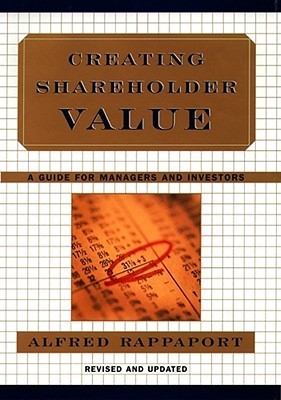
Creating Shareholder Value: A Guide for Managers and Investors
by Alfred Rappaport
Rating: 4.2 ⭐
• 3 recommendations ❤️
Economist, consultant, and Wall Street Journal contributor Alfred Rappaport provides managers and investors with the practical tools and tests for a corporate strategy that creates shareholder value.The ultimate test of corporate strategy, the only reliable measure, is whether it creates economic value for shareholders.After a decade of downsizings frequently blamed on shareholder value decision making, this book presents a new and indepth assessment of the rationale for shareholder value. Further, Rappaport presents provocative new insights on shareholder value applications (1) business planning, (2) performance evaluation, (3) executive compensation, (4) mergers and acquisitions, (5) interpreting stock market signals, and (6) organizational implementation. Readers will be particularly interested in Rappaport's answers to three management performance evaluation (1) What is the most appropriate measure of performance? (2) What is the most appropriate target level of performance? and (3) How should rewards be linked to performance? The recent acquisition of Duracell International by Gillette is analyzed in detail, enabling the reader to understand the critical information needed when assessing the risks and rewards of a merger from both sides of the negotiating table.The shareholder value approach presented here has been widely embraced by publicly traded as well as privately held companies worldwide. Brilliant and incisive, this is the one book that should be required reading for managers and investors who want to stay on the cutting edge of success in a highly competitive global economy.

Saving Capitalism From Short-Termism: How to Build Long-Term Value and Take Back Our Financial Future
by Alfred Rappaport
Rating: 3.7 ⭐
• 2 recommendations ❤️
“As Rappaport keeps on speaking out for the realities surrounding investment and speculation, our society will profit as it builds on his keen insights.”―from the Foreword by John C. Bogle, founder of the Vanguard Group “Al Rappaport brings insight and wisdom to the short-termism debate, fully demonstrating the way perverse incentives are undermining public companies and capital markets.”―John Plender, Financial Times "In this rigorous, useful, and delightful book, Rappaport undresses short-term financial incentives for what they parasites that draw the value-creating innovation out of companies. And he shows how executives can align long-term value-creating investments with the right investors' expectations."―Clayton Christensen, Harvard Business School “How to make managers focus on the long-run is one of the most consequential and difficult questions in corporate governance and is the subject of much debate and disagreement. Professor Alfred Rappaport’s insightful book is a valuable contribution to this important debate.”―Lucian Bebchuk, Professor, Harvard Law School, and coauthor of Pay Without Performance “ Saving Capitalism from Short-Termism insightfully exposes the contradictions by which we incentivize money managers to require short-term focus by company managers. Again and again in rereading this book, I am struck with the author’s felicitous style in raising subject after subject in which I have long been interested―but, until this read, have not been able to resolve. Buy it, read it, and enjoy.”―Robert A.G. Monks, founder ISS (Institutional Shareholder Services), Lens Governance Advisors, and The Corporate Library “Capitalism fails when corporate managers and professional investors prefer their own interests to those the true owners of businesses. In Saving Capitalism from Short-Termism , Al Rappaport shows how new incentives schemes can deliver shareholder value for the 21st century.”―Edward Chancellor, author of Devil Take the A History of Financial Speculation and member of GMO's Asset Allocation team About the Book Business leaders today obsess over quarterly earnings and the current stock price―and for good reason. Corporate incentives typically focus on short-term profits rather than long-term value creation. Nothing is more harmful to businesses―and to the broader economy. Few business thinkers in recent decades have contributed more to this subject than Alfred Rappaport. As an author and educator, Rappaport is a pioneer in developing the principles of values-based management and is an acknowledged authority on how to make long-term shareholder value the essential driver of corporate strategy. His latest work, Saving Capitalism from Short-Termism , is a clarion call for conquering the addiction to short-term profit―and getting on the path to building long-term value. Rappaport’s solution to short-termism is simple but business leaders must align the interests of corporate and investment managers with those of their shareholders and beneficiaries. His plan

Expectations Investing offers a unique and powerful alternative for identifying value-price gaps. Rappaport and Mauboussin provide everything the reader needs to utilize the discounted cash flow model successfully. And they add an important they suggest that rather than forecasting cash flows, investors should begin by estimating the expectations embedded in a company's stock price. An investor who has a fix on the market's expectations can then assess the likelihood of expectations revisions. To help investors anticipate such revisions, Rappaport and Mauboussin introduce an "expectations infrastructure" framework for tracing the process of value creation from the basic economic forces that shape a company's performance to the resulting impact on sales, costs, and investment. Investors who use Expectations Investing will have a fundamentally new way to evaluate all stocks, setting them on the path to success. Managers will be able to use the book to devise, adjust, and communicate their company's strategy in light of shareholder expectations.

Expectations Investing: Reading Stock Prices for Better Returns
by Alfred Rappaport

Brand New. Ship worldwide

Gerando Valor para o Acionista
by Alfred Rappaport
A framework for financial reporting by diversified companies,
by Alfred Rappaport
Segment reporting for managers and investors;: National Association of Accountants research study,
by Alfred Rappaport

Saving Capitalism From Short-Termism: How to Build Long-Term Value and Take Back Our Financial Future
by Alfred Rappaport

Analise de investimentos
by Alfred Rappaport
Getting a Grant in the 1990s
by Alfred Rappaport

Ekusupekutēshon Tōshi Nyūmon: Shijō No Kitai O Kabuka De Yomitoku
by Alfred Rappaport

Shareholder Value. Ein Handbuch für Manager und Investoren.
by Alfred Rappaport
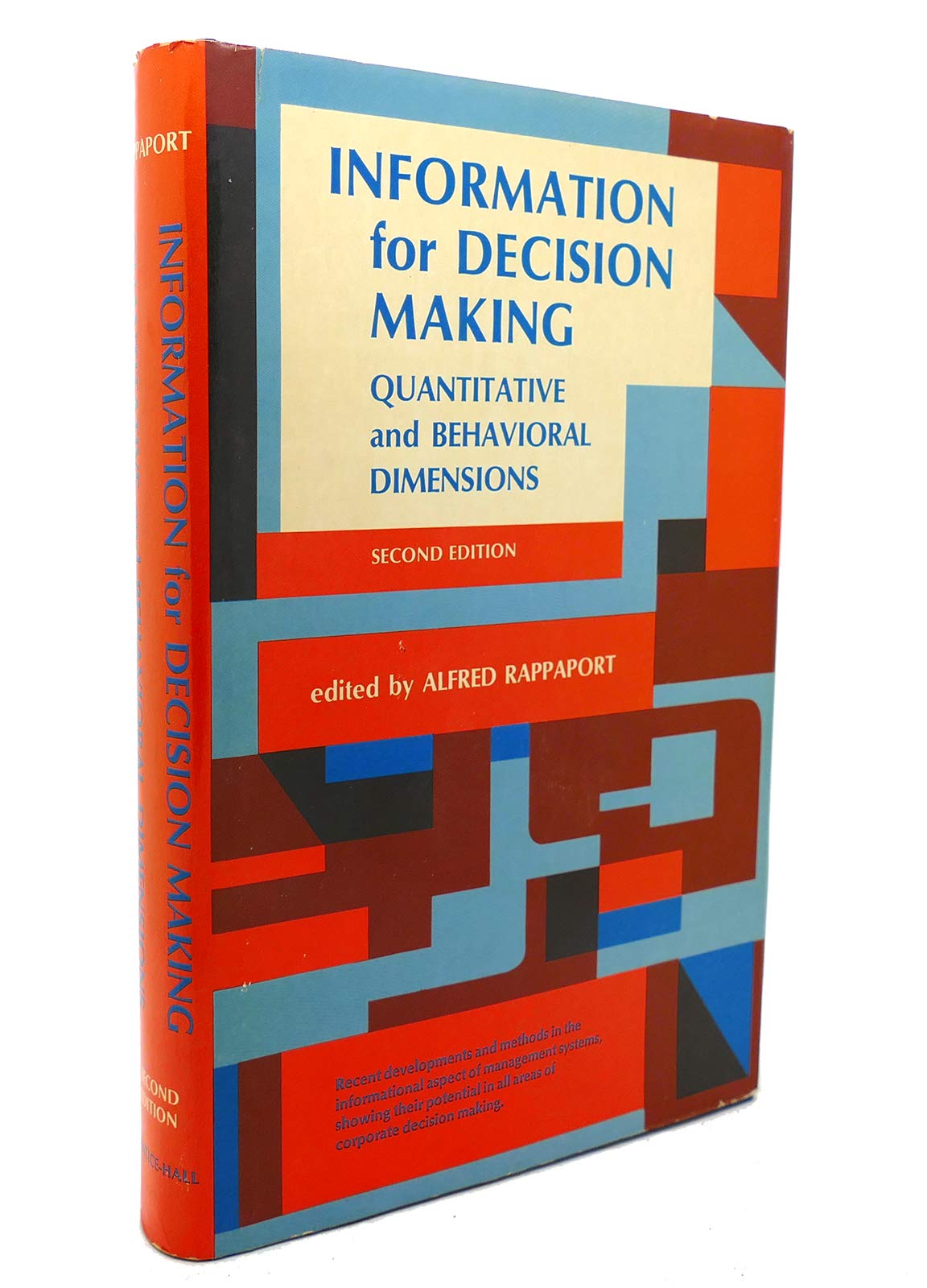
Information for decision making;: Quantitative and behavioral dimensions
by Alfred Rappaport
Information for Decision Readings in Cost and Managerial Accounting