
Alexander R. Luria
Alexander Romanovich Luria (Russian: Алекса́ндр Рома́нович Лу́рия ) was a famous Soviet neuropsychologist and developmental psychologist. He was one of the founders of cultural-historical psychology and the leaders of the Vygotsky Circle. Apart from his work with Vygotsky, he is widely known for his later work with two extraordinary psychological case studies, his study of a man with a highly advanced memory published as The Mind of a Mnemonist, and the study of a man with traumatic brain injury published in The Man with a Shattered World.
30 Books Written

The Mind of a Mnemonist: A Little Book about a Vast Memory
by Alexander R. Luria
Rating: 4.1 ⭐
• 1 recommendation ❤️
The Mind of a Mnemonist is a rare phenomenon - a scientific study that transcends its data and, in the manner of the best fictional literature, fashions a portrait of an unforgettable human being."

Russian psychologist A. R. Luria presents a compelling portrait of a man’s heroic struggle to regain his mental faculties. A soldier named Zasetsky, wounded in the head at the battle of Smolensk in 1943, suddenly found himself in a frightening world: he could recall his childhood but not his recent past; half his field of vision had been destroyed; he had great difficulty speaking, reading, and writing.Much of the book consists of excerpts from Zasetsky’s own diaries. Laboriously, he records his memories in order to reestablish his past and to affirm his existence as an intelligent being. Luria’s comments and interpolations provide a valuable distillation of the theory and techniques that guided all of his research. His “digressions” are excellent brief introductions to the topic of brain structure and its relation to higher mental functions.

This important book, by the most distinguished Soviet psychologist of our time, is the product of almost forty years of extensive research aimed at understanding the cerebral basis of human psychological activity. The main part of the book describes what we know today about the individual systems that make up the human brain and about the role of the individual zones of the cerebral hemispheres in the task of providing the necessary conditions for higher forms of mental activity to take place. Finally, Luria analyzes the cerebral organization of perception and action, of attention and memory, or speech and intellectual processes, and attempts to fit the facts obtained by neuropsychological studies of individual brain systems into their appropriate place in the grand design of psychological science.
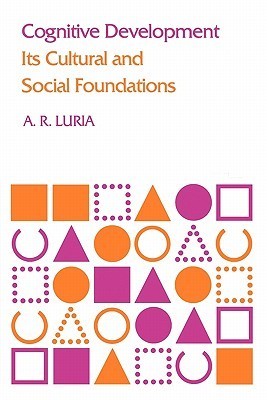
Alexander Romanovich Luria, one of the most influential psychologists of the twentieth century, is best known for his pioneering work on the development of language and thought, mental retardation, and the cortical organization of higher mental processes. Virtually unnoticed has been his major contribution to the understanding of cultural differences in thinking.In the early 1930s young Luria set out with a group of Russian psychologists for the steppes of central Asia. Their to study the impact of the socialist revolution on an ancient Islamic cotton-growing culture and, no less, to establish guidelines for a viable Marxist psychology. Lev Vygotsky, Luria's great teacher and friend, was convinced that variations in the mental development of children must be understood as a process including historically determined cultural factors. Guided by this conviction, Luria and his colleagues studied perception, abstraction, reasoning, and imagination among several remote groups of Uzbeks and Kirghiz―from cloistered illiterate women to slightly educated new friends of the central government.The original hypothesis was abundantly supported by the the very structure of the human cognitive process differs according to the ways in which social groups live out their various realities. People whose lives are dominated by concrete, practical activities have a different method of thinking from people whose lives require abstract, verbal, and theoretical approaches to reality.For Luria the legitimacy of treating human consciousness as a product of social history legitimized the Marxian dialectic of social development. For psychology in general, the research in Uzbekistan, its rich collection of data and the penetrating observations Luria drew from it, have cast new light on the workings of cognitive activity. The parallels between individual and social development are still being explored by researchers today. Beyond its historical and theoretical significance, this book represents a revolution in method. Much as Piaget introduced the clinical method into the study of children's mental activities, Luria pioneered his own version of the clinical technique for use in cross-cultural work. Had this text been available, the recent history of cognitive psychology and of anthropological study might well have been very different. As it is, we are only now catching up with Luria's procedures.

Luria's last work, summing up his contributions to the study of the psychology of language. Discusses his general philosophical approach and theoretical and empirical research, providing a concise account of how he applied his ideas to the developmental, cross-cultural, and clinical issues of language and cognition. Emphasizes the author's views on language and speech, and how they lead to a set of questions and procedures in empirical research. Also examines some of the general concerns of contemporary Soviet Psychology.

Luria looks back on his life and career in psychology, drawing attention to the Soviet scientific establishment and his struggle to formulate a new psychological theory concerning memory, language, and intelligence

Higher Cortical Functions in Man. Second Edition, Revised and Expanded
by Alexander R. Luria
Rating: 4.1 ⭐
This full-length translation of Professor Luria's book introduces to the English speaking world a major document in neuropsychology, summarizing Professor Luria's earlier contributions to that area for nearly a third of a century. It is a monumental contribution. Nothing of this scope exists in the Western literature of this field, with the possible exception of Ajuriaguerra and Hecaen's book (in French) on the cerebral cortex. Professor Luria's book thus marks a further and decisive step toward the eventual coalescence of neurology and psychology, a goal to which only a few laboratories in the East and West have been devoted over the last decades. The book is unique in its organization. The first half deals with observations and interpretations concerning the major syndromes of man's left cerebral those grievous distortions of higher functions traditionally described as aphasia, agnosia, and apraxia. There is also a detailed and brilliant analysis of the syndrome of massive frontal-lobe involvement. The entire second half of the book is given over to a painstaking description of Professor Luria's tests, many of them introduced by himself, and set out in such detail that anyone could repeat them and thus verify Professor Luria's interpretations.

Text: English, Russian (translation)

English, Russian (translation)


Uma das suas principais afirmações a respeito da possibilidade de uma interação frutífera entre a psicologia e a medicina apareceu em 1929 no artigo A Psicologia e a Clínica . Neste, Alexander Romanovich Luria revia a psicologia contemporânea, incluindo não só o trabalho de Pavlov sobre as neuroses experimentais, e seu próprio trabalho, com o método motor combinado, mas também de europeus como Jung, Freud e Adler sobre os distúrbios psicogênicos, de Binet acerca da psicologia diferencial, e de Piaget sobre o desenvolvimento do pensamento. Uma de suas mensagens centrais era a possibilidade de utilização de métodos clínicos para a realização de pesquisa científica sobre o comportamento humano. Assim, ao mesmo tempo em que duvidava das possibilidades terapêuticas dos psicoterapeutas ou da base das teorias alternativas da personalidade, ele via nos ataques feitos aos métodos clássicos e laboratório um movimento comum e sadio em direção a uma psicologia que seria ao mesmo tempo científica e relevante para a prática médica- Pouco a pouco a psicologia abstrata e estatística de Wundt tem renascido de maneira fundamental; aproximou-se das tarefas concretas da vida e, por vontade própria ou não, começou a superar a natureza mecanicista das ciências naturais anteriores. Com o novo conteúdo, vieram novos princípios e um novo método.

Text in Russian language. Sixth edition. Hardcover. Pages are clean, binding is sound, and text remains clear throughout. No dust jacket. T

Barcelona. 19 cm. 137 p., 1 h. Encuadernación en tapa blanda de editorial. Colección 'Breviarios de Conducta Humana', numero coleccion(6). Luriia, Aleksandr Romanovich 1902-1977. Traducido del ruso por Pedro Mateo Merino. Sentidos. Percepción .. Este libro es de segunda mano y tiene o puede tener marcas y señales de su anterior propietario. 8424404386

This work has been selected by scholars as being culturally important and is part of the knowledge base of civilization as we know it.This work is in the public domain in the United States of America, and possibly other nations. Within the United States, you may freely copy and distribute this work, as no entity (individual or corporate) has a copyright on the body of the work.Scholars believe, and we concur, that this work is important enough to be preserved, reproduced, and made generally available to the public. To ensure a quality reading experience, this work has been proofread and republished using a format that seamlessly blends the original graphical elements with text in an easy-to-read typeface.We appreciate your support of the preservation process, and thank you for being an important part of keeping this knowledge alive and relevant.

Книга представляет собой последовательное изложение научных проблем, которые разрабатывались выдающимся российским психологом А.Р.Лурия в течение всей его жизни. Его научная автобиография - неотъемлемая часть истории и современного состояния отечественной и мировой психологической науки. Разрабатывая концепции исторического происхождения психических функций человека, А.Р.Лурия совместно с Л.С.Выготским и А.Н.Леонтьевым закладывал основы отечественной психологии.

O homem não está restrito a simples reflexos estímulo-respostas. Ele consegue estabelecer conexões indiretas entre as estimulações que recebe e as respostas que emite através de vários elos de mediação. Quando introduz uma modificação no ambiente através de seu próprio comportamento, essa modificação vai influenciar seu comportamento futuro. Luria e Vigotski aplicam o conceito de mediação quase que exclusivamente aos processos de desenvolvimento mental da criança, especialmente ao discutir o papel da linguagem no desenvolvimento. É utilizado o método clínico para investigar os processos de raciocínio usados pelos indivíduos ao enfrentarem os problemas propostos pelos autores. As pesquisas utilizam o oponente hipotético, incluem discussões em grupo e utilizam as intervenções como dados.

Speech and the Development of Mental Processes in the Child: An Experimental Investigation
by Alexander R. Luria
Rating: 4.0 ⭐
Excerpt from Speech and the Development of Mental Processes in the An Experimental InvestigationBut at one particular point in that monologue we find language Operating differently. She talks of things she wants, things that are not there in front of her first 'the cage and then 'the zoo man and having spoken of him, off she goes to get him.This indicates what really amounts to a fourth kind of repte-t scutation. Just as movement-cum-perception provided the basis from which the second stage was reached, that of perception freed from movement, so language tied to the here-and-now forms the basis from which there develops linguistic representation freed from these bonds, freed from its dependence upon move ment and perception. At this fourth stage words come to be used not with objects but in place of them. As our example directly, suggests, the ability to use words in this way further assists exploratory activity by breaking out of Things previously experienced may be tion, as the zoo man ideas derived brought to bear upon present problems. The result is a wide ex-q tension of a child's activities, the enrichment of the possibilities of the here-and-now by drawing upon the resources of the 'nota' here' and the 'not-now'.About the PublisherForgotten Books publishes hundreds of thousands of rare and classic books. Find more at www.forgottenbooks.comThis book is a reproduction of an important historical work. Forgotten Books uses state-of-the-art technology to digitally reconstruct the work, preserving the original format whilst repairing imperfections present in the aged copy. In rare cases, an imperfection in the original, such as a blemish or missing page, may be replicated in our edition. We do, however, repair the vast majority of imperfections successfully; any imperfections that remain are intentionally left to preserve the state of such historical works.

This volume contains various articles that are a sample of the ideas constructed and facts collected by Alexander Romanovich Luria during more than half a century of psychological research.

«Язык и сознание» — последняя работа А. Р. Лурии. Автор трудился над ней в течение ряда лет, но не дожил до ее публикации. Замысел произведения был непосредственно связан с многолетними интересами А. Р. Лурии к психологии речи. На протяжении всей своей жизни Лурия изучал проблему речи, ее формирования в онтогенезе, ее функций, ее нарушений, ее мозговой организации. В данной монографии А. Р. Лурия рассматривает роль речи в формировании сознания человека, что является новым аспектом исследования этой проблемы.

Это рассказ о том, как пуля, пробившая череп человека и прошедшая в его мозг, раздробила его мир на тысячи кусков, которые он так и не мог собрать.Это книга о человеке, который отдал все силы, чтобы вернуть свое прошлое и завоевать свое будущее.Это книга о борьбе, которая не привыкла к победе, и о победе, которая не прекратила борьбы.В этой книге нет ни строки вымысла. Каждое ее положение проверено сотнями наблюдений и сопоставлений. Пишущий эти строки не был вправе вносить какие-либо изменения в страницы дневника, написанного героем, выбирая лишь куски из отдельных тетрадей и не меняя ни стиля, ни смысла.Читатель оценит эту книгу - книгу об одном живом человеке, который с таким упорством боролся за свой мозг, испытывая на каждом шагу непреодолимые трудности, но который в конечном счете вышел победителем из этой изнуряющей, неравной борьбы.

Sin duda alguna, A.R. Luria es la figura más representativa de la psicología y neuropsicología soviéticas actuales y una auténtica autoridad científica de la psicología universal.Dirigidos a profesores y estudiantes de las Facultades de Psicología e Institutos de Pedagogía de la URSS, el profesor Luria ha elaborado y dictado una serie de lecciones que constituyen un auténtico curso introductorio a la Psicología General. Estas lecciones quedan agrupadas en cuatro temas monográficos cada uno de los cuales constituyen un volumen de esta colección de 'Breviarios de Conducta Humana', cuyos títulos son los siguientes:Introducción evolucionista a la psicología.Sensación y percepción.Atención y memoria.Lenguaje y pensamiento.
This book has hardback covers.Ex-library,With usual stamps and markings,In fair condition, suitable as a study copy.No dust jacket.

Curso de Psicologia Geral I: Introdução Evolucionista à Psicologia
by Alexander R. Luria
Rating: 4.5 ⭐


The Role of Speech in the Regulation of Normal and Abnormal Behavior
by Alexander R. Luria
Rating: 4.5 ⭐
The Role of Speech in the Regulation of Normal and Abnormal Behavior examines the role of speech in the regulation of normal and abnormal behavior. Research findings on the regulatory role of verbal communication in ontogenesis and its disruption under various pathological states of the brain are summarized. The role of speech in the formation of mental processes is also discussed, along with the development of the regulatory role of speech. Comprised of three chapters, this book begins with a detailed account of the role of speech in the formation and evolution of mental processes in hopes of identifying the mechanisms underlying complex mental activities. It shows that speech enters integrally into the structure of mental processes and that it is a powerful means of regulating human behavior. The second chapter explores how the regulatory function of speech is formed and how it influences the formation of voluntary movements. The last chapter considers the relationship between speech and action as a criterion for identifying various forms of pathological behavior and for analyzing the compensation of the defects that result from it. This monograph will be of interest to psychologists.

A. R. Luria And Contemporary Psychology: Festschrift Celebrating The Centennial Of The Birth Of Luria
by Alexander R. Luria
Rating: 4.0 ⭐
Book by Akhutina, Tatiana, Glozman, Janna, Moskovich, Lena, Dorothy Robbins

Psicologia e Pedagogia: Bases Psicológicas da Aprendizagem e do Desenvolvimento
by Alexander R. Luria
Rating: 5.0 ⭐
Os artigos deste livro abordam alguns princípios básicos da psicologia pedagógica e da pedagogia soviética, relativos aos problemas da comunicação, da relação desenvolvimento-aprendizagem, da divisão do trabalho etc. Os artigos foram escritos relacionados com as técnicas e teorias americanas do comportamento e constituem uma demonstração de um rigoroso espírito científico e também de um profundo empenho humanista.

Sin duda alguna, A.R. Luria es la figura más representativa de la psicología y neuropsicología soviéticas actuales y una auténtica autoridad científica de la psicología universal.Dirigidos a profesores y estudiantes de las Facultades de Psicología e Institutos de Pedagogía de la URSS, el profesor Luria ha elaborado y dictado una serie de lecciones que constituyen un auténtico curso introductorio a la Psicología General. Estas lecciones quedan agrupadas en cuatro temas monográficos cada uno de los cuales constituyen un volumen de esta colección de 'Breviarios de Conducta Humana', cuyos títulos son los siguientes:Introducción evolucionista a la psicología.Sensación y percepción.Atención y memoria.Lenguaje y pensamiento.