
Aldo Leopold
A Sand County Almanac , published posthumously in 1949, of American writer and naturalist Aldo Leopold celebrates the beauty of the world and advocates the conscious protection of wild places. His effect on resource management and policy lasted in the early to mid-twentieth century, and since his death, his influence continued to expand. Through his observation, experience, and reflection at his river farm in Wisconsin, he honed the concepts of land health and a land ethic that since his death ever influenced in the years. Despite more than five hundred articles and three books during the course of his geographically widespread career, time at his shack and farm in Wisconsin inspired most of the disarmingly simple essays that so many persons found so thought-provoking. Life story of Aldo Leopold, the development of his career as a conservationist, scientist, and philosopher, and his open-mindedness, his vision, and the evolution of his thinking throughout his life inspire other persons to start or to further their own intellectual journey of discovery. A closer engagement with his story, his inspiration, and his family helps persons better to understand the contours of environmental history and the role in culture and to reflect on their own in the complex weave of the way in which our society relates to land. His vision of a society that cares about the connections between people and land provides a starting point for thinking about modern-day cultures, economies, ecosystems, and communities. Starker Leopold, Luna Leopold, Nina Leopold, Carl Leopold, and Estella Leopold—children of Aldo—founded the Aldo Leopold foundation in 1982. People respected all members of the Leopold family as scientists and conservationists in their own right. They recognized the shack and farm as a focal point for legacy of their father for generations to come and for this primary reason established the foundation. This public charity owns and manages the Leopold center, including the Leopold shack and 264 surrounding acres in addition to several other parcels and also manages much of the adjoining 1,800-acre Leopold memorial reserve, which neighboring landowners established as an early trust in 1967. It acts as the executor of literary estate of Leopold, encourages scholarship on Leopold, and serves as a clearinghouse for information regarding Leopold, his work, and his ideas. It provides interpretive resources and tours for five thousand visitors annually, cooperates with partners on education and other programming off site, and maintains a robust website and numerous print resources. The Aldo Leopold foundation manages this Goodreads page.
30 Books Written

First published in 1949, A Sand County Almanac combines some of the finest nature writing since Thoreau with an outspoken and highly ethical regard for America's relationship to the land.Written with an unparalleled understanding of the ways of nature, the book includes a section on the monthly changes of the Wisconsin countryside; another part that gathers informal pieces written by Leopold over a forty-year period as he traveled through the woodlands of Wisconsin, Iowa, Arizona, Sonora, Oregon, Manitoba, and elsewhere; and a final section in which Leopold addresses the philosophical issues involved in wildlife conservation. As the forerunner of such important books as Annie Dillard's Pilgrim at Tinker Creek, Edward Abbey's Desert Solitaire, and Robert Finch's The Primal Place, this classic work remains as relevant today as it was sixty-five years ago.

Written by Aldo Leopold, this book is a set of informal essays during his long years of observation and returning to the land and the nature. His beautiful words keep down different scenery at his farm in each month of a year, and states of earth and nature in several other states. Description of some local stories is also included. His opinion of land ethic is summarized too. The book has rich and interesting content, and would make readers realize interdependence between people and land.

In twenty short books, Penguin brings you the classics of the environmental movement.In this lyrical meditation on America's wildlands, Aldo Leopold considers the different ways humans shape the natural landscape, and describes for the first time the far-reaching phenomenon now known as 'trophic cascades'.Over the past 75 years, a new canon has emerged. As life on Earth has become irrevocably altered by humans, visionary thinkers around the world have raised their voices to defend the planet, and affirm our place at the heart of its restoration. Their words have endured through the decades, becoming the classics of a movement. Together, these books show the richness of environmental thought, and point the way to a fairer, saner, greener world.

To those who know the grace of Aldo Leopold's writing in A Sand County Almanac, this posthumous collection from his journals and essays will be a new delight. These daily journal entries on hunting, fishing and exploring, written in camp during his many field trips in lower California, New Mexico, Canada, and Wisconsin, indicate the source of Leopold's ideas on land ethics found in his longer essays. The excerpts from these journals—many taken from notes written around a camp fire, spattered with a slapped mosquito or a drop of coffee—show in direct context what he did in his own leisure time. The essays are taken from more contemplative notes which were still in manuscript when Leopold died, fighting a grass fire in 1948. Round River has been edited by Leopold's son, Luna, a geologist well-known in the field of conservation. It is also illustrated throughout with line drawings by Charles W. Schwartz. All admirers of Leopold's work—indeed, all lovers of nature—will find this book richly rewarding.

His name is inextricably linked with a single work, A Sand County Almanac, a classic of natural history literature and the conservationist's bible. This book brings together the best of Leopold's essays.

For the Health of the Land: Previously Unpublished Essays And Other Writings
by Aldo Leopold
Rating: 4.2 ⭐
Aldo Leopold's classic work A Sand County Almanac is widely regarded as one of the most influential conservation books of all time. In it, Leopold sets forth an eloquent plea for the development of a "land ethic" -- a belief that humans have a duty to interact with the soils, waters, plants, and animals that collectively comprise "the land" in ways that ensure their well-being and survival. For the Health of the Land , a new collection of rare and previously unpublished essays by Leopold, builds on that vision of ethical land use and develops the concept of "land health" and the practical measures landowners can take to sustain it. The writings are vintage Leopold -- clear, sensible, and provocative, sometimes humorous, often lyrical, and always inspiring. Joining them together are a wisdom and a passion that transcend the time and place of the author's life.The book offers a series of forty short pieces, arranged in seasonal "almanac" form, along with longer essays, arranged chronologically, which show the development of Leopold's approach to managing private lands for conservation ends. The final essay is a never before published work, left in pencil draft at his death, which proposes the concept of land health as an organizing principle for conservation. Also featured is an introduction by noted Leopold scholars J. Baird Callicott and Eric T. Freyfogle that provides a brief biography of Leopold and places the essays in the context of his life and work, and an afterword by conservation biologist Stanley A. Temple that comments on Leopold's ideas from the perspective of modern wildlife management.The book's conservation message and practical ideas are as relevant today as they were when first written over fifty years ago. For the Health of the Land represents a stunning new addition to the literary legacy of Aldo Leopold.


With this book, published more than a half-century ago, Aldo Leopold created the discipline of wildlife management. Although A Sand Country Almanac is doubtless Leopold’s most popular book, Game Management may well be his most important. In this book he revolutionized the field of conservation.

A Sand County Almanac with Other Essays on Conservation from Round River
by Aldo Leopold
Rating: 4.4 ⭐
NO DUST JACKET PRESENT. FORMER LIBRARY BOOK WITH USUAL STAMPS AND MARKINGS. TAN BOARDS WITH MINOR CHAFING, SCUFFING & EDGEWEAR. INSIDE COVERS & PAGES SHOW SOME CHAFING & MARKING, NOT AFFECTING READABILITY. CONTENT PAGES CLEAN AND ALL ARE INTACT. PLEASE SEE OUR SCAN.
Leopold's writing on the sandhill cranes and the excerpts from his journals make you immediately want to go to Wisconsin. he text is excerpted from the Sand County Almanac. Meine's essay on Leopold is very interesting. You can read more about the volume here,

Während in Europa der Zweite Weltkrieg tobt, schreibt der US-amerikanische Forstwissenschaftler und Umweltethiker Aldo Leopold über die Wälder von Arizona, Oregon und Manitoba, wo er Flora und Fauna erkundet hat, und den Einfluss menschlichen Handelns auf die Natur. Er erinnert sich an die magischen Tänze der Waldschnepfen, sinniert über die Trunkenheit des Windes, wundert sich über die Sprache der Bäume und über ihr Gedächtnis, beschreibt Gemälde, die der Wisconsin River an manchen Sommermorgen malt, und Felsenblümchen, die kleinsten Blumen der Welt. Selten wurde so sinnlich über die Natur geschrieben, wurde in so knappen, eindringliehen Worten so viel über die wichtigen Dinge des Lebens gesagt. 1949, ein Jahr nach Leopolds Tod und ein Jahrhundert nach Thoreaus Walden erschienen, ist A Sand County Almanac, aus dem dieser Band eine Auswahl bietet, längst nicht nur ein Klassiker des nature writing und ein Grundlagentext der Umweltschutzbewegung, sondern vor allem, so Literaturnobelpreisträger Jean-Maria Gustave Le Clézio, ein Brevier für alle, die nach einem ausgeglichenen Leben streben.

Excerpt from The Farmer as a ConservationistAs for the owners, it would be a fair assertion to say that land depletion has broken as many as it has enriched.About the PublisherThis book is a reproduction of an important historical work. Forgotten Books uses state-of-the-art technology to digitally reconstruct the work, preserving the original format whilst repairing imperfections present in the aged copy. In rare cases, an imperfection in the original, such as a blemish or missing page, may be replicated in our edition. We do, however, repair the vast majority of imperfections successfully; any imperfections that remain are intentionally left to preserve the state of such historical works.
![Aldo Leopold: A Sand County Almanac & Other Writings on Ecology and Conservation (Library of America: Written by Aldo Leopold, 2013 Edition, (Reprint) Publisher: Library of America [Hardcover]](https://m.media-amazon.com/images/S/compressed.photo.goodreads.com/books/1699254277i/181695356.jpg)

Aldo Leopold’s work as a forester, an instructor at the University of Wisconsin and author helped to establish the modern land conservation movement. This short essay from 1947, evidently lecture notes, provides useful insight into Leopold’s teaching methods, a snapshot of how he framed humankind’s relationship to land for his students.This book was handset in Monotype Dante and printed in a limited edition of 160 copies on a Vandercook proof press. The text paper was handmade in the 1980s by the Imago paper mill in California. Sixteen pages handsewn into a paper wrapper printed in a pattern of ornaments.

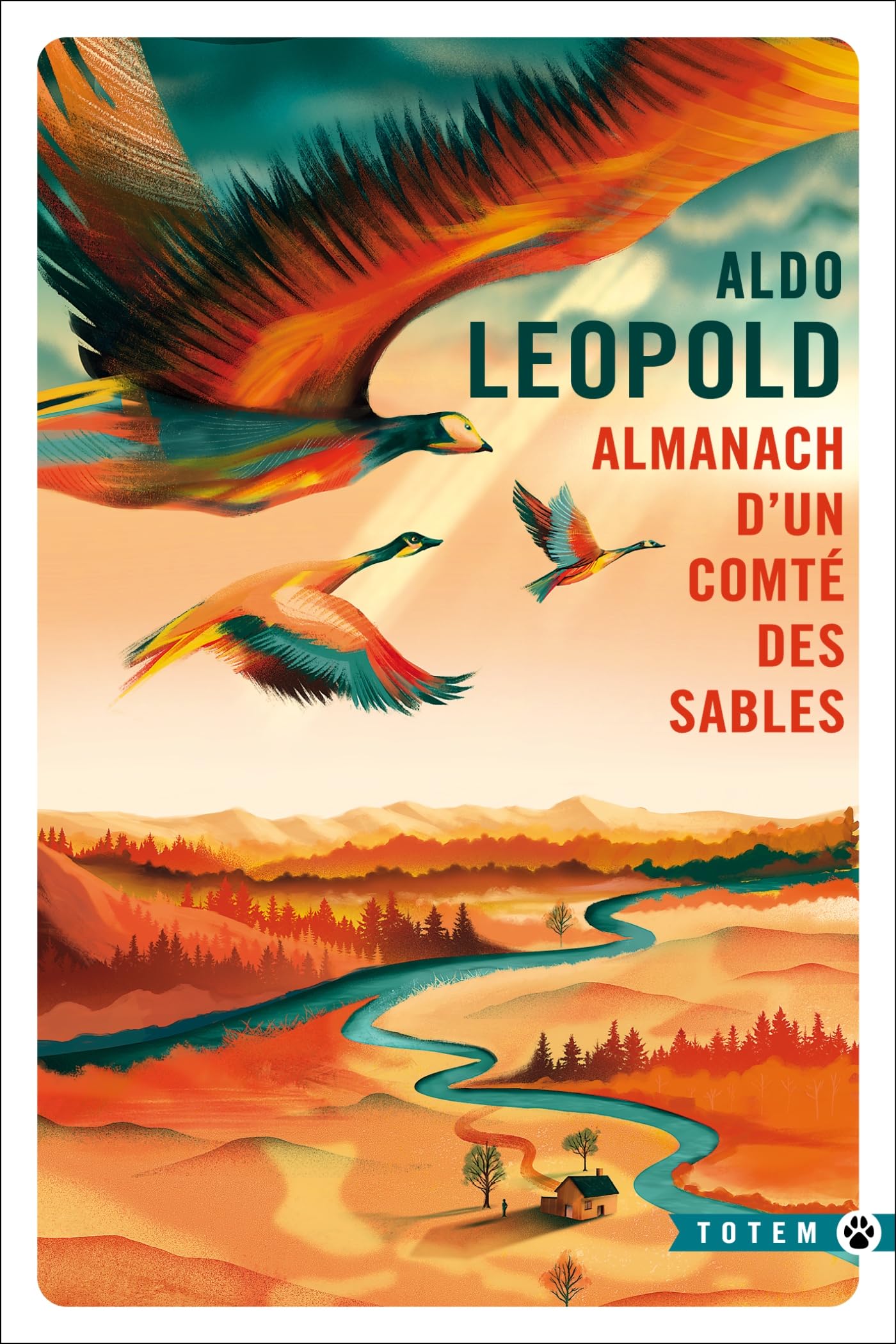
Le prophète de l’écologie était d’abord un forestier. L’Almanach d’un comté des sables s’appuie sur 20 ans de travail de terrain. Dans ce recueil d’articles, on découvre l’élaboration progressive de sa conception de la protection de la nature.Dans le contexte contemporain d’innovation et de réflexion sur la libre évolution, Leopold nous ramène aux fondamentaux de la protection de la nature. Textes sélectionnés par Daniel Vallauri et Jean-Claude Génot

Je ne me fais pas dillusions sur la rapidit avec laquelle une conscience cologique peut porter ses fruits. Il a fallu dix-neuf sicles pour dfinir un code thique mme de rgir la conduite des hommes entre eux, et rien nest encore parfait. Llaboration dun code de conduite portant sur les relations entre lhomme et la terre pourrait bien prendre autant de temps.

2014 REPRINT BY THE WISCONSIN SOCIETY FOR ORNITHOLOGY. SAME COVER AS STOCK PHOTO SHOWN. MINOR SCUFFING & EDGE WEAR ON COVERS. MINOR DISCOLORATION ON FRONT COVER. NO MARKING OR WRITING FOUND WITHIN BOOK.
This work has been selected by scholars as being culturally important, and is part of the knowledge base of civilization as we know it. This work was reproduced from the original artifact, and remains as true to the original work as possible. Therefore, you will see the original copyright references, library stamps (as most of these works have been housed in our most important libraries around the world), and other notations in the work. This work is in the public domain in the United States of America, and possibly other nations. Within the United States, you may freely copy and distribute this work, as no entity (individual or corporate) has a copyright on the body of the work.As a reproduction of a historical artifact, this work may contain missing or blurred pages, poor pictures, errant marks, etc. Scholars believe, and we concur, that this work is important enough to be preserved, reproduced, and made generally available to the public. We appreciate your support of the preservation process, and thank you for being an important part of keeping this knowledge alive and relevant.

Aldo Leopold n'est pas inconnu en France, où Aubier avait publié déjà en 1995 son Almanach d'un comté des sables. Ce recueil était constitué en grande partie du texte éponyme, qu'accompagnaient plusieurs essais. L'Almanach est un texte posthume : Leopold venait tout juste d'en apprendre la publication future lorsqu'il mourut d'une crise cardiaque le 21 avril 1948. Il avait 61 ans et laissait, outre ce dernier manuscrit, une œuvre considérable comprenant plus de mille textes publiés et inédits, articles, essais, recherches, études… Pour l'essentiel conservés à l'Université du Wisconsin, les écrits de Leopold témoignent aussi de sa contribution essentielle à la structuration de l'écologie comme science et pratique. Les textes rassemblés dans ce volume conservent tous un écho aujourd'hui : la déforestation des campagnes (et la destruction des haies, maladie décidément contagieuse) ; l'érosion des terres pauvres ; la destruction des marais ; l'expansion incontrôlée des villes à des fins purement économiques (Leopold a sur le dieu Automobiliste des considérations on ne peut plus lucides) ; la disparition des zones inexplorées ; l'importance des fermiers comme gardiens et conservateurs de la terre ; la surexploitation des forêts ; la bonne gestion du gibier ; la destruction parfois ignare des mauvaises herbes (ou de ce que l'on considère à tort comme telles) et des espèces sauvages. Également au sommaire de notre Pour la santé de la terre, trois essais fondamentaux sur l'écologie de Leopold, « Quelques principes essentiels de la conservation dans le Sud-Ouest des États-Unis » (1923), « Éthique de la préservation de la nature » (1933) et « Considérations biotiques sur la terre » (1939) : il y aborde les grands équilibres écologiques et les chaînes alimentaires, à la compréhension desquels il a largement contribué. Pour la santé de la terre fait aussi découvrir un autre « Almanac », celui, dédié à la conservation de la nature, qu'ont reconstitué le philosophe J. Baird Callicott et l'environnementaliste Eric T. Freyfogle, à lire dans le droit fil de L'Almanach d'un comté des sables, avec lequel il partage quelques chroniques. Et l'inclassable « Les prophètes forestiers », où Leopold s'interroge avec la douce ironie qui est l'un de ses registres favoris sur les pratiques écologiques et sylvicoles des anciens Hébreux. Avec les 14 textes, largement inédits en français rassemblés dans Pour la santé de la terre, nous espérons contribuer à la redécouverte en France d'un immense penseur et acteur de l'écologie, dont les écrits à la langue magnifique ont encore valeur d'enseignement.
Sand County Almanac
by Aldo Leopold
![A Hunter's Notes on Doves in the Rio Grande Valley Volume 23 1921 [Leather Bound]](https://m.media-amazon.com/images/S/compressed.photo.goodreads.com/books/1696001534i/147834435.jpg)
{ 19.78 x 26.13 cms} Leather Binding on Spine and Corners with Golden Leaf Printing on round Spine (extra customization on request like complete leather, Golden Screen printing in Front, Color Leather, Colored book etc.) Reprinted in 2017 with the help of original edition published long back [1921]. This book is printed in black & white, sewing binding for longer life, printed on high quality Paper, re-sized as per Current standards, professionally processed without changing its contents. As these are old books, we processed each page manually and make them readable but in some cases some pages which are blur or missing or black spots. We expect that you will understand our compulsion in these books. We found this book important for the readers who want to know more about our old treasure so we brought it back to the shelves. Hope you will like it and give your comments and suggestions. - English, - Volume 23, Pages 50. EXTRA 10 DAYS APART FROM THE NORMAL SHIPPING PERIOD WILL BE REQUIRED FOR LEATHER BOUND BOOKS. COMPLETE LEATHER WILL COST YOU EXTRA US$ 25 APART FROM THE LEATHER BOUND BOOKS. {FOLIO EDITION IS ALSO AVAILABLE.} Complete A Hunter's Notes on Doves in the Rio Grande Valley Volume 23 1921 Aldo Leopold
Almanach d'un comté des sables
by Aldo Leopold
![Report on game survey of Ohio : submitted to the Game Restoration Committee, Sporting Arms and Ammunition Manufacturers' Institute / by Aldo Leopold. 1928 [Leather Bound]](https://m.media-amazon.com/images/S/compressed.photo.goodreads.com/books/1699647424i/147062673.jpg)
Leather Binding on Spine and Corners with Golden Leaf Printing on round Spine (extra customization on request like complete leather, Golden Screen printing in Front, Color Leather, Colored book etc.) Reprinted in 2022 with the help of original edition published long back [1928]. This book is printed in black & white, sewing binding for longer life, Printed on high quality Paper, re-sized as per Current standards, professionally processed without changing its contents. As these are old books, we processed each page manually and make them readable but in some cases some pages which are blur or missing or black spots. If it is multi volume set, then it is only single volume, if you wish to order a specific or all the volumes you may contact us. We expect that you will understand our compulsion in these books. We found this book important for the readers who want to know more about our old treasure so we brought it back to the shelves. Hope you will like it and give your comments and suggestions. - English, Pages 204. EXTRA 10 DAYS APART FROM THE NORMAL SHIPPING PERIOD WILL BE REQUIRED FOR LEATHER BOUND BOOKS. COMPLETE LEATHER WILL COST YOU EXTRA US$ 25 APART FROM THE LEATHER BOUND BOOKS. {FOLIO EDITION IS ALSO AVAILABLE.} Complete Report on game survey of Ohio : submitted to the Game Restoration Committee, Sporting Arms and Ammunition Manufacturers' Institute / by Aldo Leopold. 1928 Leopold, Aldo, -.
![Rare Aldo Leopold A SAND COUNTY ALMANAC 1949 Oxford University Press First Edition [Hardcover] Aldo Leopold](https://m.media-amazon.com/images/S/compressed.photo.goodreads.com/books/1698706370i/137805984.jpg)
Rare Aldo Leopold A SAND COUNTY ALMANAC 1949 Oxford University Press First Edition [Hardcover] Aldo Leopold
by Aldo Leopold
This rare and vintage book is a perfect addition to any bibliophile's collection
Report on Huron Mountain Club
by Aldo Leopold
EQUILIBRIO ECOLOGICO
by Aldo Leopold

Wild blue flame
by Aldo Leopold
Wild blue flameAldo Leopold, the father of environmental ethics, was introduced to Korean readers through "The Twelve Months of the Sand Army," a bible by modern environmentalists, but he is still a low figure to us. But Leopold is an important figure in US environmental movement history. As a Forest Service official, naturalist, professor, and writer, he tried to live our lives without harming the land. It also proposed a new ethical system for land. This book presents Aldo Leopolds tireless passion for life and his nature, with a wealth of photographic material, which has greatly influenced environmental movement and ideas today.

Ein Jahr im Sand County
by Aldo Leopold

Wildlife Conservation and Management
by Aldo Leopold

野性のうたが聞こえる
by Aldo Leopold