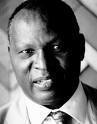
Ahmadou Kourouma
Ahmadou Kourouma, (November 24, 1927 – December 11, 2003) was an Ivorian novelist. The eldest son of a distinguished Malinké family, Ahmadou Kourouma was born in 1927 in Côte d'Ivoire. Raised by his uncle, he initially pursued studies in Bamako, Mali. From 1950 to 1954, when his country was still under French colonial control, he participated in French military campaigns in Indochina, after which he journeyed to France to study mathematics in Lyon. Kourouma returned to his native Côte d'Ivoire after it won its independence in 1960, yet he quickly found himself questioning the government of Félix Houphouët-Boigny. After brief imprisonment, Kourouma spent several years in exile, first in Algeria (1964-1969), then in Cameroon (1974-1984) and Togo (1984-1994), before finally returning to live in Côte d'Ivoire. Determined to speak out against the betrayal of legitimate African aspirations at the dawn of independence, Kourouma was drawn into an experiment in fiction, his first novel, Les soleils des indépendances (The Suns of Independence, 1970). Les soleils des indépendances contains a critical treatment of post-colonial governments in Africa. Twenty years later, his second book Monnè, outrages et défis, a history of a century of colonialism, was published. In 1998, he published En attendant le vote des bêtes sauvages, (translated as Waiting for the Wild Beasts to Vote), a satire of post colonial Africa in the style of Voltaire in which a griot recounts the story of a tribal hunter's transformation into a dictator, inspired by president Gnassingbé Eyadéma of Togo. In 2000, he published Allah n'est pas obligé (translated as Allah is Not Obliged), a tale of an orphan who becomes a child soldier when traveling to visit his aunt in Liberia. At the outbreak of civil war in Côte d'Ivoire in 2002, Kourouma stood against the war as well as against the concept of Ivorian nationalism, calling it "an absurdity which has led us to chaos." President Laurent Gbagbo accused him of supporting rebel groups from the north of the country. In France, each of Ahmadou Kourouma's novels has been greeted with great acclaim, sold exceptionally well, and been showered with prizes including Prix Renaudot in year 2000 and The Prix Goncourt des Lycéens for Allah n'est pas obligé . In the English-speaking world, Kourouma has yet to make much of an impression: despite some positive reviews, his work remains largely unknown outside college classes in African fiction. At the time of his death, he was working on a sequel to Allah n'est pas obligé, entitled Quand on refuse on dit non (translated roughly as When One Disagrees, One Says No), in which the protagonist of the first novel, a child soldier, is demobilized and returns to his home in Côte d'Ivoire, in which a new regional conflict has arisen.
20 Books Written

Characterized as "the African Voltaire," Ahmadou Kourouma garnered enormous critical and popular praise upon the 1998 release of his third novel, En attendant le vote des b�tes sauvages. Kourouma received the Prix des Tropiques, among other prestigious prizes, for that book, and the French edition went on to sell 100,000 copies.Carrol F. Coates's translation, Waiting for the Vote of the Wild Animals, introduces English-language audiences to Kourouma's irreverent view of the machinations of the African dictators who played the West against the East during the thirty years of the cold war. Profiting from western financial support, the dictators built palaces, shrines, and hunting preserves for their personal gratification as they paraded about with numerous mistresses, marabouts, and advisers. In the style of a s�r� who sings the praises of the thirty-year career of the master hunter and president Koyaga (a fictionalized Gnassingb� Eyadema of Togo) readers are treated to a brief overview of the French colonization of the "Naked people," hunters in West African mountain country, followed by the account of Koyaga's assumption of power through treachery, assassination, and sorcery. In an interview Kourouma noted the Togolese assumption that if the people did not turn out to vote for Eyadema in the democratic elections following the cold war, the wild animals would come out of the forest to vote for him. The novel ends with an apocalyptic stampede, although the animals are probably fleeing a bush conflagration rather than running to the polls.

ALLAH IS NOT OBLIGED TO BE FAIR ABOUT ALL THE THINGS HE DOES HERE ON EARTH.These are the words of the boy soldier Birahima in the final masterpiece by one of Africa’s most celebrated writers, Ahmadou Kourouma. When ten-year-old Birahima's mother dies, he leaves his native village in the Ivory Coast, accompanied by the sorcerer and cook Yacouba, to search for his aunt Mahan. Crossing the border into Liberia, they are seized by rebels and forced into military service. Birahima is given a Kalashnikov, minimal rations of food, a small supply of dope and a tiny wage. Fighting in a chaotic civil war alongside many other boys, Birahima sees death, torture, dismemberment and madness but somehow manages to retain his own sanity. Raw and unforgettable, despairing yet filled with laughter, Allah Is Not Obliged reveals the ways in which children's innocence and youth are compromised by war.

Quel sera le sort de Fama, authentique prince malinké, aux temps de l'indépendance et du parti unique ? L'ancien et le nouveau s'affrontent en un duel tout à la fois tragique et dérisoire tandis que passe l'histoire, avec son cortège de joies et de souffrances. Au-delà de la fable politique, Ahmadou Kourouma restitue comme nul autre toute la profondeur de la vie africaine, mêlant le quotidien et le mythe dans une langue réinventée au plus près de la condition humaine. Dès sa parution en 1970, ce livre s'est imposé comme un des grands classiques de la littérature africaine.

Où l'on retrouve Birahima, l'enfant-soldat desguerres tribales de Sierra Leone et du Liberia.Maintenant démobilisé, il se débrouille à Daloa,une ville du Sud de la Côte-d'Ivoire où il exerce lafonction d'aboyeur pour une compagnie de gbagas,les taxis-brousse locaux. Mais il rêve toujours derichesse et de gloire. Surtout, il n'a d'yeux que pourFanta, belle comme un masque gouro. Lorsque lafille décide de fuir vers le Nord, Birahima se proposecomme garde du corps. Chemin faisant. Fantaentreprend de faire l'éducation de son jeune compagnon.Elle lui raconte l'histoire de leur pays, desorigines à nos jours, que le gamin interprète à safaçon naïve et malicieuse. Et puis que ne donnerait-ilpas pour boire ainsi les paroles de Fanta ?

Ahmadou Kourouma's long-awaited novel - hailed by critics as "a major event in the history of French-language African literature" and "a masterpiece of literary creation" - tells the story of Djigui Keita, king of fictional Soba. Relying on ancestral magic, faith in Allah, and baked-mud fortifications, Djigui finds himself powerless in the face of oncoming French colonial troops and falls into the fateful politics of conciliation, compromise, and betrayal that still pervades postcolonial Africa.Tyrannical chief and authentic victim of historical forces, opportunist and pious humanitarian, Djigui Keita, the "AgeOldMan" of his people, is brutally awakened from the tranquillity of traditional certitudes and dragged into a colonial tragedy "made in Europe." Enduring the monnew - the insults, outrages, trials, contempts, and humiliations - of colonialism, Djigui acquires the dimensions of a tragic hero. Ultimately, deep meditation, inspired by the infinite sufferings of his subjects during the more than 125 years of his reign, reveals to Djigui the true nature of people and their acts.A novel as rich in natural resources as the African continent, Monnew shines with the gold of poetic comedy and plunges into the quagmire of the African tragedy.Kourouma writes with the accent of his native Malinke language and culture, conveying and analyzing the intricate mechanisms and linguistic complications of postcolonial Africa. In a tender, virile, rigorously intelligent voice, Kourouma uses his prodigious powers of poetry, humor, and stylistic invention to hasten the end of "the seasons of bitterness," the centuries of African sacrifice.

Pourquoi Mamie Aïssata est-elle formellement opposée aux rites d'initiation ? Mathieu vient de débarquer à Abidjan, en Côte-d'Ivoire, dans la famille de son père. Ses cousins doivent être initiés au bois sacré, dans le nord du pays. Mais on dit que l'initiation fait encourir des dangers mortels à ceux qui la subissent. Mamie Aïssata arrivera-t-elle à empêcher Yacouba, chasseur et prêtre traditionnel, de ravir sa fille pour l'exposer à ces épreuves initiatiques ?


Légendes, extraits de chansons, paroles de sages africains, ces « paroles » de Youssou N'Dour, Salif Keita et Amadou Hampaté Bâ entre autres, nous conduisent du Mali au Burkina Faso, du Cameroun au Sénégal, à la rencontre des griots, les fameux maîtres de la parole dans la société malinké d'Afrique de l'ouest. Sorte d'aèdes ou de bardes, ils ont pour rôle de magnifier l'histoire de la famille à laquelle ils sont attachés. À la qualité des textes s'ajoutent les splendides photographies des oeuvres du sculpteur Ousmane Sow dont la réputation n'est plus à faire.

Independentzien eguzkiak
by Ahmadou Kourouma
Erritmo narratibo afrikarrera egokitzen dut hizkuntza [...]. Liburu hau afrikarrei zuzentzen zaie. Malinkeraz pentsatu nuen eta frantsesez idatzi, naturaltzat jotzen dudan askatasun bat hartuz hizkuntza klasikoarekiko [...]. Zer egin nuen? Besterik gabe, nire izaera askatu, nire pentsamendua adierazteko zurrunegia zitzaidan hizkuntza klasiko bat itxuraldatuz. Beraz, malinkera frantsesera itzuli nuen, hizkuntza frantsesa hautsiz erritmo afrikarra berraurkitzeko eta berreraikitzeko. Estilo malinke bat sortzen ahalegindu nintzen. Malinkeraz hausnartzen nuen, eta saiatzen nintzen aurkezten nola hautematen zuen malinke batek gertaera jakin bat, nola agertzen zitzaion bere gogoan. Malinkeraz pentsatzen nuen, eta kontua zen gero malinkeraz egindako arrazoiketa intelektual hori berritzultzea, transmititzea.

Quand on refuse on dit non (Cadre Rouge t. 1)
by Ahmadou Kourouma
Les soleils des ind�pendances
by Ahmadou Kourouma
The Suns of Independence by Ahmadou Kourouma Adrian Adams
by Ahmadou Kourouma
The Suns of Independence
by Ahmadou Kourouma
SUNS OF INDEPENDENCE.
by Ahmadou Kourouma
Der Schwarze Fuerst
by Ahmadou Kourouma

Esperant el vot de les feres
by Ahmadou Kourouma
coleccion EL BALANCI numero 448, primera edicion octubre 2002, 347 paginas, texto en catalan, tapa blanda, en buen estado, con el sello del Departament de Cultura de la Generalitat de Catalunya

Le forgeron, homme de savoir
by Ahmadou Kourouma
Ahmadou Kourouma, grand écrivain de Côte d'Ivoire, a conçu (à la demande de son éditeur italien) une série d'albums sur les hommes clés de la culture africaine : un cahier documentaire et une fiction pour les enfants de 10-12 ans et leurs parents, complétés par un glossaire et de nombreuses photos.Des illustrations de Giorgio Bacchin.

Le grand livre des proverbes africains
by Ahmadou Kourouma

Homens da África
by Ahmadou Kourouma
Ricamente ilustrado com fotografias e imagens, o livro é um retrato detalhado de traços culturais da África Ocidental descritos por meio do cotidiano e dos costumes de quatro personagens emblemáticas: o griô (poeta, músico e contador de histórias), o caçador, o príncipe e o ferreiro. A obra é dividida em quatro capítulos, combinando textos informativos e ficcionais sobre cada uma dessas personagens. Com isso, o leitor conhece diversos aspectos da vida nas aldeias africanas, como a arte, os costumes, a religião, as palavras, os ritos, as moradias e as diferentes organizações sociais e políticas. A edição brasileira conta com o apoio da Casa das Áfricas.

Kourouma
by Ahmadou Kourouma
comprend:Les Soleils des IndépendancesMonnè, outrages et défisEn attendant le vote des bêtes sauvagesAllah n'est pas obligéQuand on refuse on dit nonLe Diseur de vérité