
Adam Hochschild
Hochschild was born in New York City. As a college student, he spent a summer working on an anti-government newspaper in South Africa and subsequently worked briefly as a civil rights worker in Mississippi in 1964. Both were politically pivotal experiences about which he would later write in his book Finding the Trapdoor. He later was part of the movement against the Vietnam War, and, after several years as a daily newspaper reporter, worked as a writer and editor for the leftwing Ramparts magazine. In the mid-1970s, he was one of the co-founders of Mother Jones. Hochschild's first book was a memoir, Half the Way Home: a Memoir of Father and Son (1986), in which he described the difficult relationship he had with his father. His later books include The Mirror at Midnight: a South African Journey (1990; new edition, 2007), The Unquiet Ghost: Russians Remember Stalin (1994; new edition, 2003), Finding the Trapdoor: Essays, Portraits, Travels (1997), which collects his personal essays and reportage, and King Leopold's Ghost: A Story of Greed, Terror, and Heroism in Colonial Africa (1998; new edition, 2006), a history of the conquest and colonization of the Congo by Belgium's King Léopold II. His Bury the Chains: Prophets and Rebels in the Fight to Free an Empire's Slaves, published in 2005, is about the antislavery movement in the British Empire. Hochschild has also written for The New Yorker, Harper's Magazine, The New York Review of Books, The New York Times Magazine, and The Nation. He was also a commentator on National Public Radio's All Things Considered. Hochschild's books have been translated into twelve languages. A frequent lecturer at Harvard's annual Nieman Narrative Journalism Conference and similar venues, Hochschild lives in San Francisco and teaches writing at the Graduate School of Journalism at the University of California, Berkeley. He is married to sociologist Arlie Russell Hochschild. Taken from http://en.wikipedia.org/wiki/Adam_Hoc...
13 Books Written

Bury the Chains: Prophets and Rebels in the Fight to Free an Empire's Slaves
by Adam Hochschild
Rating: 4.3 ⭐
• 5 recommendations ❤️
From the author of the widely acclaimed King Leopold's Ghost comes the taut, gripping account of one of the most brilliantly organized social justice campaigns in history - the fight to free the slaves of the British Empire. In early 1787, twelve men - a printer, a lawyer, a clergyman, and others united by their hatred of slavery - came together in a London printing shop and began the world's first grass-roots movement, battling for the rights of people on another continent. Masterfully stoking public opinion, the movement's leaders pioneered a variety of techniques that have been adopted by citizens' movements ever since, from consumer boycotts to wall posters and lapel buttons to celebrity endorsements. A deft chronicle of this groundbreaking antislavery crusade and its powerful enemies, Bury the Chains gives a little-celebrated human rights watershed its due at last.

From the acclaimed, best-selling author Adam Hochschild, a sweeping history of the Spanish Civil War, told through a dozen characters, including Ernest Hemingway and George Orwell: a tale of idealism, heartbreaking suffering, and a noble cause that failed For three crucial years in the 1930s, the Spanish Civil War dominated headlines in America and around the world, as volunteers flooded to Spain to help its democratic government fight off a fascist uprising led by Francisco Franco and aided by Hitler and Mussolini. Today we're accustomed to remembering the war through Hemingway’s For Whom the Bell Tolls and Robert Capa’s photographs. But Adam Hochschild has discovered some less familiar yet far more compelling characters who reveal the full tragedy and importance of the war: a fiery nineteen-year-old Kentucky woman who went to wartime Spain on her honeymoon, a Swarthmore College senior who was the first American casualty in the battle for Madrid, a pair of fiercely partisan, rivalrous New York Times reporters who covered the war from opposites sides, and a swashbuckling Texas oilman with Nazi sympathies who sold Franco almost all his oil — at reduced prices, and on credit. It was in many ways the opening battle of World War II, and we still have much to learn from it. Spain in Our Hearts is Adam Hochschild at his very best.

King Leopold's Ghost: A Story of Greed, Terror, and Heroism in Colonial Africa
by Adam Hochschild
Rating: 4.2 ⭐
In the 1880s, as the European powers were carving up Africa, King Leopold II of Belgium seized for himself the vast and mostly unexplored territory surrounding the Congo River. Carrying out a genocidal plundering of the Congo, he looted its rubber, brutalized its people, and ultimately slashed its population by ten million--all the while shrewdly cultivating his reputation as a great humanitarian. Heroic efforts to expose these crimes eventually led to the first great human rights movement of the twentieth century, in which everyone from Mark Twain to the Archbishop of Canterbury participated. King Leopold's Ghost is the haunting account of a megalomaniac of monstrous proportions, a man as cunning, charming, and cruel as any of the great Shakespearean villains. It is also the deeply moving portrait of those who fought Leopold: a brave handful of missionaries, travelers, and young idealists who went to Africa for work or adventure and unexpectedly found themselves witnesses to a holocaust. Adam Hochschild brings this largely untold story alive with the wit and skill of a Barbara Tuchman. Like her, he knows that history often provides a far richer cast of characters than any novelist could invent. Chief among them is Edmund Morel, a young British shipping agent who went on to lead the international crusade against Leopold. Another hero of this tale, the Irish patriot Roger Casement, ended his life on a London gallows. Two courageous black Americans, George Washington Williams and William Sheppard, risked much to bring evidence of the Congo atrocities to the outside world. Sailing into the middle of the story was a young Congo River steamboat officer named Joseph Conrad. And looming above them all, the duplicitous billionaire King Leopold II. With great power and compassion, King Leopold's Ghost will brand the tragedy of the Congo--too long forgotten--onto the conscience of the West

World War I stands as one of history's most senseless spasms of carnage, defying rational explanation. In a riveting, suspenseful narrative with haunting echoes for our own time, Adam Hochschild brings it to life as never before. He focuses on the long-ignored moral drama of the war's critics, alongside its generals and heroes. Thrown in jail for their opposition to the war were Britain's leading investigative journalist, a future winner of the Nobel Prize for Literature, and an editor who, behind bars, published a newspaper for his fellow inmates on toilet paper. These critics were sometimes intimately connected to their enemy hawks: one of Britain's most prominent women pacifist campaigners had a brother who was commander in chief on the Western Front. Two well-known sisters split so bitterly over the war that they ended up publishing newspapers that attacked each other. Today, hundreds of military cemeteries spread across the fields of northern France and Belgium contain the bodies of millions of men who died in the war to end all wars. Can we ever avoid repeating history?
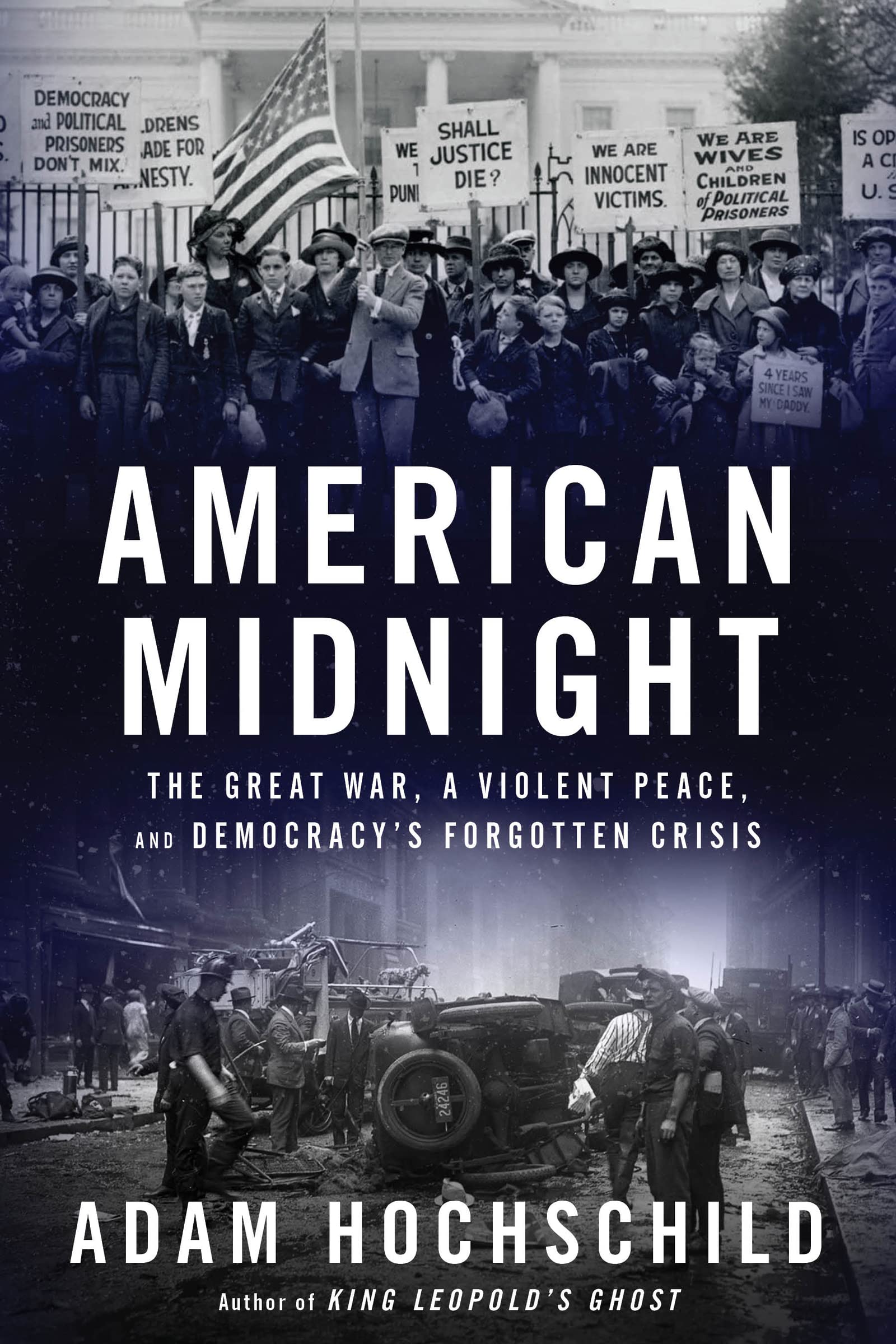
American Midnight: The Great War, a Violent Peace, and Democracy's Forgotten Crisis
by Adam Hochschild
Rating: 4.2 ⭐
From award-winning, New York Times bestselling historian Adam Hochschild, a fast-paced, revelatory new account of a pivotal but neglected period in American history: World War I and its stormy aftermath, when bloodshed and repression on the home front nearly doomed American democracy.The nation was on the brink. Angry mobs burned Black churches to the ground and chased down pacifists and immigrants. Well over a thousand men and women were jailed solely for what they had written or said, even in private. An astonishing 250,000 people joined a nationwide vigilante group—sponsored by the Department of Justice.This was America during and after the Great War: a brief but appalling era blighted by torture, censorship, and killings. Adam Hochschild brings to life this troubled period, which stretched from 1917 to 1921, through the interwoven tales of a colorful cast of characters: some well-known, among them the sphinxlike Woodrow Wilson and the ambitious young bureaucrat J. Edgar Hoover; others less familiar, such as the fiery antiwar advocate Kate Richards O’Hare and the outspoken Leo Wendell, a labor radical who was frequently arrested and wholly trusted by his comrades—but who was in fact Hoover’s star undercover agent.A groundbreaking work of narrative history, American Midnight recalls these horrifying yet inspiring four years, when some brave Americans strove to keep their fractured country democratic, while ruthless others stimulated toxic currents of racism, nativism, red-baiting, and contempt for the rule of law—poisons that feel ominously familiar today.

Although some twenty million people died during Stalin’s reign of terror, only with the advent of glasnost did Russians begin to confront their memories of that time. In 1991, Adam Hochschild spent nearly six months in Russia talking to gulag survivors, retired concentration camp guards, and countless others. The result is a riveting evocation of a country still haunted by the ghost of Stalin.

Rebel Cinderella: From Rags to Riches to Radical, the Epic Journey of Rose Pastor Stokes
by Adam Hochschild
Rating: 3.7 ⭐
From the best-selling author of King Leopold's Ghost and Spain in Our Hearts comes the astonishing but forgotten story of an immigrant sweatshop worker who married an heir to a great American fortune and became one of the most charismatic radical leaders of her time. Rose Pastor arrived in New York City in 1903, a Jewish refugee from Russia who had worked in cigar factories since the age of eleven. Two years later, she captured headlines across the globe when she married James Graham Phelps Stokes, scion of one of the legendary 400 families of New York high society. Together, this unusual couple joined the burgeoning Socialist Party and, over the next dozen years, moved among the liveliest group of activists and dreamers this country has ever seen. Their friends and houseguests included Emma Goldman, Big Bill Haywood, Eugene V. Debs, John Reed, Margaret Sanger, Jack London, and W.E.B. Du Bois. Rose stirred audiences to tears and led strikes of restaurant waiters and garment workers. She campaigned alongside the country’s earliest feminists to publicly defy laws against distributing information about birth control, earning her notoriety as “one of the dangerous influences of the country” from President Woodrow Wilson. But in a way no one foresaw, her too-short life would end in the same abject poverty with which it began. By a master of narrative nonfiction, Rebel Cinderella unearths the rich, overlooked life of a social justice campaigner who was truly ahead of her time.

History lies heavily on South Africa, and Adam Hochschild brings to bear a lifetime's familiarity with the country in an eye-opening work that blends history and reportage. Hochschild looks at the tensions of modern South Africa through a dramatic prism: the pivotal nineteenth-century Battle of Blood River -- which determined whether the Boers or the Zulus would control that part of the world -- and its contentious commemoration by rival groups 150 years later. This incisive book offers an unusual window onto a society that remains divided. In his epilogue, Hochschild extends his view to the astonishing political changes that have occurred in the country in recent years -- and the changes yet to be made.

From the author of the best-selling King Leopold's Ghost, this haunting and deeply honest memoir tells of Adam Hochschild's conflicted relationship with his father, the head of a multinational mining corporation. The author lyrically evokes his privileged childhood on an Adirondack estate, a colorful uncle who was a pioneer aviator and fighter ace, and his first explorations of the larger world he encountered as he came of age in the tumultuous 1960s. But above all this is a story of a father and his only son and of the unexpected peace finally made between them.

In this rich collection, bestselling author Adam Hochschild has selected and updated over two dozen essays and pieces of reporting from his long career. Threaded through them all is his concern for social justice and the people who have fought for it. The articles here range from a California gun show to a Finnish prison, from a Congolese center for rape victims to the ruins of gulag camps in the Soviet Arctic, from a stroll through construction sites with an ecologically pioneering architect in India to a day on the campaign trail with Nelson Mandela. Hochschild also talks about the writers he loves, from Mark Twain to John McPhee, and explores such far-reaching topics as why so much history is badly written, what bookshelves tell us about their owners, and his front-row seat for the shocking revelation in the 1960s that the CIA had been secretly controlling dozens of supposedly independent organizations. With the skills of a journalist, the knowledge of a historian, and the heart of an activist, Hochschild shares the stories of people who took a stand against despotism, spoke out against unjust wars and government surveillance, and dared to dream of a better and more just world.

Adam Hochschild was born in New York City in 1942. His first book, Half The Way Home: A Memoir Of Father And Son, was published in 1986. It was followed by The Mirror At Midnight: A South African Journey, and The Unquiet Ghost: Russians Remember Stalin. The Unquiet Ghost won the Madeline Dane Ross Award of the Overseas Press Club of America, given to "the best foreign correspondent in any medium showing concern for the human condition. Hochschild's work has also won prizes from the World Affairs Council, the Eugene V. Debs Foundation and the Society of American Travel Writers. An anthology of his shorter pieces, Finding The Trapdoor: Essays, Portraits, Travels, won the 1998 PEN/Spielvogel-Diamonstein Award for the Art of the Essay. Hochschild's King Leopold's Ghost: A Story Of Greed, Terror And Heroism. In Colonial Africa was a finalist for the National Book Critics Circle Award. It, Half The Way Home, and The Unquiet Ghost were all named Notable Books of the Year by the New York Times Book Review. His books have been translated into six languages. Besides his books, Hochschild has also written for The New Yorker, Harper's, The New York Review of Books, The New York Times Magazine, Mother Jones, The Nation, and many other newspapers and magazines. He is a former commentator on National Public Radio's "All Things Considered." Hochschild teaches writing at the Graduate School of Journalism at the University of California at Berkeley, and has been a guest teacher at other campuses in the U.S. and abroad. In 1997-98, he was a Fulbright Lecturer in India. He lives in San Francisco with his wife Arlie, the sociologist and author. They have two sons.

Anabel está visitando Loch Ness con su familia. Ella satisface y hace amigos con el monstruo de Loch Ness cuando ella descubre que él tiene gusto del chocolate.

Half the Way Home by Adam Hochschild
by Adam Hochschild