
A. Manette Ansay
A. Manette Ansay grew up in Wisconsin among 67 cousins and over 200 second cousins. She is the author of six novels, including Good Things I Wish You (July, 2009), Vinegar Hill, an Oprah Book Club Selection, and Midnight Champagne, a finalist for the National Book Critics Circle Award, as well as a short story collection, Read This and Tell Me What It Says, and a memoir, Limbo. Her awards include a National Endowment for the Arts Grant, a Pushcart Prize, the Nelson Algren Prize, and two Great Lakes Book Awards. She lives with her daughter in Florida, where she teaches in the MFA program at the University of Miami.
22 Books Written

In a stark, troubling, yet ultimately triumphant celebration of self-determination, award-winning author A. Manette Ansay re-creates a stifling world of guilty and pain, and the tormented souls who inhabit it. It is 1972 when circumstance carries Ellen Grier and her family back to Holly's Field, Wisconsin. Dutifully accompanying her newly unemployed husband, Ellen has brought her two children into the home of her in-laws on Vinegar Hill--a loveless house suffused with the settling dust of bitterness and routine--where calculated cruelty is a way of life preserved and perpetuated in the service of a rigid, exacting and angry God. Behind a facade of false piety, there are sins and secrets in this place that could crush a vibrant young woman's passionate spirit. And here Ellen must find the straight to endure, change, and grow in the all-pervading darkness that threatens to destroy everything she is and everyone she loves.

New York Times bestselling author A. Manette Ansay delivers the unforgettable story of two families united by tragedy -- and one woman's deeply emotional journey toward a choice she'd never thought possible On an ordinary morning in Fox Harbor, Wisconsin, Meg and Rex Van Dorn's lives are irrevocably changed when a drunk driver slams into Meg's car, killing the couple's six-year-old son, Evan. In a town in which everyone knows everybody else, it's no surprise that Meg and the driver, Cindy Ann Kreisler, were once the best of friends. Now, as Meg recovers from her own injuries, she and Rex find themselves unable to cope with their anger and despair, especially after Cindy Ann returns -- with a mere slap on the wrist -- to the life she lived before the living in a beautiful house, enjoying her own three daughters, all of whom walked away from the accident unharmed. Mornings, we woke with an ache in our throats, a sourness in our stomachs, that had nothing to do with Evan. The truth was that, with each passing month, he was harder to remember, harder to see. I felt as if I were grasping at the color of water, the color of the wind or the sky. And this only made me angrier. My mind returned, again and again, to Cindy Ann, to what she'd done. When I passed Evan's room, the closed door like a fist, I thought about how Cindy Ann had destroyed us. When I saw other people's children, I promised myself that someday, Cindy Ann would pay. In their rage and grief, Meg and Rex buy a boat to sail around the world, hoping to put as much distance between themselves and Cindy Ann Kreisler as possible. Adrift in the company of other live-board cruisers, Meg tries to believe that she and Rex have left their bitterness behind. But when she returns to Fox Harbor for her older brother's wedding, she is forced to face the complex ties that bind her to the woman who has wounded her so badly. For, as Meg knows better than anyone, Cindy Ann has secrets and sorrows of her own, dating back to the summer of their friendship. Impassioned, insightful, and beautifully written, Blue Water is the story of people learning to face the unthinkable -- a compelling affirmation of the human potential for forgiveness, redemption, and grace.

April Liesgang and Caleb Shannon have known each other for just three short months, so their Valentine's Day wedding at a chapel near the shores of Lake Michigan has both families in an uproar. As the festivities unfold (and the cash bar opens), everyone has an opinion and a lively prediction about April and Caleb's union, each the reflection of a different marital experience. Meanwhile, at the nearby Hideaway Lodge, a domestic quarrel ends in tragedy. As April and Caleb's life together begins, death parts another man and woman in angry violence—and as the two stories gradually intersect, their juxtaposition explores the tangled roots of vulnerability and desire. By the time the last polka has been danced and the bouquet tossed, Midnight Champagne has cast an extraordinary spell. From the novel's opening epigraph from Chekhov—"If you fear loneliness, then marriage is not for you"—to its final moments in the honeymoon suite, A. Manette Ansay weaves tenderness and fury, passion and wonder into a startling tapestry of love in all its paradox and power.

The acclaimed author of Vinegar Hill returns with a story of two unlikely romances—one historical, the other modern-day—separated by thousands of miles and well over a century.Battling feelings of loss and apathy in the wake of a painful divorce, novelist Jeanette struggles to complete a book about the long-term relationship between Clara Schumann, a celebrated pianist and the wife of the composer Robert Schumann, and her husband's protégé, the handsome young composer Johannes Brahms. Although this legendary love triangle has been studied exhaustively, Jeanette—herself a gifted pianist—wonders about the enduring nature of Clara and Johannes's lifelong attachment. Were they just "best friends," as both steadfastly claimed? Or was the relationship complicated by desires that may or may not have been consummated?Through a chance encounter, Jeanette meets Hart, a mysterious, worldly entrepreneur who is a native of Clara's birthplace, Leipzig, Germany. Hart's casual help with translations quickly blossoms into something more. There are things about men and women, he insists, that do not change. The two embark on a whirlwind emotional journey that leads Jeanette across Germany and Switzerland to a crossroads similar to that faced by Clara Schumann—also a mother, also an artist—more than a century earlier.Accompanied by photographs, sketches, and notes from past and present, A. Manette Ansay's original blend of fiction and history captures the timeless nature of love and friendship between women and men.

"When my brother disappeared in 1984, I began to see myself in the third person as if my life were a story being told to someone else." Abigail Schiller lives a seemingly normal childhood in a rural Catholic commuinity in Wisconsin. But that life is shattered when her younger brother, Sam, vanishes at the age of seventeen, fleeing their father's rigid rules of masculinity and the violence their mother denies. Finally, thirty years old and expecting a child of her own, Abby is determined to retrace her lost sibling's dark descent--embarking upon an emotional journey that will test the strength of her spirit, and contradict everything, she once believed about her family and herself.A stunning work of rare poignance and unsettling power, A. Manette Ansay's Sister marks the literary maturation of a truly exceptional voice in contemporary American fiction. Deftly spinning triumph out of tragedy, the award-winning author of Vinegar Hill offers us a fresh understanding, of family, memory, faith.

In April 1991, in a little Wisconsin town about a hundred miles southwest of the town where I grew up, a misfit boy was kidnapped by a group of high school kids who, later, would testify they'd merely meant to frighten him, to drive him around for a while. Somehow they ended up at the river, whooping and hollering on a two-lane bridge. Somehow the boy was shoved, he jumped, he slipped—acounts vary—into the icy water. The kids told police they never heard a splash; one reported seeing a brilliant flash of light. (Several people in the area witnessed a similar light, while others recalled hearing something "kind of like thunder.") All night, volunteers walked the river's edge, but it was dawn before the body was found in a barn a good mile from the bridge . . .The owner of the barn had been the one to discover the body, and she said the boy's cheeks were rosy, his skin warm to the touch. A sweet smell hung in the air. "It was," she said, "as if he were just sleeping." And then she told police she believed an angel had carried him there.For years, it had been said that an angel lived in the river. Residents flipped coins into the water for luck, and a few claimed they had seen the angel, or known someone who'd seen it. The historical society downtown had a farmwife's journal, dated 1898, in which a woman described how an angel had rescued her family from a flood. Now, as the story of the boy's death spread, more people came forward with accounts of strange things that had happened on that night. Dogs had barked without ceasing till dawn; livestock broke free of padlocked barns. Someone's child crayoned a bridge and, above it, a wide-winged tapioca angel.A miracle? A hoax? Or something in between? With acute insight and great compassion, A. Manette Ansay captures the inner life of a town and its residents struggling to forge a new identity in the face of a rapidly changing world.

From childhood, acclaimed novelist A. Manette Ansay trained to become a concert pianist. But when she was nineteen, a mysterious muscle disorder forced her to give up the piano, and by twenty-one, she couldn't grip a pen or walk across a room. She entered a world of limbo, one in which no one could explain what was happening to her or predict what the future would hold.At twenty-three, beginning a whole new life in a motorized wheelchair, Ansay made a New Year's resolution to start writing fiction, rediscovering the sense of passion and purpose she thought she had lost for good.Thirteen years later, still without a firm diagnosis or prognosis, Ansay reflects on the ways in which the unraveling of one life can plant the seeds of another, and considers how her own physical limbo has challenged—in ways not necessarily bad—her most fundamental assumptions about life and faith.Luminously written, Limbo is a brilliant and moving testimony to the resilience of the human spirit.
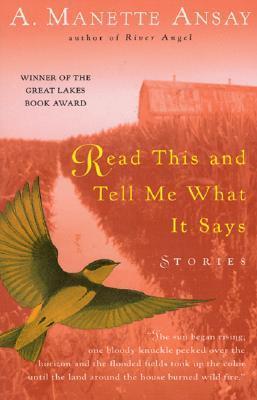
In her first full-length story collection, author A. Manette Ansay explores the rural Midwest landscape and the people who inhabit it: ordinary folk with extraordinary inner lives, struggling to make sense of the isolated, sometimes painful, and often intensely religious worlds in which they live. Her are 15 haunting and exquisitely written tales that offer a rare and unforgettable glimpse into the complexities of being human and being alive.

Tameme is the annual bilingual magazine of new writing from North America Canada, the United States, and Mexico. What does tameme mean? It is a Nhuatl word for porter or messenger. Our hope is that Tameme will play that role, bringing new writing both north and south. For example, here are Alberto Blanco, Jaime Sabnes, and Juan Volloro translated into English; Margaret Atwood, Edwidge Danticat, and A. Manette Ansay translated into Spanish. I think you will the originals are exquisite, the translations beautiful, and the juxtapositions very interesting. Tameme is also a forum for the art of translation. In the back you will find a section devoted to the translator's notes, some of them technical, some very personal, others reflections on the art of translation in general. One of our favorite reflections is from Geoff Hargreaves' "The pleasure resides in catching the echo of an authentic sounding voice, which is not exactly yours or the author's, but the speech of an imaginary figure with feet that straddle the border." Enjoy! C.M. Mayo, Editor


![Tea and Cookies: Enjoy the Perfect Cup of Tea--with Dozens of Delectable Recipes for Teatime Treats [Hardcover]](https://m.media-amazon.com/images/S/compressed.photo.goodreads.com/books/1697816186i/166578759.jpg)
Tea and Cookies: Enjoy the Perfect Cup of Tea--with Dozens of Delectable Recipes for Teatime Treats [Hardcover]
by A. Manette Ansay

Blue Water: A Novel
by A. Manette Ansay
From New York Times bestselling author A. Manette Ansay comes an unforgettable story of two families united by tragedy -- and one woman's deeply emotional journey toward a choice she'd never thought possible. On an ordinary morning in Fox Harbor, Wisconsin, Meg and Rex Van Dorn's lives are irrevocably altered when a drunk driver -- Meg's onetime best friend, Cindy Ann Kreisler -- slams into the Van Dorns' car, killing their six-year-old son, Evan. As Meg recovers from her own injuries, she and Rex are shocked when Cindy Ann receives a mere slap on the wrist. In their rage and grief, they buy a boat to sail around the world, hoping to put as much distance as possible between themselves and Cindy Ann. But when Meg returns to Fox Harbor for a family wedding, she's forced to face the complex ties that bind her to the woman who has destroyed her peace.

Blue Water by Manette Ansay
by A. Manette Ansay
Vinegar Hill [ Unrevised And Unpublished Proofs]
by A. Manette Ansay
Vinegar Hill, a novel
by A. Manette Ansay
Good Things I Wish You by Manette Ansay
by A. Manette Ansay
Vinegar Hill, a Novel
by A. Manette Ansay
Blue Water Cafe Seafood Cook
by A. Manette Ansay
Good Things I Wish You: A Novel by A. Manette Ansay
by A. Manette Ansay