
A.J. Jacobs
21 Books Written

The Year of Living Biblically: One Man's Humble Quest to Follow the Bible As Literally As Possible
by A.J. Jacobs
Rating: 3.8 ⭐
• 5 recommendations ❤️
What would it require for a person to live all the commandments of the Bible for an entire year? That is the question that animates this hilarious, quixotic, thought-provoking memoir from Jacobs (The Know-It-All). He didn't just keep the Bible's better-known moral laws (being honest, tithing to charity and trying to curb his lust), but also the obscure and unfathomable ones: not mixing wool with linen in his clothing; calling the days of the week by their ordinal numbers to avoid voicing the names of pagan gods; trying his hand at a 10-string harp; growing a ZZ Top beard; eating crickets; and paying the babysitter in cash at the end of each work day. (He considered some rules, such as killing magicians, too legally questionable to uphold.) In his attempts at living the Bible to the letter, Jacobs hits the road in highly entertaining fashion to meet other literalists, including Samaritans in Israel, snake handlers in Appalachia, Amish in Lancaster County, Pa., and biblical creationists in Kentucky. Throughout his journey, Jacobs comes across as a generous and thoughtful (and, yes, slightly neurotic) participant observer, lacing his story with absurdly funny cultural commentary as well as nuanced insights into the impossible task of biblical literalism.

The idea was deceptively New York Times bestselling author A.J. Jacobs decided to thank every single person involved in producing his morning cup of coffee. The resulting journey takes him across the globe, transforms his life, and reveals secrets about how gratitude can make us all happier, more generous, and more connected.Author A.J. Jacobs discovers that his coffee—and every other item in our lives—would not be possible without hundreds of people we usually take for farmers, chemists, artists, presidents, truckers, mechanics, biologists, miners, smugglers, and goatherds.By thanking these people face to face, Jacobs finds some much-needed brightness in his life. Gratitude does not come naturally to Jacobs—his disposition is more Larry David than Tom Hanks—but he sets off on the journey on a dare from his son. And by the end, it’s clear to him that scientific research on gratitude is true. Gratitude’s benefits are It improves compassion, heals your body, and helps battle depression.Jacobs gleans wisdom from vivid characters all over the globe, including the Minnesota miners who extract the iron that makes the steel used in coffee roasters, to the Madison Avenue marketers who captured his wandering attention for a moment, to the farmers in Colombia.Along the way, Jacobs provides wonderful insights and useful tips, from how to focus on the hundreds of things that go right every day instead of the few that go wrong. And how our culture overemphasizes the individual over the team. And how to practice the art of “savoring meditation” and fall asleep at night. Thanks a Thousand is a reminder of the amazing interconnectedness of our world. It shows us how much we take for granted. It teaches us how gratitude can make our lives happier, kinder, and more impactful. And it will inspire us to follow our own “Gratitude Trails.”

The Puzzler: One Man's Quest to Solve the Most Baffling Puzzles Ever, from Crosswords to Jigsaws to the Meaning of Life
by A.J. Jacobs
Rating: 3.9 ⭐
• 2 recommendations ❤️
The New York Times bestselling author of The Year of Living Biblically goes on a rollicking journey to understand the enduring power of puzzles: why we love them, what they do to our brains, and how they can improve our world.What makes puzzles--jigsaws, mazes, riddles, sudokus--so satisfying? Be it the formation of new cerebral pathways, their close link to insight and humor, or their community-building properties, they're among the fundamental elements that make us human. Convinced that puzzles have made him a better person, A. J. Jacobs--four-time New York Times bestselling author, master of immersion journalism, and nightly crossworder--set out to determine their myriad benefits. And maybe, in the process, solve the puzzle of our very existence. Well, almost.In The Puzzler, Jacobs meets the most zealous devotees, enters (sometimes with his family in tow) any puzzle competition that will have him, unpacks the history of the most popular puzzles, and aims to solve the most impossible head-scratchers, from a mutant Rubik's Cube, to the hardest corn maze in America, to the most sadistic jigsaw. Chock-full of unforgettable adventures and original examples from around the world--including new work by Greg Pliska, one of America's top puzzle-makers, and a hidden, super-challenging but solvable puzzle that will earn the first reader to crack it a $10,000 prize*--The Puzzler will open readers' eyes to the power of flexible thinking and concentration. Whether you're puzzle obsessed or puzzle hesitant, you'll walk away with real problem-solving strategies and pathways toward becoming a better thinker and decision maker--for these are certainly puzzling times.
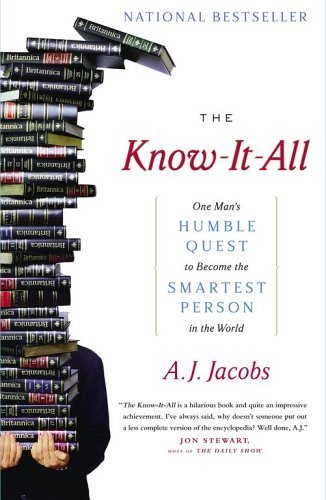
33,000 Pages44 Million Words10 Billion Years Of History1 Obsessed ManPart memoir and part education (or lack thereof), "The Know-It-All" chronicles NPR contributor A.J. Jacobs's hilarious, enlightening, and seemingly impossible quest to read the Encyclopaedia Britannica from A to Z. To fill the ever-widening gaps in his Ivy League education, A.J. Jacobs sets for himself the daunting task of reading all thirty-two volumes of the Encyclopaedia Britannica. His wife, Julie, tells him it's a waste of time, his friends believe he is losing his mind, and his father, a brilliant attorney who had once attempted the same feat and quit somewhere around Borneo, is encouraging but unconvinced. With self-deprecating wit and a disarming frankness, "The Know-It-All" recounts the unexpected and comically disruptive effects Operation Encyclopedia has on every part of Jacobs's life - from his newly minted marriage to his complicated relationship with his father and the rest of his charmingly eccentric New York family to his day job as an editor at "Esquire." Jacobs's project tests the outer limits of his stamina and forces him to explore the real meaning of intelligence as he endeavours to join Mensa, win a spot on Jeopardy!, and absorb 33,000 pages of learning. On his journey, he stumbles upon some of the strangest, funniest, and most profound facts about every topic under the sun, all while battling fatigue, ridicule, and the paralysing fear that attends his first real-life responsibility - the impending birth of his first child. "The Know-It-All" is an ingenious, mightily entertaining memoir of one man's intellect, neuroses, and obsessions, and a struggle between the all-consuming quest for factual knowledge and the undeniable gift of hard-won wisdom.

Drop Dead Healthy: One Man's Humble Quest for Bodily Perfection
by A.J. Jacobs
Rating: 3.8 ⭐
• 1 recommendation ❤️
A New York Times bestseller in hardcover, a chronicle of A.J. Jacob’s mission to radically improve every element of his body and mind—from his brain to his fingertips to his abs.Having lifted his spirit in The Year of Living Biblically and sharpened his mind in The Know-It-All, A.J. Jacobs had one feat left in the self-improvement trinity: to become the healthiest man in the world.The task was massive. First, he had to tackle a complicated web of diet and exercise advice, most of which is nonsensical, unproven, and contradictory. Second, he had to consult a team of medical advisers. And finally, he had to subject himself, over the course of two years, to a grueling regimen of exercises, a range of diets and nutritional plans, and a brutal array of techniques and practices to improve everything from his hearing to his sleep—all the while testing the patience of his long-suffering wife.Drop Dead Healthy bursts with hilarity and warmth, overturning myths about what makes good health and allowing you to reflect on your own health, body, and eventual mortality.

New York Times bestselling author of The Know-It-All and The Year of Living Biblically , A.J. Jacobs undergoes a hilarious, heartfelt quest to understand what constitutes family—where it begins and how far it goes—and attempts to untangle the true meaning of the “Family of Humankind.”A.J. Jacobs has received some strange emails over the years, but this note was perhaps the strangest: “You don’t know me, but I’m your eighth cousin. And we have over 80,000 relatives of yours in our database.”That’s enough family members to fill Madison Square Garden four times over. Who are these people, A.J. wondered, and how do I find them? So began Jacobs’s three-year adventure to help build the biggest family tree in history.Jacobs’s journey would take him to all seven continents. He drank beer with a US president, found himself singing with the Mormon Tabernacle Choir, and unearthed genetic links to Hollywood actresses and real-life scoundrels. After all, we can choose our friends, but not our family.“Whether he’s posing as a celebrity, outsourcing his chores, or adhering strictly to the Bible, we love reading about the wacky lifestyle experiments of author A.J. Jacobs” ( Entertainment Weekly ). Now Jacobs upends, in ways both meaningful and hilarious, our understanding of genetics and genealogy, tradition and tribalism, identity and connection. It’s All Relative is a fascinating look at the bonds that connect us all.

A parody of guides to the Internet offers advice on negotiating the real world, including fonts (handwriting), mail (the Postal Service), virus protection (scarves and mittens), and accessing news (reading a newspaper)

The Year of Living Constitutionally: One Man's Humble Quest to Follow the Constitution's Original Meaning
by A.J. Jacobs
Rating: 4.0 ⭐
The New York Times bestselling author of The Year of Living Biblically attempts to follow the original meaning of the Constitution in search of answers to one of the most pressing issues of our How should we interpret America’s foundational document?Is the Constitution a living document that needs to evolve with the times? Or should we try to divine the original meaning that our Founding Fathers intended, and hew to that as strictly as possible, as present-day originalists suggest?In The Year of Living Constitutionally , A.J. Jacobs tries to get inside the minds of the Founding Fathers by living as closely as possible to the original meaning of the Constitution. He exercises his Second Amendment rights by marching around Manhattan with a colonial musket. He asserts his right to free speech by writing his opinions on parchment and handing them out in Times Square. He turns his home into a traditional 1790s household by lighting candles, boiling mutton, and—because women were not allowed to sign contracts—taking over the household finances from his much more business-savvy wife.The book blends unforgettable adventures—traveling to the Capitol to personally deliver a list of grievances to Congress, consenting to quarter soldiers in his apartment, and battling Redcoats as part of a Revolutionary War reenactment group--with dozens of interviews from constitutional experts from both sides of the debate. Much like he did with the Bible in The Year of Living Biblically , Jacobs provides a crash course on our Constitution as he experiences the benefits and perils of living like it’s the 1790s. In the process, he showcases the potentially dangerous effects originalism has on our democracy as well as the progress we’ve made since the time of its writing in 1789, when, for instance, life expectancy was forty-five years and married women couldn’t own property.Now more than ever, Americans need to understand the meaning and value of the Constitution. As conservative politicians and Supreme Court Justices continue to argue for a more literal interpretation of the Constitution, A.J. Jacobs provides an entertaining yet illuminating look into how this storied document fits into our democracy today.

For his first book, The Know-It-All, A. J. Jacobs read the entire Encyclopædia Britannica from cover to cover in a quest to learn everything in the world. In The Year of Living Biblically, he followed every single rule of the Bible -- from the Ten Commandments right on down to stoning adulterers.Now comes a collection of his most hilarious and thought-provoking experiments yet. In his role as human guinea pig, Jacobs fearlessly takes on a series of life-altering challenges that provides readers with equal parts insight and humor. (And which drives A.J.'s patient wife, Julie, to the brink of insanity.)Among the many adventures:• He outsources his life. A.J. hires a team of people in Bangalore, India, to take care of everything in his life from answering his e-mails to arguing with his spouse.• He spends a month practicing Radical Honesty -- a movement that encourages us to remove the filters between our brains and mouths. (To give you an idea of what happened, the name of the chapter is "I Think You're Fat.")• He goes to the Academy Awards disguised as a movie star to understand the strange and warping effects of fame.• He commits himself to ultimate rationality, using cutting-edge science to make the best decisions possible. It changes the way he makes choices big and small, from what to buy at the grocery store to how to talk to his kids. And his revelations will change how you make decisions, too.• He attempts to follow George Washington's rules of life, uncovering surprising truths about leadership and politics in the twenty-first century. He also spends a lot of time bowing and doffing his hat.• And then there's the month when he followed his wife's every whim -- foot massages, Kate Hudson movies, and all. Depending on your point of view, it's either the best or worst idea in the history of American marriage.A mix of Bill Bryson, George Plimpton, and Malcolm Gladwell, A.J. explores the big issues of our time -- happiness, dating, morality, marriage -- by immersing himself in eye-opening situations. You'll be entertained by these stories -- some of which are new, some of which had their start in Esquire magazine. But you'll also learn to look at life in new ways.The Guinea Pig Diaries is a book packed with both laughs and enlightenment -- and that's a promise we can make with Radical Honesty.

Long before Politically Correct Bedtime Stories invaded bookstores, Americans were getting their giggles from Fractured Fairy Tales, those delightfully twisted parables brought to us between the cliffhanger adventures of our favorite cartoon heroes, Rocky & Bullwinkle. This collection, illustrated with classic art from the animated series includes the comical retelling of 25 classics such as Pinocchio (who starred in his own variety show "The Pinocchio Doody Show"), Jack and the Beanstalk (did you know that Jack grew a beanstalk in the outfield so he could catch fly balls for his baseball team?), or King Midas (who became a dentist so he could give his patients gold fillings). This satirical humor loved for so long by so many, is a must-have for fans of the show and anyone who loves classic fairy tales--with a twist.Witch's broomFrog princeRumpelstiltskinSeven chickensSir GalahadTale of a kingHansel and GretelPinocchioElves and the shoemakerThom TumPrincess and the peaSon of King MidasGolden gooseFlying carpetBeauty and the beastAladdin's lampAbsentminded kingGoblinsCutie and the beastPrince Hyacinth and the dear little princessSon of RumpelstiltskinEnchanted gnatJack and the beanstalkEnchanted fishKing Midas

A.J. Jacobs Omnibus: The Know-It-All, The Year of Living Biblically, My Life as an Experiment
by A.J. Jacobs
Rating: 3.8 ⭐
An eBook boxed set that features the first three of A.J. Jacobs's riotous—and surprisingly informative—ventures into experiential journalism. The Know-It-All: Puzzle along with A.J. as he endeavors to read—and retain—the entire encyclopedia, and discover what exactly it is he learns along the way. The Year of Living Biblically: Discover what life would be like in the 21st century if you lived precisely by the dictates of the Bible—the insights gained about religion might surprise you. My Life as an Experiment: Join A.J. on a roller-coaster tour of life as a human guinea pig: he explores both the perks and pitfalls of various undertakings in a series of charming essays, including those titled “My Outsourced Life" and "My Life as a Beautiful Woman."

FIRST Edition 1995 by Jossey-Bass Publ, Hardcover w dust jacket 320 pages.

This story is about something called Radical Honesty. It may change your life. (But honestly, we don't really care.)

The New Domestic Automakers in the United States and Canada: History, Impacts, and Prospects
by A.J. Jacobs
Rating: 5.0 ⭐
Over the past forty years, state/provincial and local governments in the United States and Canada have provided foreign automakers with approximately $4.80 billion in incentives in order to lure light vehicles assembly plants to their areas. This has included tax abatements, infrastructure construction, land giveaways, job training programs, and other subsidies. As of early 2015, ten foreign vehicle makers operated 20 light vehicles in developed North America. Despite the fact that all ten of these automakers have pursued a similar pattern—first exporting vehicles into the United States and Canada before launching vehicle plants in developed North America—each has followed its own specific historical development path and has created its own unique growth trajectory.This book provides a unique historical and qualitative review of these ten vehicle makers, from their early beginnings to their export entry into the United States and/or Canada through early 2015. In addition, it chronicles the histories of more than a dozen former automakers and potential future foreign light motor vehicle assembly plants in the United States and Canada. This includes the first foreign automaker to build its cars in the United States, De Dion-Bouton of France in July 1900, the early 20th Century endeavors of Fiat, Mercedes, and Rolls Royce, and the present day hopes of Chinese and Indian automakers. In the process, the text also provides an assessment of the top competing states and sites for any future plants, the possible incentives packages governments may offer to attract such facilities, and an estimated incentive value for each automaker.Overall, the goal of this book is to expand the knowledge of policymakers at all tiers of government in the United States and Canada and to help them take a more holistic look at the pros and cons of attracting Automobile Manufacturing FDI. It is hoped that this will enable them to make more informed decisions when pursuing a new foreign motor vehicle assembly plant. Its findings should also prove informative to urban and regional planning, political science, sociology, economics, labor, and international development scholars and students in North America and worldwide.

Excerpt from Neutrality Versus JusticeIn order to preserve the detachment of mind which I believed to be essential, I have never identified myself with the peace movement in any of its phases, nor allowed myself an interest in party politics even to the extent of recording a political vote.

This book examines the dramatic increase in automotive assembly plants in the former Socialist Central European (CE) nations of Czechia, East Germany, Hungary, Poland, and Slovakia from 1989 onwards. Enticed by relatively lower-wage labour and significant government incentives, the world’s largest automakers have launched more than 20 passenger car assembly complexes in CE nations, with production accelerating dramatically since 2001. As a result, the annual passenger car production in Western Europe declined by more than 20% between 2001 and 2015, and alternatively in the CEE it increased by nearly 170% during this period. Drawing on case studies of 25 current and former foreign-run assembly plants, the author presents a rare historical account of automotive foreign assembly plants in the CE following this dramatic geographic shift. This book will expand the knowledge of policy-makers in Europe in relation to their pursuits of FDI and will be of great interest to scholars and students of business, economic history, political science, and development.

The Automotive Industry and European Integration: The Divergent Paths of Belgium and Spain
by A.J. Jacobs
This book chronicles the divergent growth trends in car production in Belgium and Spain. It delves into how European integration, high wages, and the demise of GM and Ford led to plant closings in Belgium. Next, it investigates how lower wages and the expansion strategies of Western European automakers stimulated expansion in the Spanish auto industry. Finally, it offers three alternate scenarios regarding how further EU expansion and Brexit may potentially reshape the geographic footprint of European car production over the next ten years. In sum, this book utilizes history to help expand the knowledge of scholars and policymakers regarding how European integration and Brexit may impact future auto industry investment for all EU nations.

In 1962, South Korea assembled just 1,100 new automobiles. By 1996, this total had soared to 2,812,714. What explains this remarkable growth? The answer is complex, and involves a combination of a supportive State, timely technology alliances, a skilled but historically low-paid workforce, aggressive pricing, savvy entrepreneurs, and fortuitous circumstances. Despite this amazing ascent, comparatively little has been written about the Korean auto industry in English. In the first of a two-volume set, this 11-chapter book seeks to help fill this void by providing in-depth examinations of all six of Korea’s automakers from their beginnings through 1996. Uniquely written from the perspective of industry analysts at the time (without knowledge of the Asian Fiscal Crisis), the book should prove informative to practitioners, scholars, and students interested in automotive history, international political economy, Asian studies, and more.

This volume chronicles the maturation of the South Korean auto industry and its native automakers, from the 1997 Asian Crisis to 2019. After examining the context for domestic vehicle production in South Korea, the author presents multiple case studies for all five Korean General Motors Korea/Daewoo Motors, Kia, Hyundai, Ssangyong and Renault Samsung. This includes coverage of Hyundai-Kia’s foreign plants in North America, Europe, India, China, and Emerging Asia. The book closes by assessing the five-to-ten-year future outlooks for Korean automakers at home and abroad. This important work will prove informative to scholars of business, management, automotive history, international development, Asian studies, and public administration.